 ultimate-guide
Is a Record Weight Worth It for Sound Quality?
Table of Contents
- What a Record Weight Actually Does
- How a Record Weight Improves Vinyl Sound Quality
- Record Clamp vs Weight: Which One Do You Need?
- Turntable Motor Strain: What a Record Weight Does to Your Deck
- Materials and Mat Compatibility: What the Specs Don't Tell You
- The Downsides: When a Record Weight Isn't Worth It
- Conclusion: Is a Record Weight Worth It for Your Setup?
- Frequently Asked Questions
Last Updated: September 14, 2026
What a Record Weight Actually Does
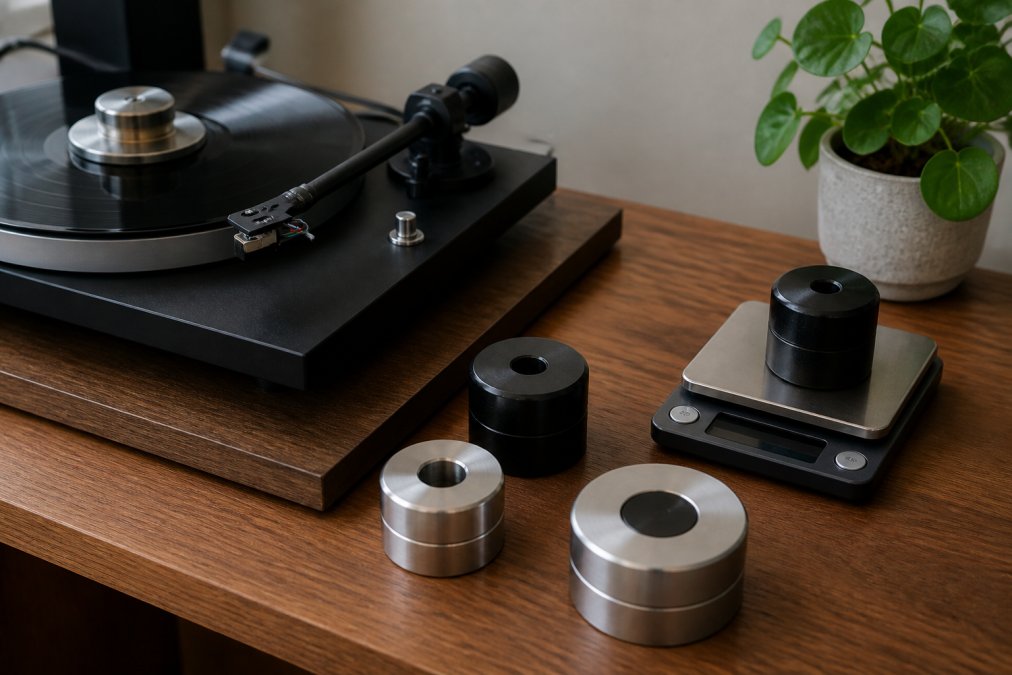
A record weight is a disc of metal or dense composite that sits on the record label and centre spindle during playback, pressing the vinyl down onto the platter. That downward pressure changes how the record and platter behave as a mechanical system.
The weight is one of the cheapest variables in that chain, and the one most people skip.
Two things happen when you add one.

Coupling the Vinyl to the Platter
The record and platter only touch at a few high points. Air gaps and tiny warps mean the vinyl isn't fully seated, so vibration from the motor, bearing and room has somewhere to rattle. Adding mass increases surface contact and pushes the record flatter against the mat, tightening the coupling between vinyl and platter, so less platter noise reaches the stylus.
Flattening Warped Records and Damping Resonance
A weight won't iron out a badly warped record. What it does is hold down mild edge lift and shallow dish warps well enough for the stylus to track cleanly. It also adds damping: extra mass reduces how much the vinyl itself resonates at low frequencies, the mechanism behind the "quieter background" most people notice first.
How a Record Weight Improves Vinyl Sound Quality
A record weight improves vinyl sound quality by reducing the noise floor, not by adding detail. You're removing interference, not creating information.
Three changes show up most often:
- Lower surface noise. Better coupling means less mechanical vibration reaching the stylus, so crackle and rumble sit further back in the mix.
- Tighter low-frequency response. Damping the record's own resonance cleans up bass that otherwise sounds loose or indistinct.
- More stable tracking. A flatter record gives the stylus an easier job, which reduces tracking error on inner grooves and helps tonearm stability through demanding passages.
These gains are subtle on a well-sorted deck and obvious on a poorly isolated one. On a solid shelf with a decent mat, expect a small improvement; on a wobbly sideboard above a speaker, a weight will do more than any cable upgrade.
Record Clamp vs Weight: Which One Do You Need?
A record weight presses down using mass alone, while a record clamp grips the spindle and pulls the record into contact with the platter.
Weights work on almost any turntable with a standard spindle. Clamps need a threaded or grooved spindle, so they're a no-go on many decks unless you modify the spindle.
| Feature | Record Weight | Record Clamp |
|---|---|---|
| How it works | Mass presses record down | Grips spindle, pulls record down |
| Spindle requirement | Standard spindle | Threaded or grooved spindle |
| Added mass on bearing | Higher | Lower |
| Best for | Mild warps, damping resonance | Severely dished records |
| Fitting time | Seconds | Seconds, but spindle-dependent |
For most people asking whether a record weight is worth it, the weight is the easier first step. A clamp makes more sense if your deck is designed for one, or if you're fighting badly dished records. Neither fixes a record genuinely warped across the playing surface.
Turntable Motor Strain: What a Record Weight Does to Your Deck
This is the part almost nobody mentions, and it's where a record weight can quietly cost you money. Every gram you add is mass the motor must accelerate, hold at speed and bring back to rest, and belt-drive and direct-drive decks absorb that load in completely different places.
What Actually Happens on a Belt-Drive Deck
On a belt-drive turntable, the motor turns a small pulley, and a rubber or silicone belt transfers that rotation to the platter's outer edge or sub-platter (Belt drive and direct drive turntables - everything you need to know). The motor is deliberately low-torque, because a weak motor coupled to a heavy platter through a compliant belt is one of the cheapest ways to smooth out cogging and flutter.
Adding mass changes three things at once:
- Startup torque demand rises. The motor must overcome the platter's rotational inertia from a standstill. A heavier platter takes longer to reach 33⅓ rpm, showing up on a modest motor as a slow, laboured spin-up.
- Belt tension and slip increase. The belt transmits more force, and over time that extra tension stretches it and accelerates wear at the pulley. A slipping belt is audible as pitch instability.
- Speed regulation gets harder. Servo or tachometer feedback loops must work harder to correct small deviations, and on cheaper controllers that can produce a slow hunting or wavering effect rather than rock-steady pitch.
What Actually Happens on a Direct-Drive Deck
A direct-drive motor turns the platter itself, usually a high-torque, low-speed motor with the platter acting as part of the rotor assembly (Belt drive and direct drive turntables - everything you need to know). There's no belt to stretch, so the failure mode is different: extra mass loads the motor bearings and main platter bearing directly. Those bearings are designed for a specific axial and radial load, and a dense multi-kilogram weight on the spindle adds to the axial load every second the deck runs.
A well-built direct-drive deck will shrug it off short term, but sustained overload accelerates bearing wear, increased rumble, spindle play, or speed instability no servicing fully cures. That's why the manufacturer's maximum platter load figure matters more than the weight's marketing copy.
A Practical Load Guide
There's no universal safe number, it depends on the motor, bearing design and platter mass. What follows is a common pattern, not a rule:
- Entry-level belt-drive decks with a light platter: low hundreds of grams is usually safe; anything near a kilogram is asking for trouble.
- Mid-range belt-drive decks with a heavier platter: a few hundred grams to around half a kilogram is often fine, but check the manual.
- Direct-drive decks with a substantial platter and bearing: heavier weights are generally tolerated, but the manual's maximum load still governs.
- Suspended sub-chassis decks: the suspension, not the motor, is the limiting factor. Added mass changes the sprung mass and detunes the suspension.
A few practical rules we give customers:
- Check your deck's manual for a maximum recommended platter load before buying anything heavy.
- Weigh the record weight before you buy it. Many are sold by diameter or appearance, not mass, and the two are not the same thing.
- If platter speed drifts, startup feels sluggish, or the belt squeals after fitting a weight, take it off. That's your deck telling you the load is too much.
- On a belt-drive deck, listen for pitch waver on sustained piano or held vocal notes, that's where speed instability is easiest to hear.
guidance on turntable setup and platter load
Materials and Mat Compatibility: What the Specs Don't Tell You
Most articles treat record weights as interchangeable lumps of metal. They aren't. Material determines density, and density determines how much mass you get in a given footprint. It also determines how the weight behaves acoustically, because every material has its own resonant signature and internal damping.
Material by Material
Brass. Dense and heavy for its size, so a brass weight delivers serious mass in a compact disc that clears the tonearm. It's also relatively well damped compared with steel, adding mass without ringing. The trade-off is cost, and a brass weight can be heavy enough to trouble a light belt-drive deck.
Stainless steel. Similar density to brass and often cheaper, but stiffer and more prone to ringing, so a bare steel weight can transmit its own resonance into the record. Many manufacturers add a damping layer or polymer insert. A single solid steel piece with no damping is worth noting.
Aluminium. Much lighter for the same volume, so an aluminium weight gives a larger disc without the mass penalty, ideal for belt-drive and suspended sub-chassis decks where you want coupling without overloading the motor or suspension. It's also well damped for a metal, which is why it's common for turntable platters.
Composites and polymers. These sit between the metals on mass and often include damping material by design. They're least likely to ring but give the least mass per unit of size, so coupling is weaker, often enough for mild warps and light damping.
The honest summary: material choice matters less than mass and fit, but it isn't irrelevant. If you want maximum mass in minimum space, brass or steel. If you want coupling without overloading a light deck, aluminium or composite.
How the Weight Interacts With Your Mat
This is the part spec sheets never cover, and it's where the weight's effect is decided. The mat is part of the damping system, not a passive surface: a weight pressing a record into soft felt behaves completely differently from one pressing into hard acrylic or rubber.
- Felt. Soft and compliant. The weight compresses the felt, adding springiness between record and platter. Felt absorbs some high-frequency noise but couples poorly, so a weight on felt flattens the record and adds damping, yet the felt limits how tightly the vinyl couples to the platter.
- Rubber. Firmer and more elastic, transferring vibration more directly than felt while still isolating somewhat. A weight on rubber gives a tighter, more controlled result with less softening.
- Cork. Light, porous and well damped, sitting between felt and rubber in compliance. Popular on lighter platters because it adds damping without much mass, but its compliance means less coupling gain than a hard mat.
- Acrylic. Hard and rigid, coupling the record firmly and transferring vibration efficiently. A weight on acrylic gives the tightest coupling of the common mats, popular on well-isolated platters. On a poorly isolated deck, that rigidity can transmit more platter noise to the stylus.
The Practical Test
Fit the weight, play a record you know well, and listen for whether bass tightens or just gets boomier. Boomier means the weight and mat are over-damping your setup; harder and more forward means the mat may be too rigid. The goal is a combination that reduces noise without adding its own character.
This is exactly the kind of thing worth checking in person rather than buying blind, which is why we provide personalised hifi demonstrations at Chiltern Audio.
The Downsides: When a Record Weight Isn't Worth It
Skip the weight if your turntable has a light platter, a modest motor, or a carefully tuned suspended sub-chassis. Adding mass to a suspended deck can throw off the suspension balance, heard as a loss of pace rather than a gain.
Other reasons to pass:
- Your records are flat and your deck is well isolated. The gains will be marginal.
- You own a deck with a short spindle or a recessed platter. The weight may foul the tonearm or sit unevenly.
- You're chasing a specific tonal change. A weight won't add warmth or brightness; it removes noise.
There's also the ritual cost: lifting it off and setting it down every time, and needing an adapter first on a 45 with a large centre hole. Small friction, but it adds up over hundreds of plays.
Conclusion: Is a Record Weight Worth It for Your Setup?
For most vinyl listeners with a standard deck, a record weight is worth it: a low-cost way to reduce surface noise, stabilise tracking and tighten bass on mildly warped records. It's not worth it if your motor or suspension is already near its limit, because you'll trade a small noise gain for real mechanical strain.
The only way to know which camp you're in is to hear it on your own system. That's what we do at Chiltern Audio: bespoke system building, expert guidance on turntables and components, and demonstrations using your records in a properly set-up room. If you're unsure whether a weight suits your deck, bring it in and we'll test it with you. Refining the signal path remains a constant pursuit for the dedicated listener, much like the process of improving audio fidelity when integrating a dedicated converter into a digital playback chain.
Frequently Asked Questions
Does a record weight actually improve sound quality?
A record weight can improve vinyl playback by increasing surface contact between the record and the platter, which reduces mechanical vibration and helps the stylus track the groove more cleanly. The audible results are usually a quieter background and a more stable soundstage. The size of the improvement depends on your turntable, the record itself and how well your system is set up, so it is worth testing one at home before committing.
Can a record weight damage my turntable motor?
Adding mass to the platter increases the load on the motor and bearing, which is why turntable motor strain is a genuine consideration rather than a myth. Direct-drive decks usually cope well because they have more torque. Belt-drive turntables, particularly budget models, can suffer from slower startup, speed instability or premature belt wear. Check your deck's manual for a recommended maximum weight, and match the record weight to the motor.
What is the difference between a record clamp and a record weight?
A record clamp screws or grips onto the spindle and presses the record down with minimal mass, while a record weight is a heavier disc that sits on the spindle and uses its own weight to couple the vinyl to the platter. Clamps suit belt-drive decks where extra mass is a concern. Weights tend to flatten warped records more effectively but add more load. Both aim to reduce vibration and improve stylus tracking.
Are record weights worth it for all turntables?
No. They deliver the most benefit on decks with a flat, well-damped platter and enough motor torque to handle the extra mass. On lightweight belt-drive turntables with modest motors, a heavy weight can slow startup and affect platter speed. If your deck has a felt mat or a suspended sub-chassis, a lighter clamp may be the better choice. Matching the accessory to your turntable matters more than the accessory itself.
Shopping for a record weight blind is how people end up with a deck that runs slow and a weight gathering dust. Chiltern Audio can help you match a weight to your turntable's motor and platter before you buy, with real-world demonstrations, bespoke system building and expert guidance on Rega turntables and the components around them. Get started with Chiltern Audio and hear the difference on your own records first.