 ultimate-guide
What Equipment Do You Need to Play Vinyl Records?
Table of Contents
- The Essential Components of a Vinyl Setup
- Understanding Turntables and Record Players
- Best Phono Preamps for Beginners
- Active vs Passive Speakers for Vinyl
- Amplifiers and Receivers Explained
- How to Set Up a Turntable Correctly
- Building Your System: Budget-Tier to Audiophile-Grade
- Frequently Asked Questions
Last Updated: October 1, 2026
The Essential Components of a Vinyl Setup
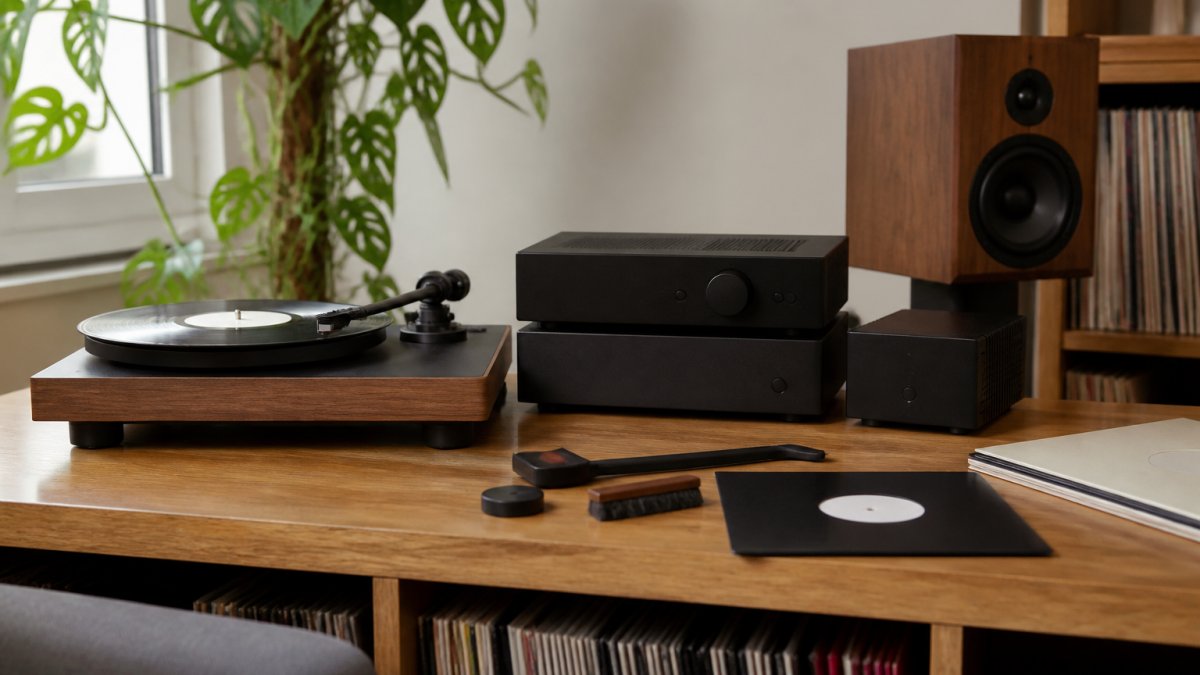
Playing vinyl records requires complete vinyl record equipment: a turntable, phono preamp, amplifier, speakers, and cabling. Each component translates the physical grooves of a vinyl record into sound.
The turntable's stylus reads grooves and generates a weak signal. The phono preamp boosts it to line level, the amplifier strengthens it further, and speakers convert it to sound. Skip any step and the chain breaks.
Modular vinyl record equipment delivers superior sound because each component is optimized for its specific job. This guide covers each essential piece and how they work together.
Understanding Turntables and Record Players
A turntable consists of a platter, tonearm, and motor. Its job is to spin the record at precise speed while the cartridge reads grooves. Consistency matters enormously.
Speed stability is critical. Professional turntables maintain accuracy to within 0.1%. Most records play at 33 RPM, singles at 45 RPM, and older records occasionally at 78 RPM.
A heavier platter maintains consistent speed better. Budget models use thin platters; higher-end models use thick, weighted platters of aluminium or acrylic.
Belt-Drive vs Direct-Drive Turntables
Belt-drive turntables use a rubber belt to transfer motor power to the platter, isolating vibration from the motor. Direct-drive turntables mount the motor directly beneath the platter. Each approach has trade-offs.
Belt-drive systems are quieter and cheaper but require belt replacement every 5-10 years. Direct-drive offers faster start-up and consistency, preferred by DJs, but motor vibration can be audible on sensitive systems. Choosing between these mechanisms becomes particularly relevant when you decide to start a vintage collection and must weigh the long-term maintenance of older hardware against the precision of modern engineering.
For home listening, belt-drive is traditional among hi-fi enthusiasts. For beginners, either works well.
Best Phono Preamps for Beginners
The phono preamp is the bridge between your turntable and the rest of your system. It amplifies the cartridge's signal from millivolts to line level, which is what amplifiers and receivers expect. Without a phono preamp, you'd hear barely a whisper from your speakers.
Many turntables include built-in preamps, convenient for beginners. However, dedicated external preamps sound better because they sit away from vibration sources and use better components.
Check the preamp's gain setting. Most cartridges output 5 millivolts; preamps amplify to roughly 200 millivolts. Look for switchable gain and support for both moving magnet (MM) and moving coil (MC) cartridges.
Active vs Passive Speakers for Vinyl
Speakers convert electrical signals into sound waves. Active speakers have built-in amplifiers; passive speakers require an external amplifier. This choice fundamentally shapes your system and deserves careful consideration.
Active Speakers: Convenience and Self-Containment
Active speakers are self-contained with built-in amplification. They're convenient, compact, and eliminate the need for a separate amplifier, making them practical for small rooms.
They simplify cabling and eliminate amplifier heat concerns, requiring only RCA or XLR connections and mains power.
The downside is limited upgrade potential; improving sound often requires replacing the entire speaker rather than just the amplifier.
Modern active speakers use efficient Class D amplifiers and sound excellent with vinyl, though the amplifier is typically optimized for general use rather than tailored to that speaker's characteristics.
Passive Speakers: Flexibility and Upgrade Potential
Passive speakers are the traditional hi-fi choice, driven by an external amplifier. You can upgrade the amplifier independently, and simpler crossovers may result in cleaner sound. The trade-off is complexity and more cabling.
Choose an amplifier matching your speakers' impedance (usually 4 or 8 ohms). A quality amplifier paired with passive speakers often delivers richer sound than active speakers at the same price, because it's optimized for those speakers.
Passive speakers last longer; drivers and crossovers can be serviced. With active speakers, a failed amplifier often means replacing the entire unit.
Choosing Between Active and Passive: Practical Factors
Room size: Active speakers work well in small to medium rooms. In larger rooms, passive speakers with a quality amplifier provide more headroom and let you position the amplifier away from the listening area.
Impedance matching: Passive speakers are rated 4 or 8 ohms. Your amplifier must match this. Mismatches reduce efficiency and can sound thin.
Upgrade path: If you plan to upgrade components over time, passive speakers offer more flexibility. You can keep the speakers and upgrade the amplifier, or vice versa. With active speakers, upgrading means replacing the entire unit.
Budget: Entry-level active speakers often outperform entry-level passive speakers plus budget amplifier at the same price. Mid-range passive speakers with a quality amplifier typically outperform active speakers in the same range.
Space and aesthetics: Active speakers are more compact with less cabling. Passive speakers require an amplifier and longer cables. For minimalism, active speakers win.
Frequency Response and Speaker Matching
Check frequency response. Vinyl contains information from 20 Hz to 20 kHz. Speakers rated 50 Hz-20 kHz miss bass. Look for 20 Hz-20 kHz or lower, especially for bass-heavy music.
Active speakers often have built-in EQ adjustments. Passive speakers rely on the amplifier and room acoustics. Properly matched passive systems sound better because components complement each other.
The Practical Recommendation
For vinyl, passive speakers with a quality amplifier often deliver richer sound, but modern active speakers sound excellent too. Choose based on room size, budget, upgrade intentions, and whether you value simplicity or flexibility. Beginners may prefer active speakers; long-term enthusiasts typically choose passive speakers with a dedicated amplifier.
Amplifiers and Receivers Explained
An amplifier boosts line-level signals to speaker level. Integrated amplifiers combine preamp and power amp in one chassis. Receivers add radio tuning.
A 50-watt amplifier is plenty for most home listening. Beyond that, headroom, the ability to handle peaks without distortion, matters more than raw power.
Tube amplifiers sound warmer and forgive imperfect recordings but run hot and need maintenance. Solid-state amplifiers are efficient, cool, and reliable. Both sound excellent with vinyl when properly matched.
How to Set Up a Turntable Correctly
Setup quality directly affects sound quality. A poorly aligned cartridge causes excessive wear on records and sounds dull or distorted. Fortunately, the process is straightforward once you understand what you're adjusting.
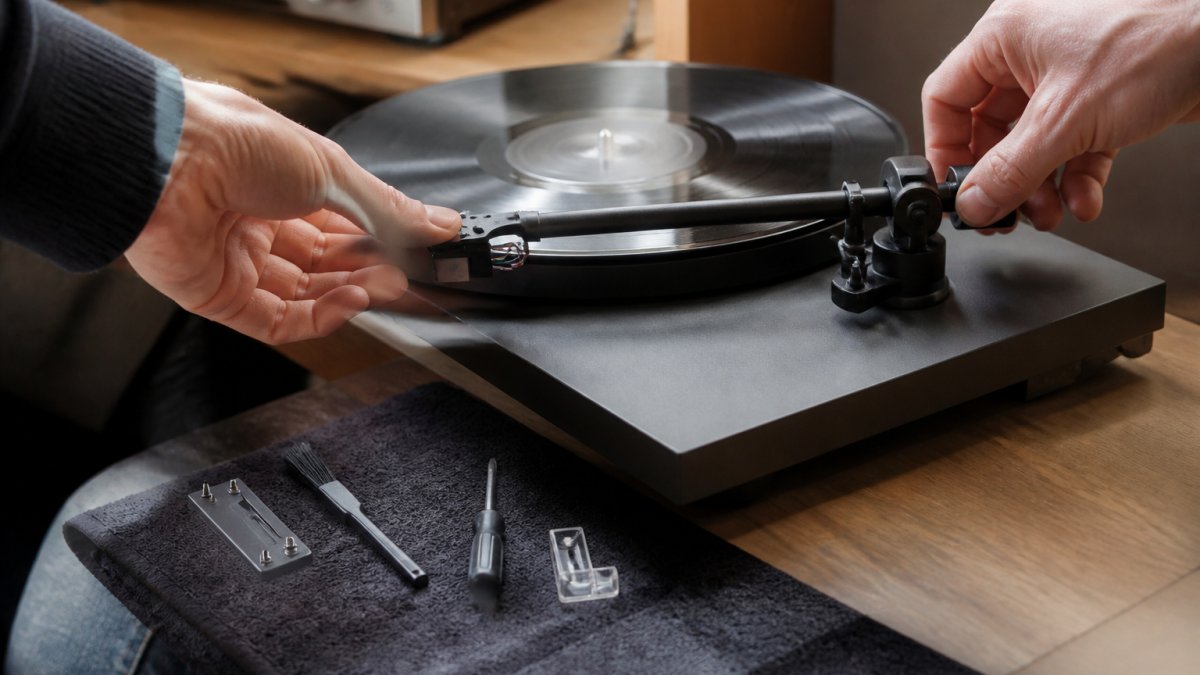
Level your turntable using a spirit level. An unlevel turntable causes tonearm drift, distortion, and uneven wear. Most turntables have adjustable feet to compensate.
Install the cartridge on the tonearm. It holds the stylus and converts groove vibrations into signals. Secure firmly without overtightening.
Cartridge Alignment and Tracking Force
Cartridge alignment determines stylus position in the groove. Misalignment causes channel imbalance and record wear. Use a protractor template for correct alignment.
Place the protractor on the platter and align the stylus with marked lines to ensure perpendicular tracking.
Tracking force is stylus pressure on the record. Too light causes skipping; too heavy causes damage. Most moving magnet cartridges track 1.5-2.5 grams per manufacturer specs.
Adjust tracking force using the counterweight on the tonearm. Small adjustments make big differences.
Anti-skate counteracts inward stylus pull. Set it to match tracking force. Too much pulls outward; too little allows inward drift.
Acoustic Environment and Turntable Placement
Turntable placement matters as much as setup and is one of the biggest factors affecting sound quality.
Turntables are vibration-sensitive. Speaker sound travels through air and solid surfaces, reaching the turntable and creating feedback, hum, or muddy sound. Isolation is critical.
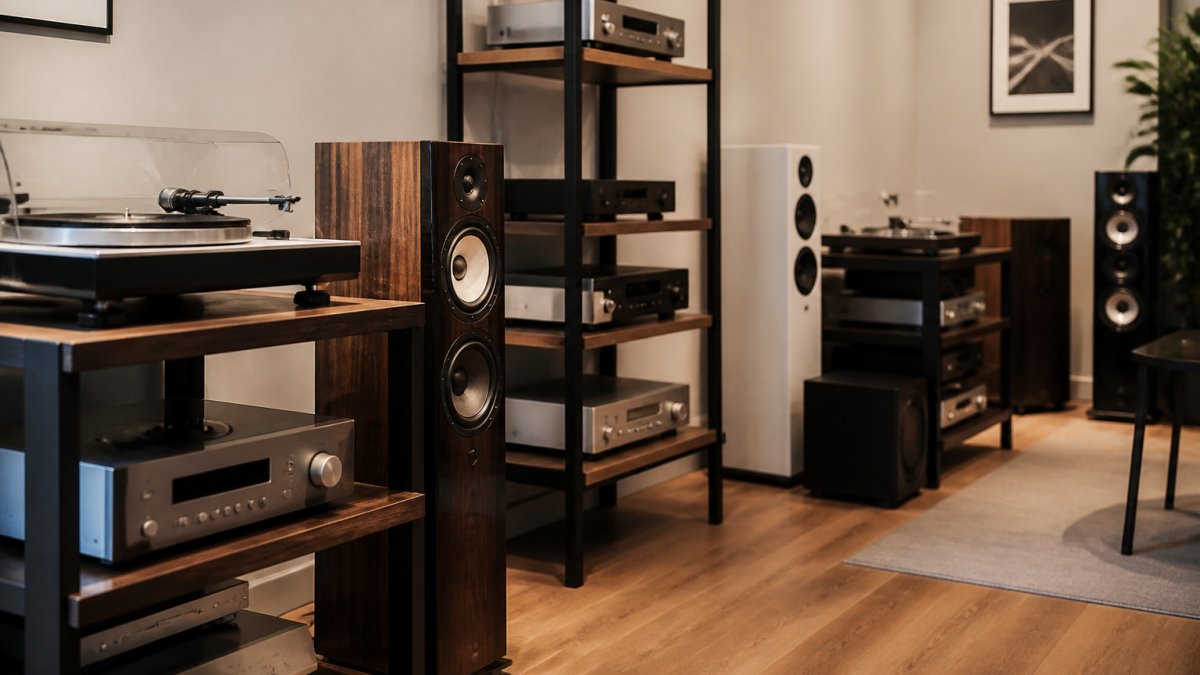
Place your turntable on a dedicated, stable surface away from speakers. Use a heavy shelf or equipment stand. Avoid placing it with your amplifier. If near speakers, use isolation feet to absorb vibration.
Wooden floors transmit vibration more than concrete.
Cabling and Connectivity Requirements
RCA cables carry signals from turntable to preamp to amplifier. Quality matters; poor cables introduce noise. Use shielded cables with solid connectors.
Troubleshooting Common Setup Issues
Hum or buzz: A constant 50 Hz hum (the mains frequency) usually indicates a grounding problem. Check that your ground wire is connected firmly to the amplifier's grounding post. If the hum persists, try moving the turntable away from the amplifier or other mains-powered equipment. Occasionally, a faulty cable or loose RCA connector causes hum; reseat all connections and try a different RCA cable if available.
Building Your System: Budget-Tier to Audiophile-Grade
Entry-level vinyl setups include a basic turntable with built-in preamp, powered speakers, and cables. These all-in-one systems sound decent and introduce you to vinyl without major investment. The limitation is upgrade potential, you can't improve individual components.
Frequently Asked Questions
What is the minimum equipment needed to play vinyl records?
You need four core components: a turntable with a cartridge, a phono preamp to amplify the signal, an amplifier or receiver to power your speakers, and speakers themselves. Some turntables include built-in phono stages, which simplifies the signal chain. The phono preamp is essential because the output from a turntable's cartridge is too weak for standard audio equipment to process directly.
Do I need an amplifier for my record player?
Yes, unless your speakers are active (powered). Turntables produce a very low-level signal that requires amplification. If you choose passive speakers, you'll need a separate amplifier or integrated receiver. Active speakers have built-in amplifiers, so they can connect directly to your turntable's output (assuming your turntable has a phono preamp). This makes active speakers a simpler choice for beginners.
Are active speakers better than passive speakers for beginners?
Active speakers are simpler for beginners because they require fewer components and less setup knowledge. They amplify the signal internally, so you skip the amplifier stage entirely. Passive speakers demand more expertise in matching impedance and gain stages, but they offer more flexibility for upgrading individual components later. Your choice depends on whether you prioritise ease of setup or future customisation.
What is the difference between a phono stage and a preamp?
A phono preamp (or phono stage) is a specific type of preamplifier designed to boost the extremely weak signal from a turntable cartridge and apply the correct EQ curve for vinyl playback. A general preamp handles line-level signals from various sources. Many modern receivers and amplifiers include a phono input, which means the phono stage is built in. If your amplifier lacks this, you'll need a separate phono preamp unit in your signal chain.
Building a vinyl setup doesn't require spending a fortune, but it does require understanding how components work together. The right turntable, preamp, amplifier, and speakers matched to your room create an engaging listening experience that digital playback often struggles to match. If you're ready to explore vinyl or upgrade an existing system, visit Chiltern Audio for a demonstration. We'll help you build a setup that sounds great in your space and fits your budget.