 listicle
Alternatives to Entry Level Turntables for Better Sound
Table of Contents
- Why Entry Level Turntables Hold Back Your Vinyl Playback
- Quick Comparison: Step-Up Turntables for Better Sound
- How to Improve Turntable Sound Quality Without Replacing the Deck
- The Best Turntable Cartridge Upgrade for Your Budget
- Phono Stage vs Built-in Preamp: Which Delivers Better Analog Fidelity?
- Step-Up Turntables Worth Considering: Rega, Fluance and Beyond
- Maintenance and the Hidden Cost of Upgrades
- Frequently Asked Questions
Last Updated: September 16, 2026
Why Entry Level Turntables Hold Back Your Vinyl Playback
Most budget decks share the same weak points: a plastic plinth that rings like a drum, a fixed tonearm, and a cartridge built to a price rather than a standard. Those compromises cap your analog fidelity before a single note reaches your amplifier.
Quick Comparison: Step-Up Turntables for Better Sound
The table below summarises the decks worth shortlisting, from budget-friendly to premium. Each one fixes at least one core weakness of a budget player.
| Turntable | Drive | Cartridge | Best For |
|---|---|---|---|
| Rega Planar 1 | Belt | Rega Carbon | Best all-round step up |
| Fluance RT82 | Belt | Ortofon OM10 | Budget upgraders |
| Fluance RT85N | Belt | Ortofon 2M Blue | Plug-and-play fidelity |
| Audio-Technica AT-LP120XUSB | Direct | AT-VM95E | Digitising vinyl |
| JBL Spinner BT | Belt | Audio-Technica | Wireless setups |
| Sony PS-LX310BT | Belt | AT3600L | Set-and-forget listening |
How to Improve Turntable Sound Quality Without Replacing the Deck
You can improve turntable sound quality dramatically without buying a new deck. In most cases, the cartridge, the phono stage and the setup deliver a bigger audible jump than a new platter ever will.
Start here before you spend anything on hardware:
- Re-level the deck. A spirit level and a stable shelf cost almost nothing and fix tracking errors.
- Set tracking force properly. Use a gauge rather than trusting the dial.
- Replace the stylus. A worn stylus adds distortion and damages record grooves.
- Isolate the plinth. Sorbothane feet or a wall shelf cut acoustic feedback.
- Check your phono stage. A cheap built-in preamp is often the weakest link in the signal path.
Setup and Calibration Basics: Tracking Force, Anti-Skate and Tonearm Resonance
Correct setup is free, and it is the single biggest upgrade available to any vinyl playback system. Tracking force, anti-skate and tonearm resonance all interact, and getting them wrong introduces distortion you will blame on the record.
Acoustic Environment: Vibration Damping and Acoustic Feedback
Where your turntable sits matters as much as what it sits on. Acoustic feedback happens when speaker vibrations travel through the floor, shelf or plinth and back into the stylus, and it smears detail across the whole frequency response.
Try these fixes, in order of cost:
- Move the deck off the same surface as the speakers.
- Use a wall-mounted shelf on a solid wall.
- Add vibration damping feet or a isolation platform.
- Keep speakers away from corners to reduce low-frequency build-up.
The Best Turntable Cartridge Upgrade for Your Budget
The best turntable cartridge upgrade depends less on price than on three matching variables: the cartridge's compliance, your tonearm's effective mass, and your phono stage's gain and loading. Get those wrong and a premium cartridge can sound worse than the budget one it replaced.
Matching Cartridges to Tonearms and Phono Stages
A practical shortlist for most budget decks:
- Ortofon 2M Red, 5.5 mV output, 20 µm/mN compliance. A safe first step on almost any low-mass arm.
- Ortofon 2M Blue, same body, nude elliptical stylus. The stylus is the upgrade; the generator is shared with the Red.
- Audio-Technica VM95E, 4 mV output, 6.5 µm/mN compliance. Slightly lower compliance, so it prefers a marginally heavier arm.
- Audio-Technica VM95ML, microline stylus, longer service life and better groove tracing than elliptical.
- Nagaoka MP-110, 5 mV output, warm tonal balance, popular with Rega owners.
Stylus profile matters more than the generator in most cases. A conical tip reads a narrower contact patch and struggles with inner-groove detail. An elliptical tip widens the contact area and tracks high frequencies more cleanly. A line-contact or microline tip goes further still, tracing the groove wall more accurately and lasting longer before wear sets in.
Moving Magnet Cartridges and Stylus Wear: What to Replace First
A moving magnet cartridge is the sensible first upgrade for almost every budget deck. It works with standard phono stages, offers high output, and replacement styli are easy to source.
The Hidden Cost of Cartridge Upgrades
This is the part most guides skip. A cartridge swap is rarely a single purchase. A 2M Blue at roughly £180 is only the beginning: you may also need a tracking force gauge (£15-£30), an alignment protractor (£10-£25), and, if the new cartridge exposes the built-in preamp, a dedicated phono stage (£80-£250). Add a set of decent interconnects (£20-£60) and the true cost of "just a cartridge upgrade" can easily reach £300-£500.
Phono Stage vs Built-in Preamp: Which Delivers Better Analog Fidelity?
A dedicated phono stage almost always beats a built-in preamp on analog fidelity. Built-in preamps are built to a budget and often add noise, hum and limited gain, which shows up as a lower signal-to-noise ratio and a flatter sound.
Step-Up Turntables Worth Considering: Rega, Fluance and Beyond
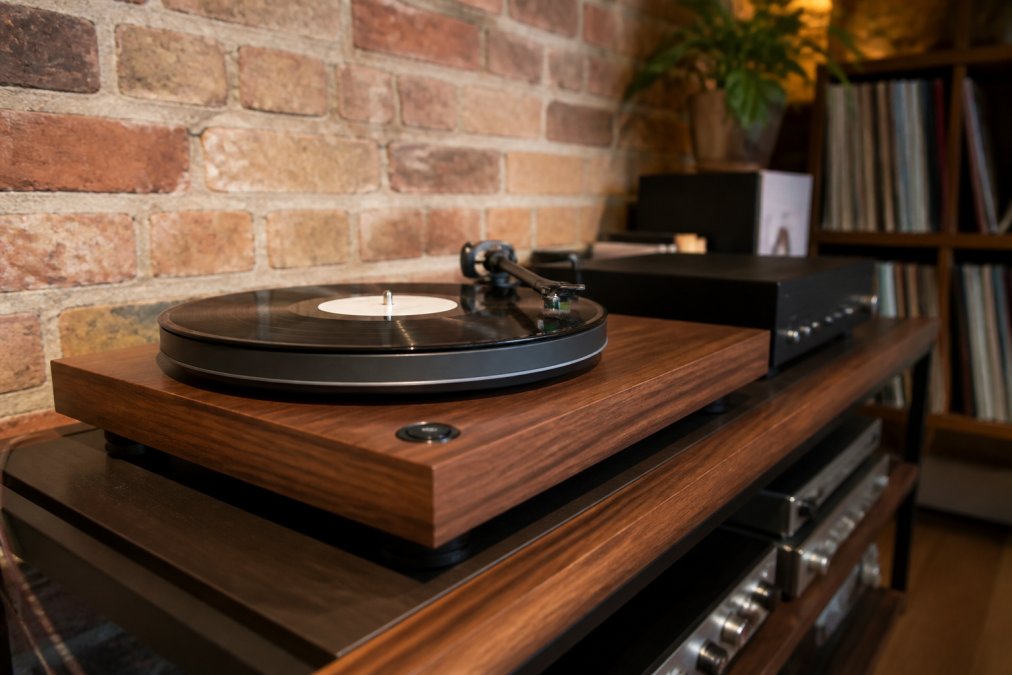
The Rega Planar 1 is the best all-round step up for most listeners. Rega pairs it with the RB110 tonearm and a phenolic platter, and keeps the design deliberately simple so the money goes into sound rather than features. The RB110 uses a friction-free bearing and an automatic bias mechanism, which removes the anti-skate guesswork that trips up most budget decks.
| Turntable | Pros | Cons |
|---|---|---|
| Rega Planar 1 | Hand-built, superb tonearm | Manual operation |
| Fluance RT85N | Premium 2M Blue cartridge | Needs external phono stage |
| Audio-Technica AT-LP120XUSB | Versatile, USB output | Large footprint |
Belt-Driven vs Direct-Drive: Which Mechanism Suits Your Setup?
Belt-driven decks suit most listeners chasing analog warmth, because the belt isolates the motor and damps vibration. Direct-drive decks start faster and hold speed with lower wow and flutter, which suits DJs and anyone digitising records.
Acoustic Environment: Why Your Room Matters More Than the Deck
Here is the angle most step-up guides miss. In a typical domestic room, speaker placement and room acoustics shape the sound you hear more than the difference between a £250 deck and a £500 one. A step-up turntable in a poorly set-up room will lose to a well-set-up budget deck almost every time.
- Move the speakers off the same surface as the deck. This alone removes the most common feedback path.
- Pull the speakers away from the front wall. A gap of at least 30 cm reduces low-frequency build-up that masks detail.
- Toe the speakers in slightly so the tweeters aim just past your ears at the listening position.
- Treat the first reflection points on the side walls with a rug, curtain or acoustic panel.
- Mount the deck on a solid wall shelf if your floor is suspended timber. Masonry walls barely transmit vibration, so the feedback path disappears.
Maintenance as a Sound Quality Factor
Maintenance is the cheapest sound quality factor available, and it is the one most owners neglect. Clean your records with a carbon-fibre brush before every play and a wet clean every ten to twenty plays. Replace the stylus on schedule, around 1,000 hours for elliptical tips. Keep the belt fresh; a stretched belt causes speed drift that no cartridge upgrade can fix.
Maintenance and the Hidden Cost of Upgrades
The hidden cost of upgrades is the part nobody budgets for. A new cartridge often demands a better phono stage, which demands better interconnects, which exposes the speakers. Each step reveals the next weak link.
Frequently Asked Questions
How can I make my turntable sound better without replacing it?
Start with setup and calibration: check tracking force, adjust anti-skate, and level the deck on a solid surface. Replace the stylus if it is worn, and add vibration damping under the platter or feet. If your amplifier lacks a phono input, a dedicated phono stage can lift analog fidelity noticeably. These changes improve vinyl playback without buying a new deck.
What is the best turntable cartridge upgrade for a step-up in sound?
Moving magnet cartridges such as the Ortofon 2M Blue or OM10 offer a clear jump in detail and tracking over stock budget cartridges. Match the cartridge to your tonearm's effective mass and set tracking force within the manufacturer's range. A cartridge upgrade often delivers more audible improvement than swapping the turntable itself.
Do I need a dedicated phono stage for better sound quality?
Not always, but a dedicated phono stage usually outperforms a built-in preamp in entry level decks. Separate phono stages offer better signal-to-noise ratio, lower distortion, and more accurate RIAA equalisation. If your amplifier has no phono input, or your deck's built-in preamp sounds thin, an external phono stage is a sensible upgrade before replacing the turntable.
When should I consider upgrading my turntable cartridge?
Replace the cartridge when the stylus shows wear (roughly 500 to 1,000 hours of play), when you hear distortion or sibilance on clean records, or when you want more detail and dynamic range. If your deck has a removable headshell, a cartridge upgrade is straightforward and reversible, making it a low-risk way to improve sound quality.
What are the key differences between entry-level and mid-range turntables?
Mid-range decks typically use better tonearms with adjustable counterweight and anti-skate, heavier plinths for vibration damping, and higher-quality platters for platter stability. They often ship with a superior moving magnet cartridge and offer a clearer upgrade path. Entry-level models prioritise plug-and-play convenience, while mid-range decks reward proper calibration with greater soundstage imaging and rhythmic precision.
Getting better sound from vinyl is less about spending more and more about spending in the right order. If you want help matching a deck, cartridge and phono stage to your room and your budget, Chiltern Audio offers real-world hifi demonstrations, bespoke system building and expert guidance on Rega turntables, plus a record cleaning service to keep your collection in shape. Get started with Chiltern Audio and build a system that finally does your records justice.