 listicle
5 Best Vinyl Record Cleaning Kits for 2026
Table of Contents
- Quick Comparison Table
- How to Clean Vinyl Records Without Damaging Them
- Manual vs. Vacuum Record Cleaning Machines
- 1. HumminGuru Ultrasonic Vinyl Record Cleaner
- 2. Spincare 5-in-1 Cleaning Kit
- 3. Big Fudge 4-in-1 Vinyl Record Cleaning Kit
- 4. Spin-Clean Record Washer System
- 5. Vinyl Buddy Ultimate
- Frequently Asked Questions
Last Updated: September 22, 2026
Quick Comparison Table
| Cleaning Kit | Type | Starting Price | Best For | Key Advantage |
|---|---|---|---|---|
| HumminGuru Ultrasonic | Ultrasonic machine | £450.00 | Serious collectors | Automated deep cleaning |
| Spincare 5-in-1 | Manual kit | £15.99 | Beginners | Budget-friendly essentials |
| Big Fudge 4-in-1 | Manual kit | £22.00 | Regular maintenance | Alcohol-free solution |
| Spin-Clean Record Washer | Immersion system | £85.00 | Batch cleaning | Dual-sided brushes |
| Vinyl Buddy Ultimate | Roller tool | £18.50 | Quick dust removal | No liquids needed |
Vinyl records deserve better care than most collectors give them. Surface noise, skipping, and premature stylus wear often stem from neglect rather than manufacturing faults.
This guide covers the five best vinyl record cleaning kits available in 2026, each designed for different budgets and cleaning depths.
How to Clean Vinyl Records Without Damaging Them
Before investing in a cleaning kit, diagnose whether surface noise stems from dirt; not all record problems are solvable through cleaning.
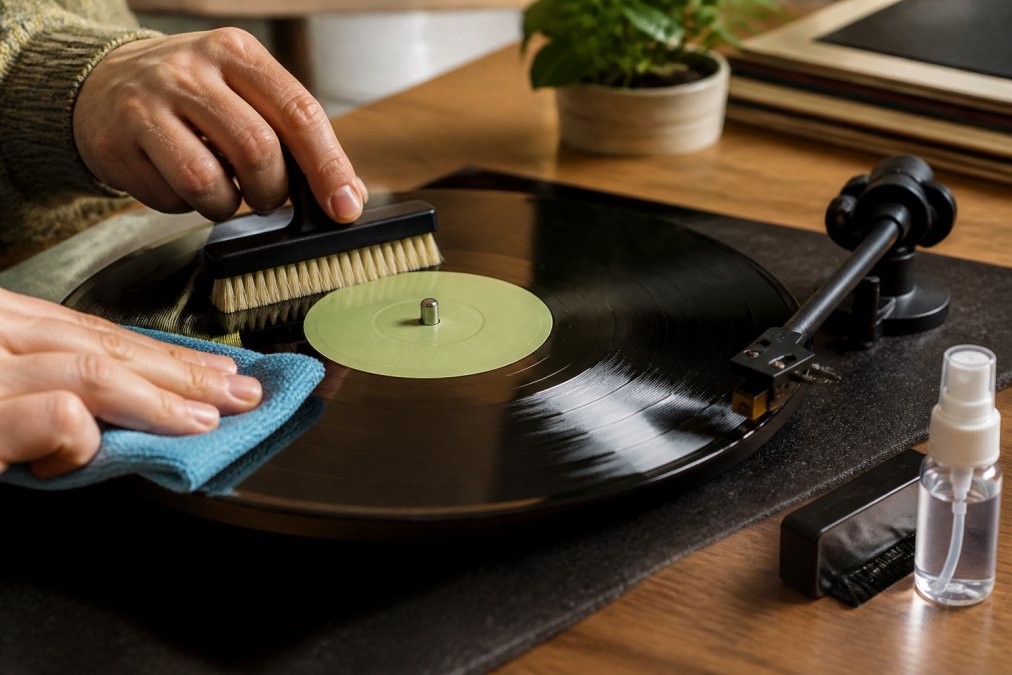
The golden rule: never apply excessive pressure. A light touch with the right tools removes dirt without causing permanent damage.
Diagnosing Surface Noise Before You Clean
Not all crackle and pop indicates a dirty record. Understanding the source of noise prevents you from buying a cleaning kit that won't solve the problem.
Dust and static noise sounds like random crackling that varies between plays and disappears after cleaning. A simple dry brush pass often eliminates this entirely.
Fingerprint and residue noise manifests as a consistent hiss or grinding sound that doesn't vary between plays. This requires wet cleaning to remove oils and grime embedded in the grooves.
Permanent groove damage (scratches, groove wear) produces clicks or pops at the same spot every time. This persists after cleaning and cannot be fixed; the damage is irreversible.
To test, play a record and note if noise is random or consistent. Dry brush it lightly with a carbon fibre brush and play again. If noise reduces by 50% or more, cleaning will help. If unchanged, the problem is likely groove damage or a stylus issue.
Dry Brushing vs. Wet Cleaning
Dry brushing works best for records you play regularly. A carbon fibre or velvet brush removes surface dust before each session in 30 seconds, preventing particles from settling deeper into grooves.
Wet cleaning tackles stubborn grime and residue that dry brushing can't reach. New pressings rarely need it unless heavily handled. Older records and secondhand finds benefit from moisture-based solutions.
Many collectors dry brush first to remove loose dust, then wet clean if needed. For fingerprint noise, skip dry brushing and go straight to wet cleaning.
Protecting the Record Label and Grooves
The label is vulnerable to water damage. When wet cleaning, tilt the record so liquid runs toward the grooves and away from the label. Never submerge fully.
For groove protection, use soft-bristled brushes like carbon fibre or velvet. Stiff brushes scratch groove walls and degrade sound fidelity over time.
Apply cleaning solution sparingly; a light mist followed by a gentle brush pass works better than soaking.
Manual vs. Vacuum Record Cleaning Machines
Manual systems cost less but require effort. Vacuum machines automate drying, which matters for large collections. The best choice depends on what you're cleaning: new pressings versus vintage finds have different needs.
Cleaning New Pressings vs. Vintage Records
New vinyl pressings arrive relatively clean but accumulate static charge during manufacturing and shipping. They need dust and static removal more than deep grime extraction. A manual kit with anti-static fluid works well. New pressings rarely justify an ultrasonic machine unless you're buying dozens monthly.
Vintage records often carry decades of accumulated dust, fingerprints, and grime. These benefit from ultrasonic or vacuum systems. Manual brushing alone may not penetrate deeply enough. For restoring 20+ secondhand records, manual cleaning becomes prohibitive.
Many collectors own both: a manual kit for regular maintenance of new records and a more powerful system for occasional deep cleaning of older finds. This hybrid approach balances cost and capability.
Manual Cleaning Systems
Manual cleaning means you control every variable: brush pressure, solution amount, and drying time. You'll develop a feel for what works. The drawback is consistency. Fatigue sets in after cleaning ten records. Your technique may slip by the fifteenth.
Manual systems excel at spot-cleaning, maintaining records in good condition, and learning technique. They struggle with large backlogs of dirty vintage records and consistent results across 50+ records.
Vacuum and Ultrasonic Machines
Vacuum machines apply solution, scrub, and extract moisture in one cycle, taking 2-3 minutes per record. For collectors with 50+ records, this efficiency justifies the investment.
Ultrasonic cleaners use sound waves at 40kHz to dislodge dirt particles from groove walls without brushing.
1. HumminGuru Ultrasonic Vinyl Record Cleaner
Best for serious collectors looking for automated, deep-cleaning results.
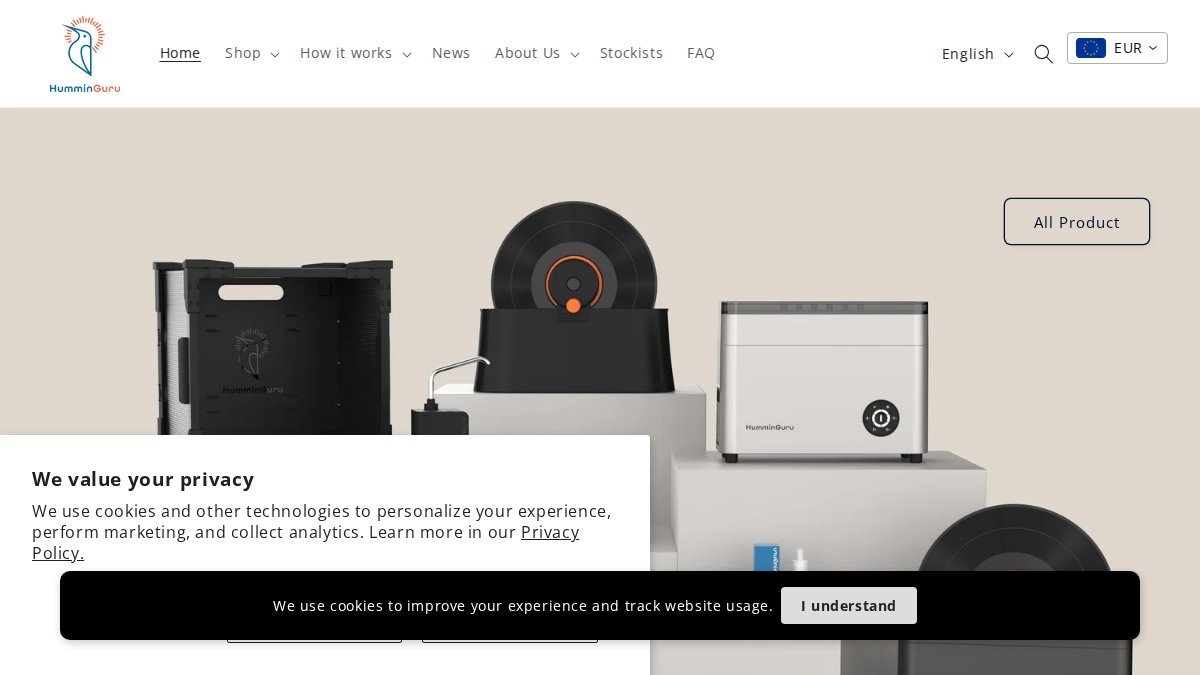
The HumminGuru uses ultrasonic technology at 40kHz to vibrate dirt particles loose from groove walls without brush contact. It handles records of various sizes with automatic cycles taking 5-6 minutes per record.
Pros:
- Highly effective at removing deep grime and stubborn residue
- Fully automated process saves time on large collections
- Compact and lightweight for its capability
Cons:
- Higher initial investment compared to manual alternatives
- Requires distilled water and occasional cleaning solution refills
2. Spincare 5-in-1 Cleaning Kit
Best for beginners and those needing cost-effective daily maintenance.
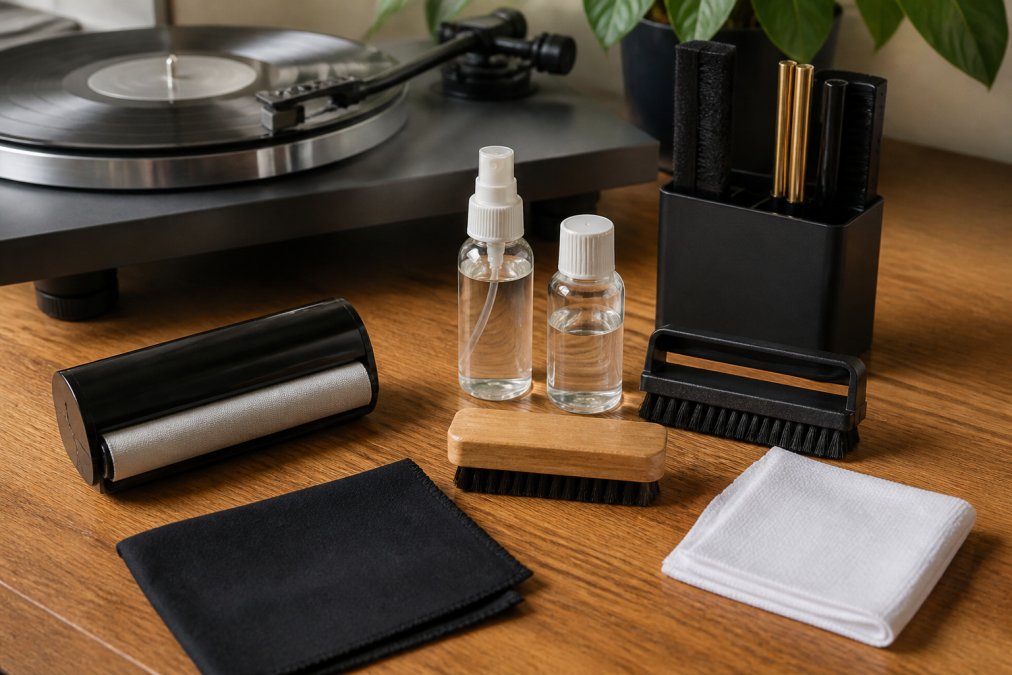
The Spincare kit includes a velvet brush, stylus cleaner, anti-static fluid, microfibre cloth, and storage case; everything fits in a small box.
Pros:
- Excellent value for money
- Includes essential tools for both record and stylus care
- Compact storage makes it easy to keep near your turntable
Cons:
- Requires manual effort for every record
- Limited to surface and light groove cleaning
Ideal for collectors with 20-50 records played regularly.
3. Big Fudge 4-in-1 Vinyl Record Cleaning Kit
Best for collectors who prefer simple, reliable manual cleaning.
Big Fudge's kit emphasises the cleaning solution itself. Their proprietary alcohol-free formula targets fingerprints and residue without the harshness of traditional cleaning compounds. The kit includes a velvet brush, stylus brush, and ergonomic handle that makes the cleaning process feel less like a chore.
Pros:
- Safe for all vinyl types, including vintage pressings
- Easy to use and store
- Effective alcohol-free cleaning solution
Cons:
- Not suitable for heavy-duty restoration of very dirty records
- Manual cleaning still requires time investment
Best for collectors maintaining 30-80 records with regular care.
4. Spin-Clean Record Washer System
Best for cleaning large batches of records efficiently without electricity.
Pros:
- Cleans both sides simultaneously
- Very durable and long-lasting
- No electricity dependency
Cons:
- Requires drying time for each record
- Manual rotation requires consistent technique
5. Vinyl Buddy Ultimate
Best for quick surface dust removal before playing a record.
Pros:
- Very quick and easy to use
- No liquids required
- Reusable roller lasts indefinitely
Cons:
- Does not clean deep inside the grooves
- Limited to surface dust removal
Best for regular players maintaining records in good condition.
Frequently Asked Questions
What is the best vinyl record cleaning kit for beginners?
The Spincare 5-in-1 Cleaning Kit is ideal for beginners because it includes all essential tools, velvet brush, stylus cleaner, anti-static fluid, and microfibre cloth, at an affordable price. It requires no electricity and teaches you proper manual cleaning technique. For those willing to spend more, the Spin-Clean Record Washer System offers a more immersive approach that cleans both sides simultaneously, though it requires more drying time between records.
How often should I clean my vinyl records?
Clean records before each play using a carbon fibre brush or roller to remove surface dust and debris. Perform a deeper wet clean every 3-6 months, depending on storage conditions and how frequently you play the records. Records stored in dusty environments or played regularly need more frequent maintenance. Vintage pressings may require deeper cleaning less often to avoid excessive handling.
Can I use household items to clean vinyl records safely?
Avoid household cleaners, as they can damage vinyl grooves and leave residue. Distilled water alone can work for very light cleaning, but it leaves static discharge and does not remove oils or debris effectively. Purpose-made cleaning solutions are formulated to be residue-free and anti-static. If you must use a homemade solution, mix distilled water with a tiny amount of mild dish soap, but dedicated vinyl cleaning fluid is safer and more effective.
Is a record weight worth it for sound quality?
Record weights improve sound fidelity by increasing platter contact and reducing vibration, which minimises surface noise and enhances groove tracking. The improvement is most noticeable on older or warped pressings and when using high-quality turntables where the stylus can fully resolve the benefits. Budget-conscious collectors may skip weights initially, but serious audiophiles find them worthwhile for LP preservation and playback clarity.
What is the difference between manual and ultrasonic cleaning?
Manual cleaning uses brushes and cleaning fluid applied by hand, offering control and affordability but requiring effort for each record. Ultrasonic cleaners use sound waves at 40kHz to agitate cleaning solution, removing deep-seated grime automatically with minimal handling. Ultrasonic machines excel at heavy restoration and batch cleaning but cost significantly more. Manual kits suit routine maintenance; ultrasonic machines suit serious collectors with large collections or heavily soiled records.