 listicle
5 Best Bookshelf Speakers for Small Rooms in 2026
Table of Contents
- How We Picked the Best Bookshelf Speakers for Small Rooms
- Quick Comparison: Top Bookshelf Speakers for Small Rooms
- 1. KEF Q1 Meta: The Imaging Champion
- 2. Wharfedale Diamond 12.1i: Best Budget Hifi Speakers 2026
- 3. DALI Kupid: The Placement-Friendly Performer
- 4. Acoustic Energy AE300 Mk2: Premium Power in a Compact Cabinet
- 5. Neat Iota II: The Ultra-Compact Overachiever
- How to Position Bookshelf Speakers for Small Rooms
- Frequently Asked Questions
Last Updated: September 9, 2026
Finding genuinely good bookshelf speakers for small rooms is harder than it looks. Most compact models sacrifice bass extension for footprint, while others throw a huge soundstage but need space to breathe that you simply don't have. The 5 best bookshelf speakers for small rooms in 2026 solve that problem with clever driver design, careful port tuning, and cabinets engineered for near-wall placement. At Chiltern Audio, we demonstrate these models, and this guide reflects what works in real living rooms and apartments.
A bookshelf speaker is a compact, passive loudspeaker designed to sit on a stand, shelf, or desktop while delivering high-fidelity sound across the full frequency range. The challenge in small rooms is that boundary reflections and bass build-up distort what you hear, which means placement and speaker design matter as much as raw driver quality.
Below, we'll break down five genuinely different approaches to small-room sound, from budget-friendly to premium, and show you exactly how to position them for the best results.
How We Picked the Best Bookshelf Speakers for Small Rooms
We evaluated dozens of models across four criteria: cabinet footprint, bass extension relative to size, dispersion characteristics for near-wall use, and amplifier matching flexibility. Every pick here has been auditioned in rooms under 20 square metres, which is where most UK flats and spare bedrooms sit.
The common thread across all five selections is controlled bass response. Small rooms amplify low frequencies unevenly, so speakers with excessive bass output or poorly tuned rear ports sound boomy and indistinct. Each model below handles this differently, and we've noted exactly how in each review.
We also prioritised speakers that work well with modest amplification. If you're pairing with a starter integrated amp or a Rega turntable setup, you don't want speakers that demand high current to come alive.
Quick Comparison: Top Bookshelf Speakers for Small Rooms
| Model | Starting Price | Best For | Standout Feature |
|---|---|---|---|
| KEF Q1 Meta | £499 | Imaging and clarity | Metamaterial Absorption Technology |
| Wharfedale Diamond 12.1i | £249 | Budget-conscious buyers | Klarity cone low distortion |
| DALI Kupid | Contact for pricing | Placement flexibility | Optimised dispersion patterns |
| Acoustic Energy AE300 Mk2 | £699 | Premium dynamics | Ceramic aluminium sandwich cones |
| Neat Iota II | £995 | Ultra-compact spaces | Planar magnetic tweeter |
Prices are manufacturer RRP and may vary by retailer. For a full demonstration and current pricing, please contact us.
1. KEF Q1 Meta: The Imaging Champion
The KEF Q1 Meta is the best bookshelf speaker for small rooms when imaging and clarity are your top priorities. Its Uni-Q driver array places the tweeter at the acoustic centre of the woofer, which creates a remarkably consistent dispersion pattern across the listening area. That means you get a precise, stable soundstage even if you're not sitting perfectly in the sweet spot.
The Metamaterial Absorption Technology (MAT) lines the rear of the tweeter to absorb unwanted high-frequency reflections, reducing harmonic distortion noticeably at low-to-mid volumes. This makes the Q1 Meta ideal for evening listening sessions where you're not pushing high sound pressure levels but still want detail.
What most reviews miss is that the Q1 Meta rewards quality amplification. Budget amps will drive them fine, but pairing them with a clean integrated amplifier reveals significantly better stereo imaging and dynamic range. The rear port needs roughly 20cm of clearance from the wall, so they're less placement-friendly than some rivals here.
2. Wharfedale Diamond 12.1i: Best Budget Hifi Speakers 2026
For best budget hifi speakers 2026, the Wharfedale Diamond 12.1i is the clear winner. At £249 a pair, they deliver a neutral, detailed sound signature that punches far above their price point. The Klarity cone material keeps distortion low, and the rear-ported design provides controlled bass response that works surprisingly well in small rooms.
The trade-off is limited low-end extension. Below about 50Hz, the 12.1i rolls off noticeably, so if you listen to bass-heavy genres at volume, you'll want to consider a subwoofer later. For acoustic music, jazz, and vocals, they're genuinely excellent.
Where the Diamond 12.1i really shines is amplifier flexibility. They're an easy 8-ohm load with reasonable sensitivity, meaning they sound good with modest integrated amps and even some AV receivers. That makes them a sensible first purchase for anyone building their first hifi system on a budget.
3. DALI Kupid: The Placement-Friendly Performer
The DALI Kupid takes a different approach to the small-room problem. Instead of fighting boundary effects, it's designed to work with them. The optimised dispersion pattern means you can place these speakers closer to walls and corners without the sound becoming muddy or shouty, which is rare at this level.
Its compact form factor suits tight spaces, and the high-fidelity driver configuration delivers a coherent, musical presentation. DALI's hybrid tweeter design, combining a soft dome with a ribbon element, gives extended high-frequency response that brings recordings to life.
The main caveat is that the Kupid benefits from dedicated stands. On a bookshelf or desktop, the bass can become slightly indistinct, and you lose some of the imaging precision. Budget for a pair of decent stands if you want the full performance. Please contact us for current pricing and demonstration availability.
4. Acoustic Energy AE300 Mk2: Premium Power in a Compact Cabinet
The Acoustic Energy AE300 Mk2 is for listeners who refuse to accept that small rooms mean small sound. The ceramic aluminium sandwich cone drivers are exceptionally rigid, which keeps cabinet resonance and distortion low even when you push the volume. The result is impressive dynamic range from a cabinet that doesn't dominate your room. luxury theater seating.
Build quality is superb, with real wood veneer and high-gloss finishes that look far more expensive than the price suggests. The AE300 Mk2 feels like a piece of furniture, not just a speaker.
The catch is that they demand better amplification. Plan on spending at least as much on an amp as you do on these speakers to hear what they're capable of. With the right partner, they deliver room-filling sound that belies their compact dimensions, making them a strong choice for small-to-medium rooms where you want both refinement and headroom.
5. Neat Iota II: The Ultra-Compact Overachiever
The Neat Iota II is the speaker you buy when space is genuinely at a premium but you refuse to compromise on fidelity. Its unique footprint, roughly the size of a large hardback book, fits on narrow shelves, desktops, or window sills where nothing else will. The planar magnetic tweeter delivers detailed, fast high frequencies that most dome tweeters can't match.
What's remarkable is the size-to-sound ratio. Despite the tiny cabinet, the Iota II produces a surprisingly open, expansive soundstage. The trick is a carefully tuned driver arrangement that works as a point source, projecting a coherent image well beyond what the physical dimensions suggest.
The price, £995, is steep for the form factor. You're paying for engineering density and the unique aesthetic. But for a bedroom setup, a home office, or a second system where space is genuinely constrained, nothing else comes close.
How to Position Bookshelf Speakers for Small Rooms
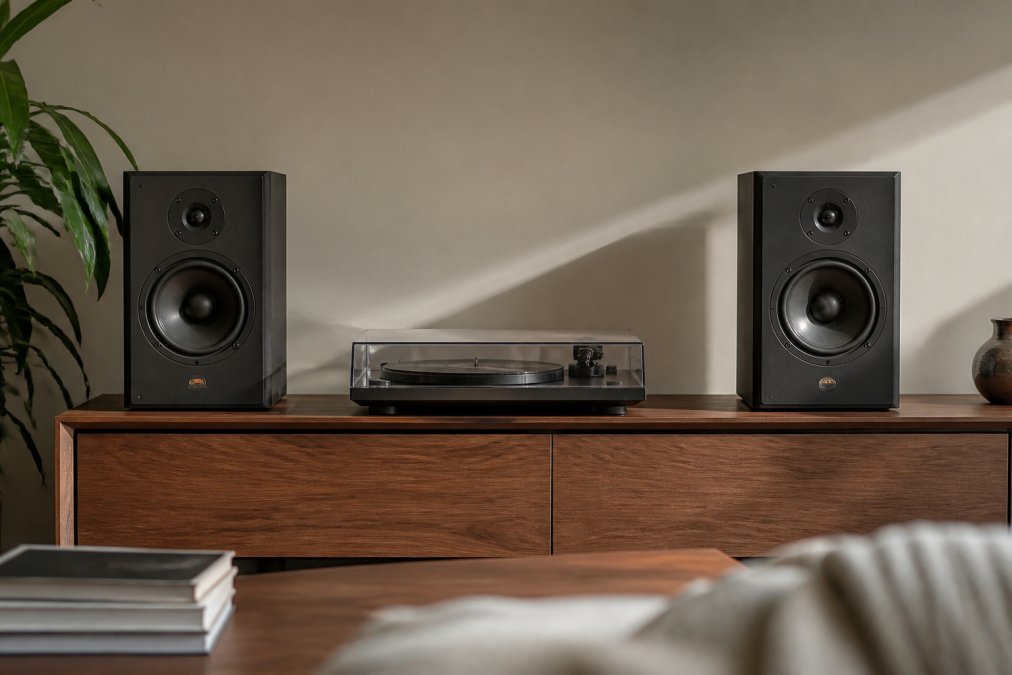
Getting speaker placement right transforms how your system sounds, often more than upgrading components. The goal is to create an equilateral triangle between you and the two speakers, with your ears at the apex and the speakers at the other two points. Your listening position should be roughly one to 1.5 times the distance between the speakers.
Start by positioning the speakers so the tweeters are at ear height when you're seated. For stand-mount speakers, this usually means stands that place the tweeter around 90cm from the floor. On a desktop, use isolation pads to angle the speakers slightly upward toward your ears.
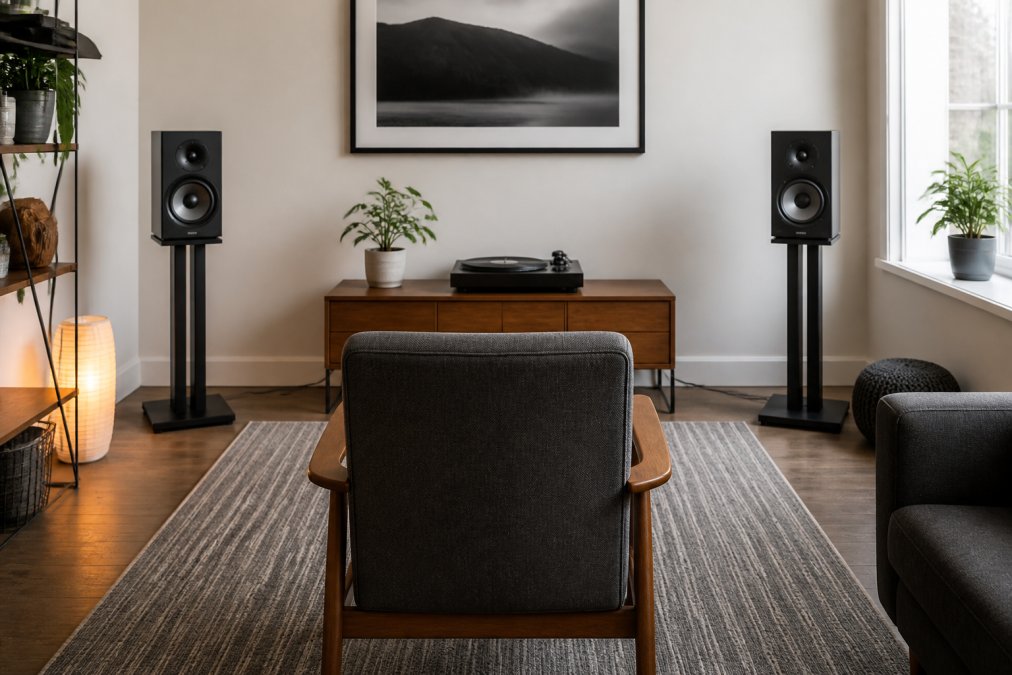
Toe-in is your next adjustment. Pointing the speakers directly at your listening position sharpens stereo imaging but narrows the sweet spot. Starting with no toe-in and gradually angling inward until the centre image locks into place usually gives the best balance in small rooms. According to guidance from the BBC's sound engineering resources, even small angular changes of a few degrees significantly affect perceived stereo width and centre focus.
Desktop vs. Stand-Mount Ergonomics
Desktop placement introduces two problems: vibration coupling and reflection from the desk surface. The desk acts as a resonator, muddying bass response, while the surface reflects sound waves that cancel out frequencies in the midrange.
Isolation pads or small stands solve the first problem by decoupling the speaker from the desk. Angling the speakers upward, so the tweeters point at your ears rather than your chest, addresses the second. Desktop setups also benefit from pulling the speakers forward so they sit near the front edge of the desk, reducing early reflections from the surface.
Stand-mount placement is simpler acoustically but requires more floor space. The main advantage is that stands place the speakers in free space, away from reflective surfaces, which produces cleaner bass and better-defined imaging.
Dealing with Wall Proximity and Bass Build-Up
Wall proximity is the single biggest acoustic challenge in small rooms. When a speaker sits close to a wall, the boundary reinforces bass output, typically boosting frequencies below 150Hz by several decibels. This sounds impressive at first but quickly becomes boomy and indistinct.
The fix depends on your speaker's port configuration. Front-ported speakers tolerate near-wall placement well. Rear-ported speakers, like the Wharfedale Diamond 12.1i, need clearance behind them to let the port breathe. A good starting point is 20cm from the rear wall and 50cm from side walls.
If you can't achieve that distance, use the port bungs that ship with most speakers. Plugging the port reduces bass output and shifts the tuning, which often tames boom in tight placements. The trade-off is reduced low-end extension, but a controlled, accurate response beats a boomy one every time. For more detailed guidance on room acoustics and boundary effects, the Acoustics Research Centre guidance offers practical explanations of how room dimensions and speaker placement interact.
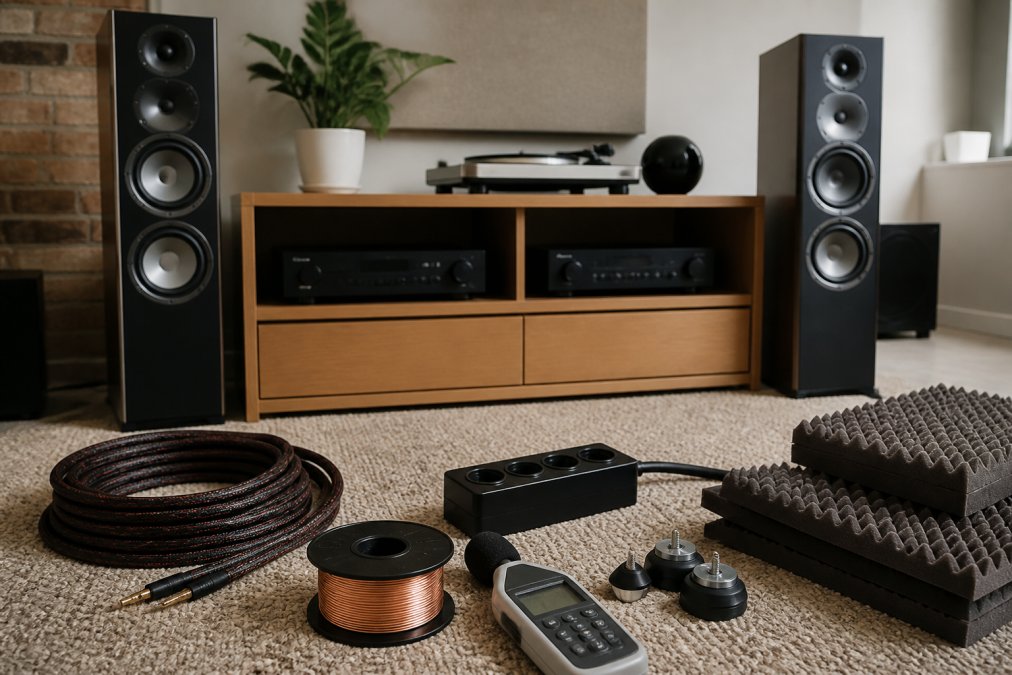
Beyond speaker position, basic acoustic treatment makes a noticeable difference. A rug on a hard floor, curtains over large windows, and a bookshelf on the opposite wall all break up reflections that smear imaging. You don't need professional panels; soft furnishings absorb the worst early reflections and clean up the soundstage. Research from the Institute of Acoustics resources confirms that controlling early reflections is the most effective first step in treating small listening spaces.
Choosing the best bookshelf speakers for small rooms in 2026 comes down to understanding your space and your priorities. The Wharfedale Diamond 12.1i offers unbeatable value, the KEF Q1 Meta delivers class-leading imaging, and the Neat Iota II fits where nothing else will. What every model here has in common is that they reward careful placement and quality amplification.
That's where Chiltern Audio makes the difference. We offer real-world hifi demonstrations so you can hear how these speakers perform before you buy, and our team provides expert guidance on matching speakers to amplifiers for a balanced system. Whether you're building your first setup or upgrading an existing one, we'll help you get the sound your room deserves. Get in touch to discuss your space and budget. Shop now with Chiltern Audio and build a system that sounds as good as it looks.
Frequently Asked Questions
What is the best bookshelf speaker for a small room?
The best bookshelf speaker for a small room depends on your budget and priorities. The KEF Q1 Meta offers exceptional imaging thanks to its Uni-Q driver array, making it a top choice for critical listening. For a more budget-friendly option, the Wharfedale Diamond 12.1i delivers a neutral, detailed sound that punches well above its price. Both models are compact enough for shelves or stands in tight spaces.
Do I need a subwoofer with bookshelf speakers in a small room?
In a small room, adding a subwoofer can be beneficial, but it is not always necessary. Bookshelf speakers like the Acoustic Energy AE300 Mk2 offer impressive bass extension for their size. However, a subwoofer can add depth for movies or electronic music. If you choose to integrate one, proper crossover settings are key to avoid overwhelming the room with boomy, uncontrolled bass.
Are active or passive speakers better for small rooms?
For very small rooms or desktop setups, active speakers simplify your system by removing the need for a separate amplifier. Passive speakers, like the DALI Kupid, offer more flexibility to upgrade components over time and let you match them with a dedicated amp for a specific sound. Your choice depends on whether you prefer simplicity or a more modular, upgradeable hifi system.
How should I position bookshelf speakers in a small room for the best sound?
Position your speakers at ear height when seated, and angle them towards your listening position. Keep them at least 20-30 cm away from rear walls to reduce bass boom, especially for rear-ported designs like the Wharfedale Diamond 12.1i. Form an equilateral triangle between yourself and the two speakers to achieve a solid stereo image and clear soundstage.