 comparison
Can You Use Hi-Fi Speakers for Home Cinema?
Table of Contents
- Hi-Fi Versus Home Cinema: Key Differences
- Can Hi-Fi Speakers Be Used for Movies?
- Connecting Hi-Fi Speakers to an AV Receiver
- Home Cinema Speaker Setup: Expanding Your Stereo Pair
- Matching Speakers for Home Cinema: Tonal Balance and Compatibility
- Using Hi-Fi Speakers With a Subwoofer for Films
- Room Acoustics, Placement, and Calibration
- Upgrade Paths: When to Keep Your Hi-Fi Speakers and When to Expand
- Frequently Asked Questions
Last Updated: October 12, 2026
Hi-Fi Versus Home Cinema: Key Differences
Can you use hi-fi speakers for home cinema? Yes, with caveats. Hi-fi speakers are built for stereo music; home cinema systems are built for multichannel surround. Understanding the differences tells you whether your existing speakers can serve double duty or need expanding.
Stereo Sound Versus Surround Sound
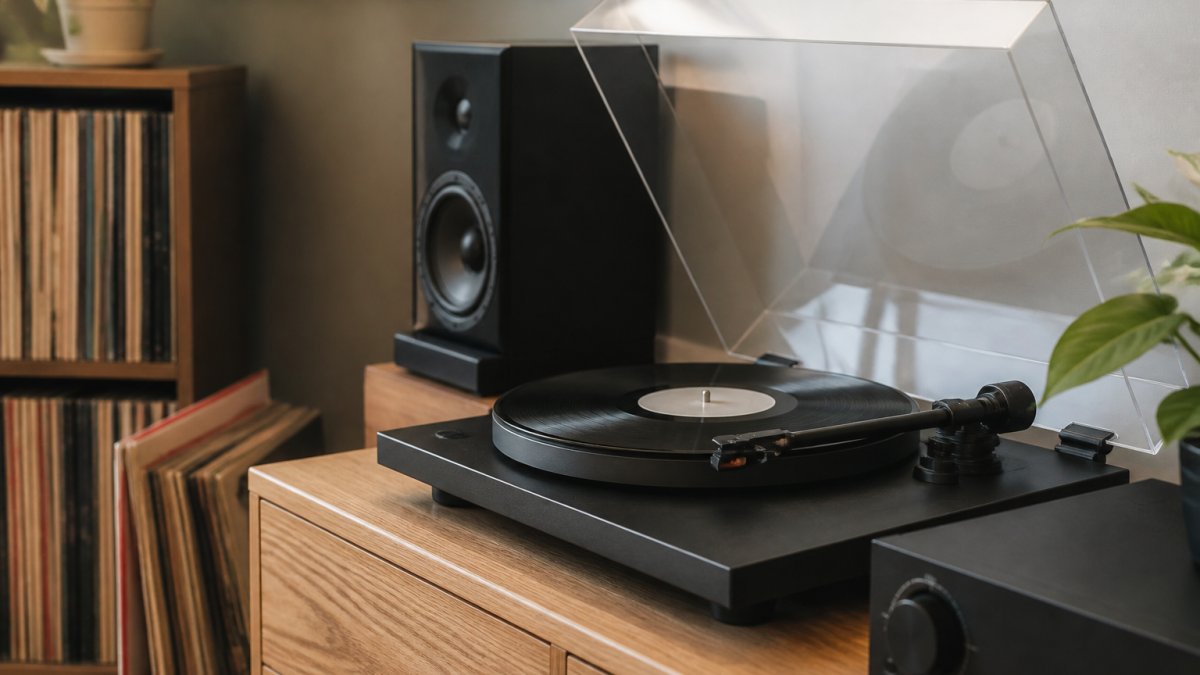
A typical hi-fi stereo system uses two speakers and an amplifier to create a two-channel soundstage, relying on the listener's position between them for width and depth.
Home cinema uses multiple speakers around the room for immersive, multichannel sound.
The key distinction: stereo gives you width, home cinema gives you envelopment.
Music Listening Versus Film and Television Use
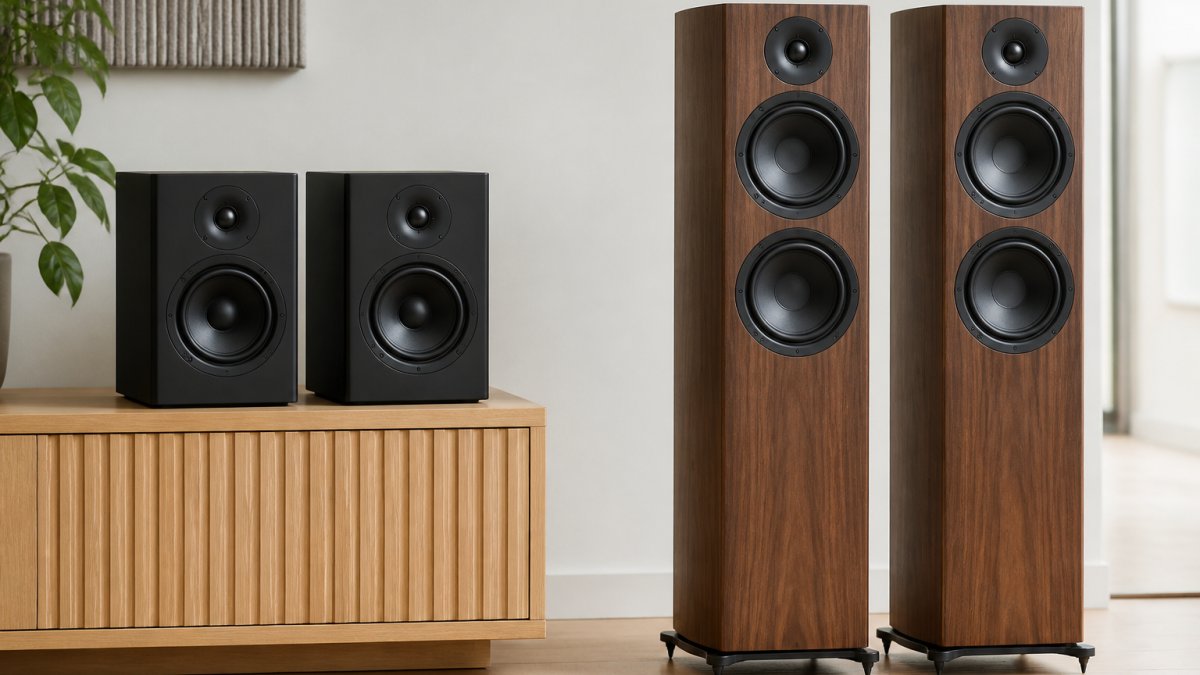
Stereo music is mixed to exploit two-channel space: vocals centre, instruments left and right, reverb for depth. Hi-fi speakers excel at revealing these details.
Using only hi-fi speakers for films means missing this surround dimension: you'll hear front-channel dialogue and action but lose the spatial design.
Can Hi-Fi Speakers Be Used for Movies?
Yes, you can use hi-fi speakers for films. Your fronts handle dialogue and forward-facing action well, but you're ignoring half the soundtrack.
Front-Channel Performance and Dialogue Clarity
Hi-fi speakers typically excel at dialogue, designed for clarity and tonal balance across the midrange where most speech frequencies live. As front left and right channels, they'll sound clear and natural.
The centre channel, handling roughly 60% of a film's soundtrack, is where dedicated home cinema setups shine. Many hi-fi pairs lack a matching centre.
Limitations Without Surround Channels
Without surround speakers, you're missing the spatial dimension of modern film sound. Ambient effects, rain, wind, crowd noise, or a spaceship's hum are mixed into the surrounds.
For television, especially sports and nature documentaries, surrounds add real value.
The practical result: your hi-fi speakers handle the main content, but you're experiencing a reduced version of the intended soundtrack.
Connecting Hi-Fi Speakers to an AV Receiver
To use hi-fi speakers in a home cinema setup, connect them to an AV receiver instead of your stereo amplifier. It's straightforward, but compatibility matters.
Amplifier and Receiver Compatibility
Your hi-fi speakers will work with an AV receiver as long as its front-channel outputs can drive them. Most modern receivers handle 4-8 ohm loads, covering most hi-fi speakers.
One consideration: if your hi-fi speakers are used to a powerful dedicated amplifier, they may sound different through a receiver, which delivers less power per channel.
Wiring and Speaker Level Outputs
Connecting speakers to an AV receiver is the same as to an amplifier: speaker-level cables from the receiver's front-channel outputs to your speakers. No adapters needed.
The receiver handles the rest, processing surround sound from your TV, streaming device, or Blu-ray player and routing it to the right speakers.
Home Cinema Speaker Setup: Expanding Your Stereo Pair
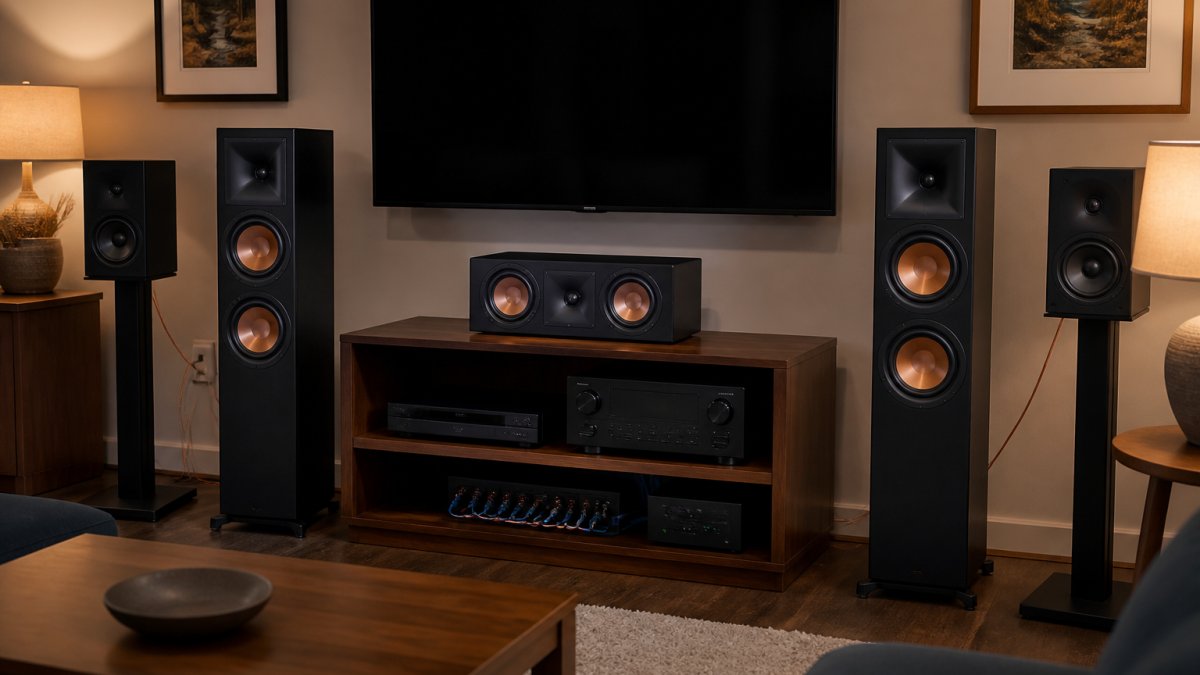
To build a proper hi-fi speakers home cinema system around your existing pair, you're adding three key components: a centre speaker, surround speakers, and typically a subwoofer.
Centre Speaker Role and Dialogue Handling
The centre speaker is critical: it anchors dialogue to the screen so voices stay centred regardless of seating position.
Matching your centre to your hi-fi speakers is essential.
If your hi-fi speakers are discontinued or from a boutique manufacturer, a perfect match may be hard to find.
Surround Speakers and Immersive Sound
Surround speakers sit to the sides or slightly behind the listening position.
Surrounds don't need to match your hi-fi fronts tonally; they serve a different purpose.
Placement affects immersion. Surrounds should be elevated slightly (roughly ear-level or higher when seated) and positioned 90-110 degrees from the listening position.
5.1-Channel Configuration Explained
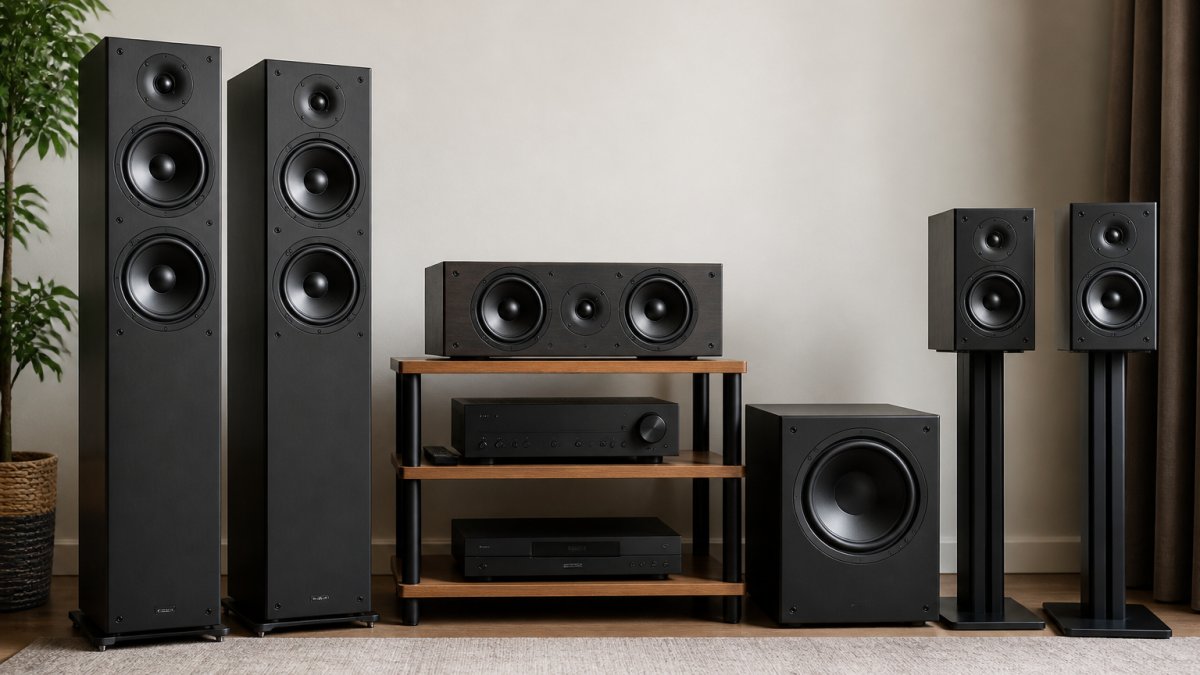
A 5.1 system includes five speakers and one subwoofer:
- Front left and right: Your hi-fi speakers, handling music, dialogue, and forward-facing action
- Centre: Dialogue and centre-screen action
- Surround left and right: Ambient effects and spatial cues
- Subwoofer: Low-frequency effects (explosions, rumbling, deep bass)
The ".1" is the subwoofer, handling frequencies below 80 Hz typically. This frees the other speakers from very low bass so they can focus on clarity and detail in their ranges.
For most rooms, 5.1 is the sweet spot: genuine immersion without the complexity and cost of 7.1 (two more surrounds behind you) or Atmos (height channels for overhead effects).
Matching Speakers for Home Cinema: Tonal Balance and Compatibility
If you're mixing hi-fi speakers with home cinema speakers, tonal matching is critical. A mismatched system sounds disjointed: dialogue shifts in character as it pans, and the soundscape lacks cohesion. Achieving this seamless sonic integration often requires the expertise provided by professional home cinema installation services to ensure every component works in perfect acoustic harmony.
Why Tonal Matching Matters
Imagine warm, smooth hi-fi fronts with midrange richness, paired with a bright, analytical centre.
Matching doesn't mean identical speakers for every channel.
If you're starting fresh with Chiltern Audio's guidance, we recommend a complete speaker package from a single manufacturer.
If you're adapting existing hi-fi speakers, listen to potential centre and surrounds in your space before committing.
Speaker Impedance and System Integration
Speaker impedance (in ohms) affects how much power your receiver must deliver. Most speakers are 4 or 8 ohms.
However, if you're using your existing hi-fi amplifier alongside an AV receiver (hi-fi speakers through the amp, receiver powering surrounds and centre), impedance matching matters more.
Most modern receivers handle mixed impedances without issue.
Using Hi-Fi Speakers With a Subwoofer for Films
Adding a subwoofer transforms both music and film playback. A good subwoofer handles the heavy lifting below 80 Hz, letting your other speakers focus on clarity and detail.
Bass Response and Dynamic Range
Hi-fi speakers often struggle with deep bass, especially smaller standmounts: they may roll off below 60 Hz or need significant amplifier power for convincing low frequencies.
For films, the subwoofer reproduces the low-frequency effects (LFE) in the .1 channel.
For music, a quality subwoofer adds dimension to bass-heavy genres like electronic, hip-hop, and rock, and helps classical music where orchestral instruments' lowest notes need proper reproduction.
Calibration and Crossover Settings
A subwoofer's crossover frequency determines where it takes over from your main speakers. Most AV receivers let you set this per channel. A typical crossover is 80 Hz: speakers handle above, subwoofer below.
Subwoofer placement matters: the same sub sounds boomy in one corner and tight in another. Experiment along the front wall, in corners, and along side walls.
Room Acoustics, Placement, and Calibration
Your room is part of your audio system: hard surfaces reflect sound, soft surfaces absorb it, and dimensions create standing waves that colour bass. Placement and calibration matter as much as speaker choice.
Listening Position and Soundstage
Seating distance affects surround effectiveness: closer (2.4-3 metres) feels more directional, farther (3.6 metres+) spreads the field wider. There's no "correct" distance; it depends on your room and preference.
Soundstage, the sense of width, depth, and height, depends on placement and room acoustics. Speakers too close to walls sound boxy; too far into the room may lack impact.
Common Setup Mistakes and How to Avoid Them
A frequent mistake is placing surrounds too high or too far back, making them sound disconnected from the front soundstage.
Another common error is setting subwoofer volume too high. A subwoofer should enhance, not dominate: you should feel bass more than hear it distinctly.
Dialogue clarity suffers when the centre is too loud or too quiet.
| Setup Element | Best Practice | Why It Matters |
|---|---|---|
| Front speaker placement | 0.3-0.6 metres from side walls, angled toward listening position | Minimises wall reflections, optimises stereo image |
| Centre speaker height | Ear-level or slightly above when seated | Anchors dialogue to screen naturally |
| Surround speaker position | 90-110 degrees from listening position, elevated | Creates immersive spatial field without intrusion |
| Subwoofer placement | Near front wall or corner; experiment for best bass | Room acoustics dramatically affect bass response |
| Listening distance | 2.4-3.6 metres from screen (1.5x screen width) | Affects surround effectiveness and viewing comfort |
Upgrade Paths: When to Keep Your Hi-Fi Speakers and When to Expand
Your decision depends on your speakers, space, and budget. There's no single right answer, but here's how to think about it.
Assessing Your Current System
Ask three questions: Do your hi-fi speakers sound good for music? Is a matching centre speaker available? Are they positioned where a home cinema system would work?
If your speakers are old, discontinued, or from a small manufacturer, matching centre and surrounds are hard to find.
Placement matters too.
Building a Hybrid Stereo and Home Cinema System
A hybrid system uses your hi-fi speakers for music and the front channels of home cinema, adding centre, surround, and subwoofer speakers for films and television.
This works well if your hi-fi speakers are high-quality, positioned for both music and film, and have a matching centre available.
At Chiltern Audio, we help customers build exactly these hybrid systems.
Using hi-fi speakers for home cinema is entirely practical, and for many listeners it's the ideal path forward.
Frequently Asked Questions
Can you use hi-fi speakers for home cinema?
Yes, hi-fi speakers can work as the front channels in a home cinema system. A quality stereo pair will handle dialogue, music, and front-channel effects well. However, hi-fi speakers alone will not deliver surround sound or the immersive multichannel experience that home cinema requires. To get full home cinema capability, you'll need to add a centre speaker for dialogue clarity, surround speakers for ambient effects, and an AV receiver that supports multichannel audio formats like Dolby Digital and DTS.
Do home cinema speakers need to match?
Matching speakers for home cinema is essential for consistent sound quality across your system. Your front left, centre, and right speakers should have similar tonal characteristics so dialogue and sound effects blend smoothly as they pan across the screen. Surround speakers can be different models, though maintaining the same brand or series helps. Mismatched speakers create audible gaps in the soundstage and can make dialogue sound disconnected from the action. When expanding an existing hi-fi system, choose a centre speaker and surrounds from the same manufacturer or series as your front speakers.
How do you connect hi-fi speakers to an AV receiver?
Hi-fi speakers connect to an AV receiver using speaker cables plugged into the receiver's speaker terminals. If your hi-fi speakers were originally connected to a stereo amplifier, you'll need to disconnect them from that amp first. The AV receiver provides pre-amplified signals to power the speakers directly. Ensure the speaker impedance (usually 4, 6, or 8 ohms) matches or exceeds what the receiver can handle. Check your receiver's manual for the correct terminal connections and polarity. If you want to keep using your original stereo amplifier alongside the AV receiver, some receivers offer home-theatre bypass mode, which lets the amp handle the front channels while the receiver manages surrounds and subwoofer.
Can you use a subwoofer with hi-fi speakers for films?
Absolutely. Adding a subwoofer to hi-fi speakers significantly improves home cinema performance by handling low-frequency effects (explosions, thunder, rumbling) that stereo speakers struggle to reproduce. A subwoofer also reduces strain on your main speakers, allowing them to focus on midrange and dialogue clarity. Set the subwoofer's crossover frequency (typically 80-120 Hz) so it blends smoothly with your speakers' bass response. Calibration is critical: adjust the subwoofer's level and phase so it doesn't boom or create dead zones in your listening area. Many AV receivers include automatic calibration microphones that measure subwoofer integration and adjust settings for you.
What's the difference between stereo and surround sound?
Stereo uses two channels (left and right) to create a soundstage between the speakers. Surround sound adds additional channels: a centre speaker for dialogue, side or rear surrounds for ambient effects, and a subwoofer for bass. A 5.1-channel system (five speakers plus subwoofer) is the standard for home cinema. Stereo is ideal for music, where the soundstage depth and instrument separation matter most. Surround sound is designed for films and television, where sound effects need to move around the room and immerse the listener. Hi-fi speakers excel at stereo playback; achieving full surround sound requires expanding the system with compatible additional speakers and an AV receiver.