 comparison
Bookshelf vs Floorstanding Speakers for Music: 2026 Guide
Table of Contents
- Bookshelf vs Floorstanding Speakers for Music: The Quick Comparison
- How Room Size and Listening Room Dimensions Decide It
- Bass Response, Low-Frequency Extension and Cabinet Volume
- Do Bookshelf Speakers Need a Subwoofer?
- Speaker Positioning for Optimal Soundstage and Imaging
- Hifi Speaker Stand Height Guide: Getting Tweeter Height Right
- Cost, Floor Space and Living With Each Type
- Conclusion: Choosing Between Bookshelf and Floorstanding Speakers
- Frequently Asked Questions
Last Updated: October 4, 2026
Bookshelf vs Floorstanding Speakers for Music: The Quick Comparison
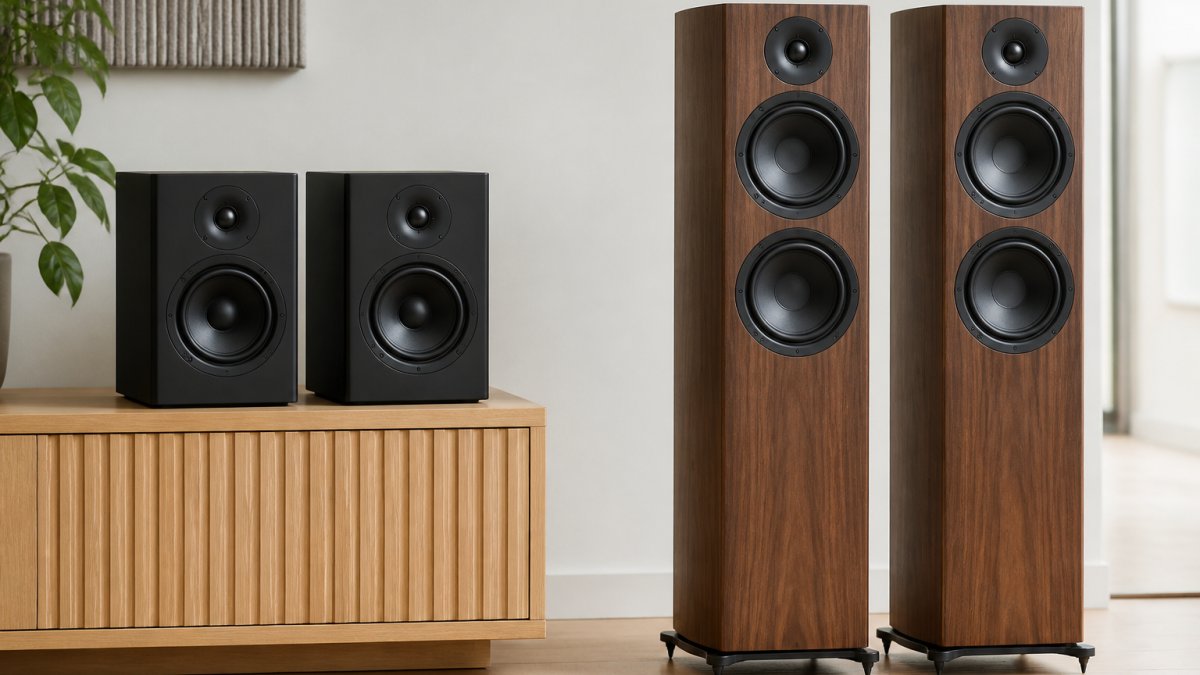
Choosing between bookshelf vs floorstanding speakers for music comes down to one honest question: how much low-frequency output does your room actually support? Bookshelf speakers win on imaging precision and flexibility. Floorstanders win on bass weight and scale. Everything else is a trade-off you can live with.
We run demonstrations with both types in the same room, and the pattern is consistent. Smaller rooms reward compact standmounts. Larger rooms make towers sing. This guide breaks down exactly where each design wins, so you can stop guessing and start listening.
Here's the short version:
- Bookshelf speakers deliver sharper soundstage and imaging, suit small to medium rooms, and need stands for proper tweeter height.
- Floorstanding speakers move more air, extend lower, and skip the stand cost, but demand floor space and careful placement.
| Factor | Bookshelf Speakers | Floorstanding Speakers |
|---|---|---|
| Bass extension | Moderate, needs a subwoofer for deep bass | Deep, full-range without a sub |
| Soundstage and imaging | Precise, focused | Wide, room-filling |
| Floor space | Minimal cabinet, stands required | Larger footprint, no stands |
| Cost structure | Lower cabinet cost, plus stands | Higher cabinet cost, all-in |
| Best room size | Small to medium | Medium to large |
How Room Size and Listening Room Dimensions Decide It
Room size decides more than budget does. A floorstander in a boxy 3m x 3m room will boom. A bookshelf speaker in a 6m x 5m open-plan space will sound thin.
The physics is straightforward. Low frequencies need distance to develop. In a small room, room modes pile up and exaggerate certain bass notes. A compact standmount with a controlled low-frequency roll-off avoids that fight entirely.
For most listeners in a typical spare bedroom or study, bookshelf speakers on stands give better balance than towers. In a dedicated listening room with proper acoustic treatment, floorstanders have the headroom to breathe.
If you're unsure, measure your listening room dimensions first. Distance from the front wall, side walls and your listening position matters more than the total square metres.
Bass Response, Low-Frequency Extension and Cabinet Volume
Cabinet volume is the single biggest physical difference between the two designs, and it drives almost everything else you'll hear. A floorstander's tall cabinet holds more air, which lets the bass driver produce deeper low-frequency extension without the cone having to work as hard.
The trade-off is governed by a principle most guides skip: Hoffman's Iron Law. You can have low bass extension, high sensitivity, or a small cabinet, pick two. A compact speaker that claims deep bass is almost always sacrificing sensitivity or efficiency to get there. That's why a small standmount rated to 45Hz often needs more amplifier grunt than its spec sheet suggests.
Bookshelf speakers trade cabinet volume for tighter, faster bass. The smaller enclosure means less bass weight, but also less internal standing-wave resonance to manage, which is why compact speakers often sound more agile on acoustic and vocal music.
Sensitivity and impedance matter here too. Many standmounts run at 86-88dB sensitivity with a nominal 8-ohm impedance, which most integrated amplifiers drive comfortably. Floorstanders with multiple drivers can dip to 4 ohms or lower at certain frequencies, so check your amplifier's power into 4 ohms before buying, not just its 8-ohm rating.
Here's what most guides miss: it isn't about which speaker goes lower. It's about whether your room and amplifier can control what the speaker produces. Room gain, the natural boost a room adds to low frequencies below roughly 200Hz, means a speaker with modest extension can sound fuller in a small room than a deeper speaker does in a large one.
A practical way to judge this before you buy: listen to the same bass-heavy track on both designs in a room close to your own. If the floorstander's low end feels bloated or one-note, the room is the problem, not the speaker, and a standmount plus a properly integrated subwoofer will usually beat it.
Do Bookshelf Speakers Need a Subwoofer?
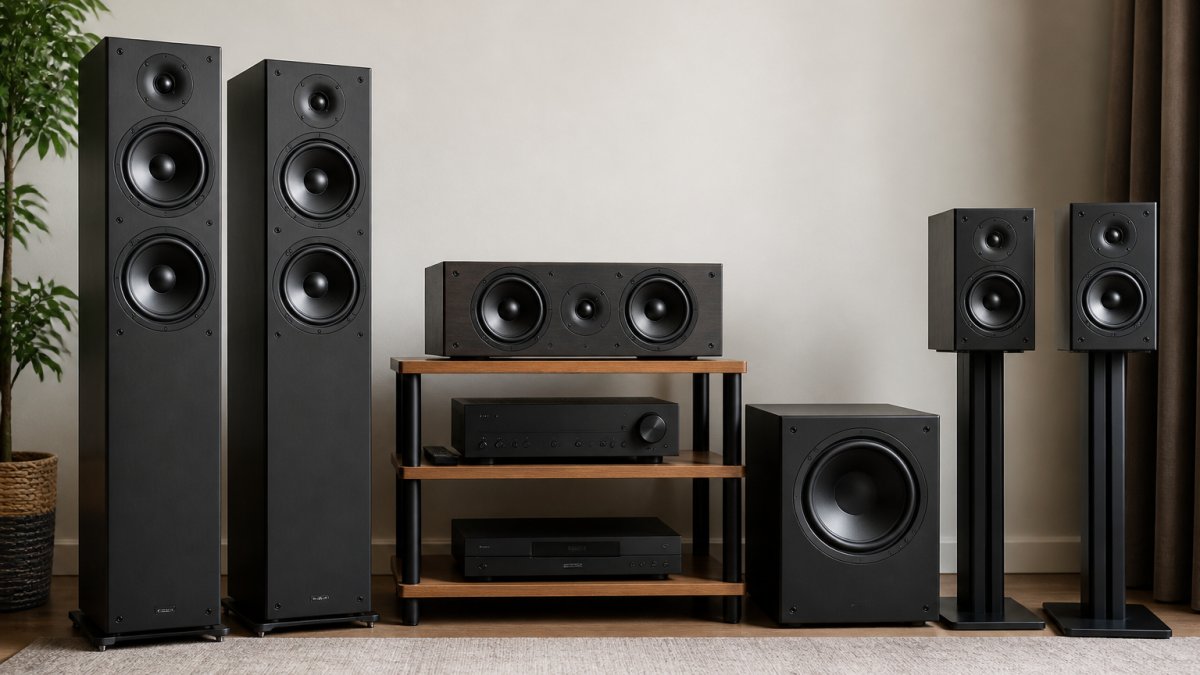
Bookshelf speakers do not always need a subwoofer, but they benefit from one if you listen to bass-heavy music or want full-range output at low volumes. A 2.1 system with compact speakers and a well-integrated subwoofer often beats a floorstander at the same total budget.
Subwoofer integration is the tricky part. You need to set the crossover correctly, usually between 60Hz and 80Hz, and place the sub where it doesn't fight your room modes. Get it right and you have the best of both worlds: precise imaging plus genuine low-frequency extension.
Get it wrong and you'll hear a gap between the speakers and the sub. That's the most common complaint we hear from people who added a sub without measuring.
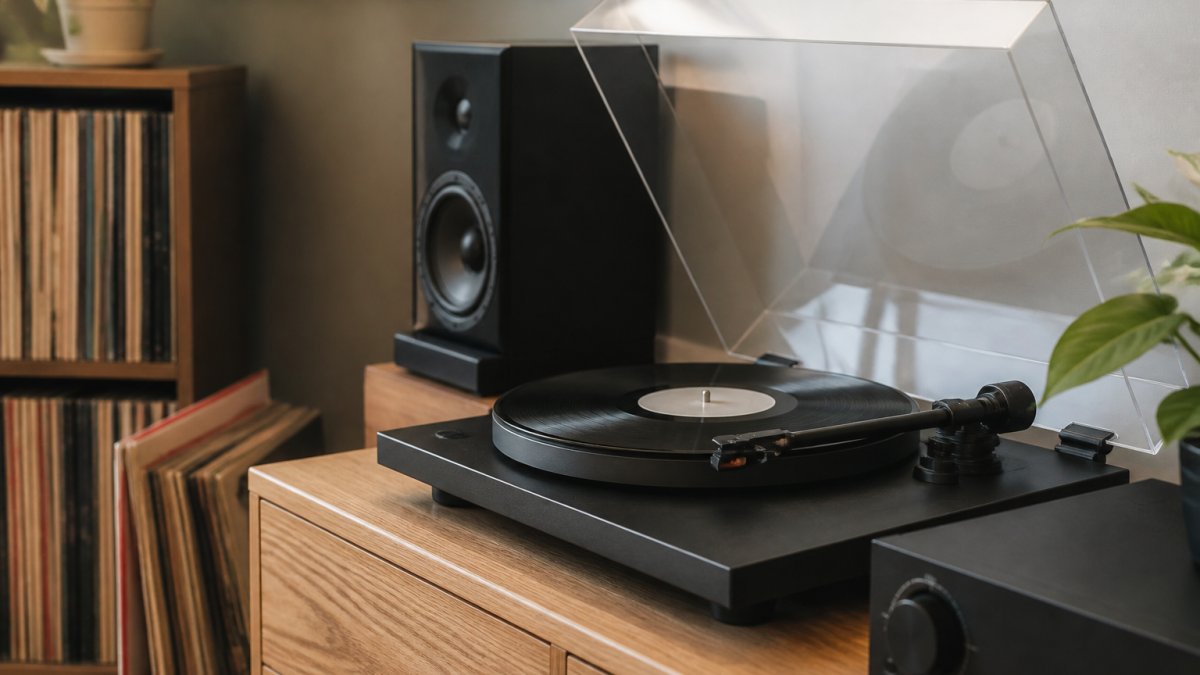
For vinyl collectors especially, a subwoofer adds weight to kick drums and bass guitar without sacrificing the mid-range clarity that makes analogue sound so engaging.
Speaker Positioning for Optimal Soundstage and Imaging
Speaker positioning for optimal soundstage and imaging follows one rule: form an equilateral triangle between the two speakers and your listening position. Get that right and everything else falls into place.
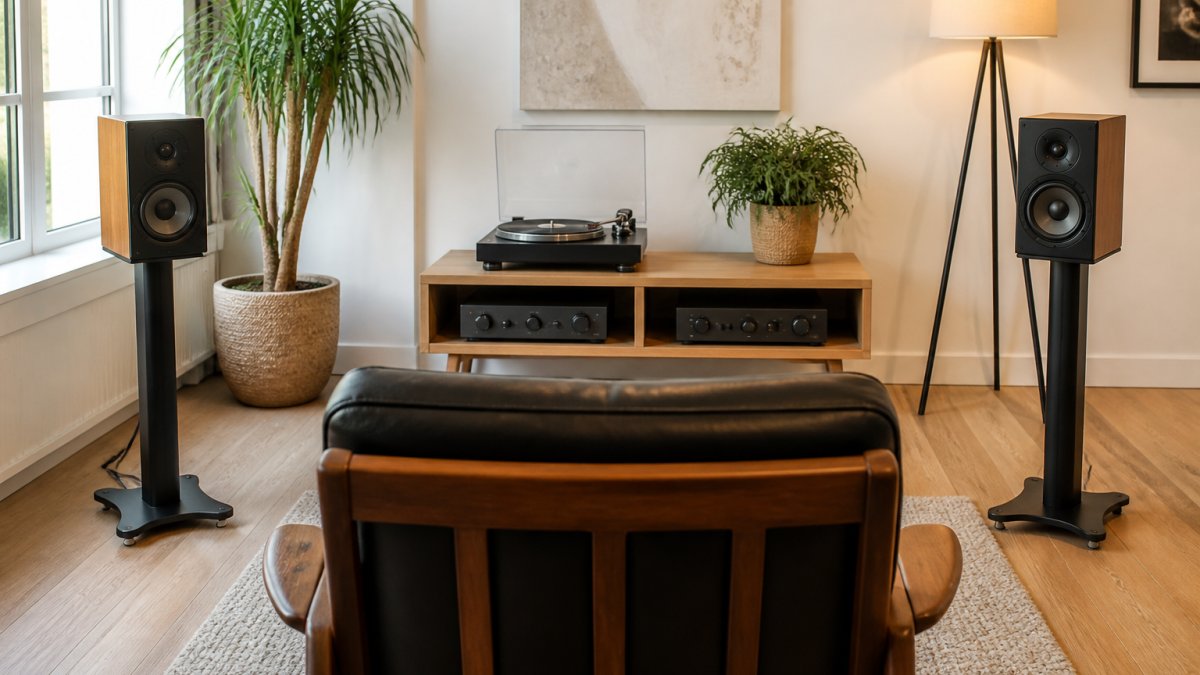
Stereo separation improves when you angle the speakers inward, roughly 5 to 10 degrees. This focuses the tweeter output toward your ears and sharpens the centre image. Too much toe-in and the soundstage collapses. Too little and instruments smear.
Floorstanders need more breathing room. Keep them at least 30cm from the rear wall and 50cm from side walls if you can. Bookshelf speakers are more forgiving, but they still benefit from a little space behind them, especially rear-ported designs.
Listening position matters as much as speaker placement. Sit at least 2m back from standmounts so the drivers integrate properly. Closer than that and you'll hear each driver separately rather than as one coherent sound.
Hifi Speaker Stand Height Guide: Getting Tweeter Height Right
Hifi speaker stand height should place the tweeter at ear level when you're seated. For most people, that's 60cm to 70cm from the floor, which is why dedicated stands in that range exist.
Tweeter height directly affects high-frequency response and mid-range clarity. Sit too low and the treble passes over your head. Sit too high and you lose the sweet spot entirely.
A quick test: play a track with clear vocals, sit in your usual spot, and check whether the singer's voice feels centred and natural. If it sounds bright or dull, adjust the stand height or tilt.
Decoupling and vibration isolation matter here. A good stand separates the speaker from the floor, reducing resonance that muddies the bass. Bluetack or isolation pads under the speaker help too.
Cost, Floor Space and Living With Each Type
This is where the bookshelf-versus-floorstander decision is usually won or lost, and it's the section most comparisons rush.
Here's the honest cost structure. A standmount needs a pair of dedicated stands, which range from budget metal-and-glass designs up to mass-loaded, sand-fillable stands that genuinely improve rigidity and bass control. Add a subwoofer if you want full-range output, plus an extra interconnect and a power socket near the listening position.
| Cost element | Bookshelf system | Floorstanding system |
|---|---|---|
| Cabinet pair | Lower | Higher |
| Stands | Required, extra | Not required |
| Subwoofer | Often needed for deep bass | Usually unnecessary |
| Extra cabling | Sub interconnect, power | None |
| Floor space | Similar footprint once stands are counted | Larger permanent footprint |
| Upgrade path | Flexible, add or upgrade sub later | Fixed, bass is built in |
The floor-space point is subtler than it looks. A standmount on a stand occupies roughly the same footprint as a slim tower, so the real difference is visual mass, not square metres. Towers read as furniture; stands read as equipment.
That's the partner-acceptance question, and it's real. Partners generally accept compact speakers on tidy stands more readily than tall towers, especially in rooms that double as living spaces. A standmount plus a discreet subwoofer can be positioned and hidden far more easily than a pair of towers that dominate the wall.
Aesthetic and interior design impact shouldn't be dismissed either. Speakers you enjoy looking at get used more, and a system that fits the room gets listened to instead of apologised for.
Then there's listening fatigue, which almost no comparison addresses. Floorstanders with strong, uncontrolled bass can be tiring over long sessions in untreated rooms, the low end keeps demanding attention. Compact speakers with a controlled low-frequency roll-off often stay comfortable for hours, which matters if you listen while working or through long evening sessions.
Here are the real pros and cons:
Bookshelf speakers:
- Pros: precise imaging, flexible placement, easier to integrate into small rooms, upgradeable with a sub, visually lighter
- Cons: need stands, limited bass on their own, less scale on large orchestral works, extra cabling and setup
Floorstanding speakers:
- Pros: full-range bass, no stands needed, room-filling scale, often higher sensitivity, simpler system
- Cons: larger visual footprint, more demanding on room acoustics, higher entry cost, harder to reposition
If you want to hear the difference for yourself, our team runs real-world demonstrations so you can compare both designs in a proper listening environment rather than guessing from spec sheets.
Conclusion: Choosing Between Bookshelf and Floorstanding Speakers
The hardest part isn't picking a type. It's matching that choice to your room, your amplifier and how you actually listen. Get that wrong and even great speakers disappoint.
That's where we come in. Chiltern Audio offers bespoke system building, expert matching of audio components for a balanced setup, and real-world hifi demonstrations so you can hear the difference before you commit. We also handle Rega turntable guidance and record cleaning if you're building an analogue system around your new speakers.
Shop Now and let us help you build a setup that actually works in your room.
Frequently Asked Questions
Are floorstanding speakers always better than bookshelf speakers for music?
No. Floorstanding models usually reach lower and move more air, which suits larger rooms and bass-heavy genres. But a well-built standmount such as the KEF LS50 Meta can beat a budget tower on imaging, mid-range clarity and transient response. In rooms under roughly 15 square metres, a good pair of bookshelf speakers on proper stands often sounds more controlled than a floorstander whose bass excites room modes.
Do bookshelf speakers need a subwoofer for a full-range sound?
Most standmounts roll off somewhere between 45Hz and 60Hz, so they miss the bottom octave that floorstanders cover. If you listen to orchestral, electronic or bass-driven rock, adding a subwoofer fills that gap and lets the main drivers work less hard. For acoustic, vocal and jazz material in a small room, a decent standmount alone can sound complete. Match the sub carefully and set the crossover just above the speaker's natural roll-off.
What is the 83% rule for speakers?
It is a rough stereo setup guideline rather than a formal standard. It says the distance between the two speakers should be about 83% of the distance from each speaker to your listening position. In practice, if you sit 3 metres back, start with the speakers around 2.5 metres apart and adjust from there. It is a starting point for stereo separation, not a fixed rule, and small rooms often need a narrower triangle.
How does room size influence the choice between bookshelf and floorstanding speakers?
Smaller rooms, roughly under 15 square metres, usually favour bookshelf speakers because a large cabinet's bass output excites room modes and muddies the low end. Rooms above 25 square metres often need floorstanders simply to reach a comfortable sound pressure level without straining the amplifier. Between those sizes, either can work, and acoustic treatment plus careful listening position will matter more than the speaker type itself.
Do bookshelf speakers require dedicated stands for optimal sound?
Yes, in most cases. Placing a standmount on a shelf or sideboard couples it to furniture, which adds colouration and blurs imaging. A rigid stand of the right height puts the tweeter near ear level when you are seated, and decoupling the cabinet from the floor reduces vibration transfer. Expect stands to cost a meaningful fraction of the speaker price, so budget for them from the start rather than treating them as an afterthought.