 how-to
How to Match Speakers and Amplifiers: 2026 Guide
Table of Contents
- What You'll Need Before You Match Speakers and Amplifiers
- Speaker Impedance Explained: Ohms and Nominal Ratings
- Speaker Sensitivity and Amplifier Matching: Decibels and Headroom
- Amplifier Power Handling vs Speaker Wattage: RMS, Peak and Clipping
- Step-by-Step: How to Match Speakers and Amplifiers Safely
- Damping Factor and Active vs Passive Matching
- Common Mistakes When You Match Speakers to Amplifiers
- Frequently Asked Questions
Last Updated: September 17, 2026
What You'll Need Before You Match Speakers and Amplifiers
Matching speakers and amplifiers comes down to three numbers: impedance in ohms, power output in watts, and sensitivity in decibels. Get them right and everything falls into place; get them wrong and you risk weak sound at best, a blown tweeter at worst.
This guide from Chiltern Audio walks you through the process, from spec sheet to wiring. Have these to hand:
- Your amplifier's spec sheet (power output, impedance range, damping factor)
- Your speakers' spec sheet (nominal impedance, sensitivity, power handling)
- A calculator or phone for quick sums
- The amplifier's manual, which lists its safe impedance range
Most first-time buyers skip straight to wattage and ignore the rest, the single biggest mistake in system matching.
Reading the Spec Sheet: What Actually Matters
Four specs decide whether your system works:
- Nominal impedance (ohms): the average electrical load the speaker presents
- Sensitivity (dB): how loud the speaker plays per watt of input
- Power handling (watts): how much the speaker can take before distorting
- Amplifier output (watts per channel): how much clean power the amp delivers
Ignore peak music power claims. They tell you nothing useful about real-world performance.
Speaker Impedance Explained: Ohms and Nominal Ratings
Speaker impedance explained in one line: it's the electrical load your speaker places on the amplifier, measured in ohms, and it changes constantly as the music plays.
The nominal impedance is a rounded average. A speaker sold as 8 ohms might swing between 5 and 30 ohms depending on frequency, so the nominal figure alone tells you little about how hard it is to drive. Lower impedance means more current for a given voltage, more heat and strain on the power supply. A 4-ohm speaker is harder to drive than an 8-ohm one, all else being equal.
- 8 ohms: easy load, most amplifiers handle it
- 6 ohms: moderate load, check your amp's rating
- 4 ohms: demanding load, needs a capable amplifier
- 2 ohms: very demanding, only for amps built for it
Why Real-World Impedance Curves Drop Below Nominal
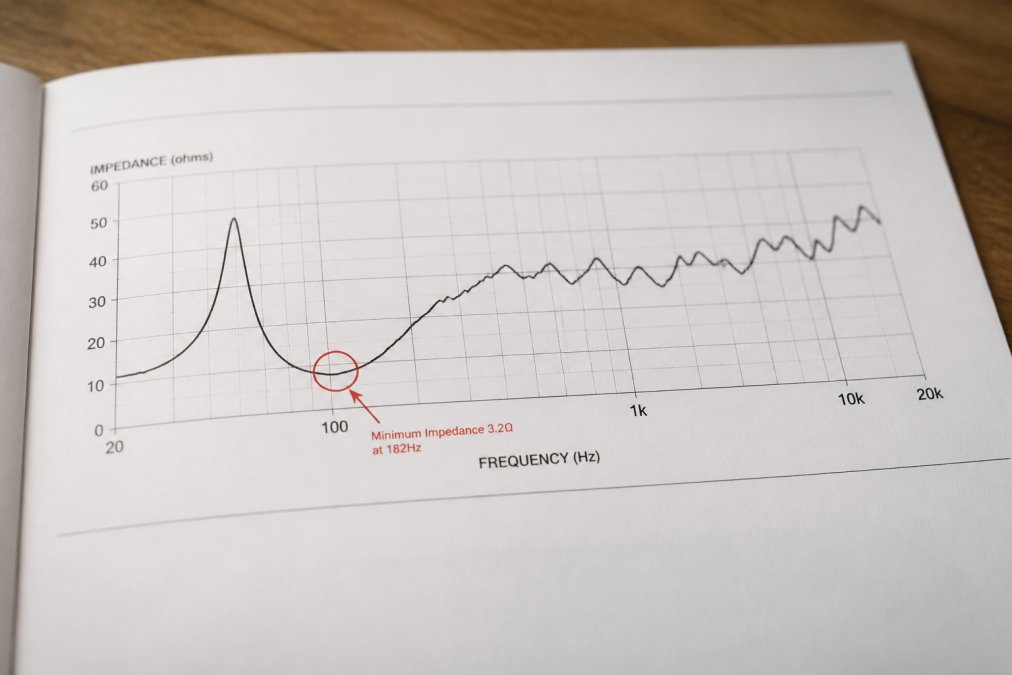
A speaker's impedance curve shows how the load changes across the frequency range, where most systems fail. Two features matter:
- The bass resonance peak. Every driver has a free-air resonance, usually somewhere in the 40-80 Hz region for a typical bookshelf woofer. At that frequency the impedance rises sharply, often to 20-40 ohms. That's the easy part of the load.
- The dip above resonance. Just above the resonance peak, impedance falls to its lowest point, frequently to 4 ohms or below on a speaker sold as 8 ohms nominal. This is the region where the amplifier must deliver the most current, and it usually coincides with bass-heavy programme material.
A speaker rated at 8 ohms nominal might dip to 4 ohms at 150 Hz, where the amplifier works hardest. If your amp can't deliver current then, you get strained, thin sound and, in the worst case, clipping into a load it can't sustain.
Manufacturers publish these curves in the manual or online. Check them if your amplifier is modest or your speakers demanding: a curve that stays above 6 ohms across the audible band is an easy partner for almost any amp.
Phase Angle: The Spec Nobody Prints
Impedance magnitude is only half the story. The other half is phase angle, the timing relationship between voltage and current in the load. When impedance dips low and phase angle swings far from zero at the same frequency, the amplifier must deliver current out of step with voltage, the genuinely punishing condition.
A speaker that dips to 4 ohms with a benign phase angle is far easier to drive than one that dips to 4 ohms with a 60-degree phase swing.
How to Read an Impedance Curve in Practice
You don't need measurement equipment, most manufacturers publish a graph in the manual or product page. Look for:
- The lowest point on the curve. If it sits below your amp's minimum rating, stop.
- The frequency where that dip occurs. A dip in the 100-300 Hz region is the most common and the most demanding, because that's where musical energy is concentrated.
- How wide the dip is. A narrow notch is survivable; a broad, shallow valley across two octaves is not.
Speaker Sensitivity and Amplifier Matching: Decibels and Headroom
Speaker sensitivity and amplifier matching hinge on one figure: the decibel rating, usually written as dB/W/m.
- 85 dB or below: needs a powerful amp, often 100W+
- 86-89 dB: average, works with most mid-range amps
- 90 dB or above: easy to drive, small amps work fine
Amplifier Power Handling vs Speaker Wattage: RMS, Peak and Clipping
Amplifier power handling vs speaker wattage confuses most people, so let's separate the terms.
The 83% Rule and Why It Matters
The 83% rule is a rough guideline: aim for an amplifier rated at roughly 83% of your speakers' RMS power handling as a minimum, then add headroom.
Step-by-Step: How to Match Speakers and Amplifiers Safely
Here's the practical process, in order:
- Check your amplifier's minimum impedance. Find it in the manual, usually 4 or 8 ohms.
- Note your speakers' nominal impedance. It must sit at or above the amp's minimum.
- Compare sensitivity to amplifier power. Low sensitivity needs more watts.
- Match RMS power handling to amplifier output. Use the 83% rule as a floor.
- Confirm the amp has enough headroom. Extra watts prevent clipping.
- Wire the speakers correctly. Keep positive and negative terminals consistent.
- Test at low volume first. Listen for distortion or cutouts before pushing harder.
If your amplifier offers bridging or parallel wiring, check the manual first, bridging can double the load and overheat amps not built for it.
Damping Factor and Active vs Passive Matching
Damping factor measures how well an amplifier controls speaker cone movement: the speaker's nominal impedance divided by the amplifier's output impedance. An amp with 0.1 ohms output impedance driving an 8-ohm speaker has a damping factor of 80.
Output Impedance and Why It Changes the Sound
Output impedance is the underlying electrical property; damping factor just expresses it. A low output impedance means the amplifier holds its output voltage steady regardless of what the speaker demands, what you want.
Active vs Passive Matching: The Distinction That Changes Everything
Active vs passive matching is the angle most guides gloss over.
The practical consequences:
- Passive: you choose the amp, more flexibility, more matching work, and the crossover's impedance is part of what your amp has to drive.
- Active: amp and speaker are pre-matched, less guesswork, less upgrade room, and the amplifier never sees the crossover's reactive load.
| Approach | Matching Effort | Flexibility | Crossover Position | Best For |
|---|---|---|---|---|
| Passive | High, you pair amp and speaker | Full choice of components | After the amplifier | Enthusiasts building a system |
| Active | Low, pre-matched | Limited | Before the amplifiers | Simple, reliable setups |
What This Means for Your Matching Decision
If you're building a passive system, damping factor and output impedance belong on your checklist alongside impedance and power. Ask for the amplifier's output impedance, or its damping factor into 8 ohms, and compare it against your speakers' impedance curve.
Common Mistakes When You Match Speakers to Amplifiers
The same errors show up again and again:
- Ignoring the impedance minimum and pairing a 4-ohm speaker with an 8-ohm-only amp
- Chasing peak power numbers instead of RMS
- Buying a low-power amp for low-sensitivity speakers
- Mixing up series and parallel wiring, which changes the load
- Forgetting that room size affects how much power you actually need
A well-matched 50W system beats a badly matched 200W one every time.
Frequently Asked Questions
What is the 83% rule for speakers?
The 83% rule is a practical guideline for matching amplifier power to speaker power handling. It suggests choosing an amplifier whose RMS output is around 83% of the speaker's RMS wattage rating. For example, a speaker rated at 100W RMS pairs well with an amplifier delivering roughly 83W per channel. This leaves enough headroom to avoid clipping while staying within the speaker's safe operating range.
Does speaker impedance matter when choosing an amplifier?
Yes. Speaker impedance, measured in ohms, determines how much current the amplifier must deliver. A 4-ohm speaker draws roughly twice the current of an 8-ohm speaker at the same voltage. Check that your amplifier is rated for the nominal impedance of your speakers. If it is only rated for 8 ohms, connecting 4-ohm speakers can trigger thermal protection or cause distortion.
Can I use 100 watt speakers with a 150 watt amp?
You can, but you need to be careful with the volume control. A 150W amplifier driving 100W speakers gives you plenty of headroom, which reduces clipping. However, if you turn the volume up too far, the amplifier can deliver more power than the speakers can handle, risking damage to the drivers. Keep listening levels sensible and watch for distortion.
What is speaker sensitivity and why does it matter for amplifier power?
Speaker sensitivity measures how loud a speaker plays with one watt of power at one metre, expressed in decibels. A speaker rated at 90dB is far easier to drive than one rated at 84dB. For every 3dB difference in sensitivity, you need double the amplifier power to reach the same volume. High-sensitivity speakers work well with low-power amplifiers, while low-sensitivity models need more wattage.