 how-to
7 Steps to Set Up Bookshelf Speakers in a Small Flat
Quick Summary
To set up bookshelf speakers in a small flat, first pick your listening position, then place both speakers the same distance from the side walls, about 1.5 to 2 metres apart. Keep each speaker 10 to 20 centimetres from the wall behind it and angle both toward your seat.
- Choose your listening position first, and avoid sitting directly beside a wall or in a corner.
- Keep the back of each speaker at least 10 to 20 centimetres from the wall.
- Set the tweeter at roughly ear height, between 60 cm and 75 cm from the floor when seated.
- Mirror placement on both sides so the stereo image does not shift.
- Decouple speakers with isolation pads to reduce bass transmission to neighbours.
Table of Contents
- Why Small Flats Make Bookshelf Speaker Setup Harder
- Step 1: Choose Your Listening Position First
- Step 2: Decide Where Your Speakers Go and How Far Apart They Should Be
- Step 3: Position Your Bookshelf Speakers Near a Wall or in a Corner Without Losing Balance
- Step 4: Pick the Right Stands or Stable Elevation When You Have No Floor Space
- Step 5: Angle, Level and Fine-Tune the Sound
- Step 6: Tame Bass Boom and Keep Noise Neighbour-Friendly
- Booking a Setup Check With Chiltern Audio
- Frequently Asked Questions
Last Updated: October 31, 2026
Setting up bookshelf speakers in a small flat is harder than most guides admit. There is less room to move them about, less space for stands, and neighbours who can hear every bass note through the wall. Compact setups tend to run into the same problems again and again. The good news is that a small room rewards careful placement more than a large one does. Work through the steps below in order and you can get a balanced, clear sound, often without buying new gear. If you are still choosing a compact speaker for a small room, see which models suit tight spaces before you position them.
Why Small Flats Make Bookshelf Speaker Setup Harder
Small rooms reflect sound more strongly than large ones. Bass builds up quickly, and a speaker placed too close to a wall can sound boomy and muddy. Walls, furniture and even the sofa all change how the sound reaches your ears. Here is what usually goes wrong in a small flat:
- Speakers pushed against the back wall, causing heavy bass boom
- Left and right speakers placed at different distances, blurring the stereo image
- Speakers sitting on a sideboard at the wrong height
- Cables stretched tight across the floor or pulled from a socket
The fix is not more equipment. It is a few deliberate choices about where things go.
Step 1: Choose Your Listening Position First
Decide where you will sit before you touch a speaker. Your sofa or favourite chair is your listening position, and everything else is built around it. Sit where you normally listen and make sure you can see the space in front of you clearly.
Think about the room, not just the furniture. In a small flat, the sofa often sits against a wall, which is fine. Avoid sitting directly beside a wall or in a corner, because the sound will pile up there. A spot a short distance out from the wall usually gives the cleanest result.
Watch out: Do not choose the listening position by where the TV or the nicest-looking wall happens to be. Pick it for sound first, then arrange the furniture to suit.
Step 2: Decide Where Your Speakers Go and How Far Apart They Should Be
Your two speakers should form a triangle with your listening position, with the speakers and your head at roughly the same distance from each other. A good starting point is to place the speakers about 1.5 to 2 metres apart and sit about the same distance back from them. Measure with a tape measure rather than guessing, because small differences matter. For a deeper guide on positioning speakers for the best soundstage, read how to position HiFi speakers.
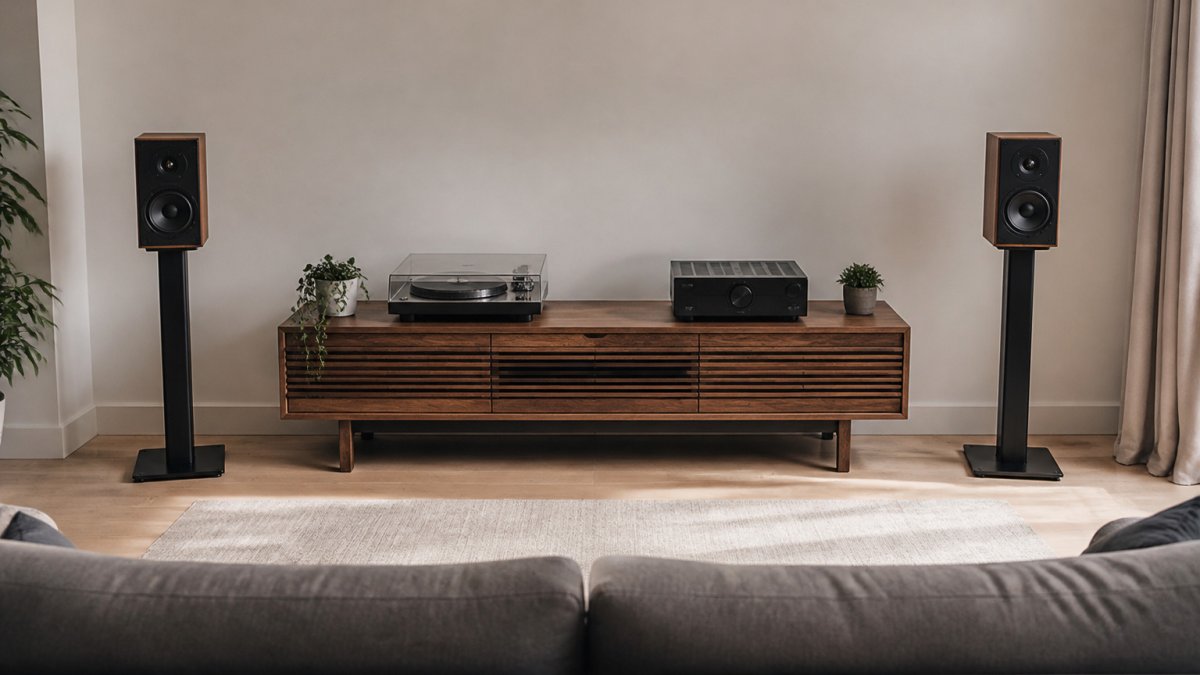
Keep both speakers the same distance from the side walls. If the left speaker is 40 centimetres from the wall and the right is 80 centimetres, the stereo image will shift toward the left. Mirror the placement on both sides.
If the room is tight, the speakers can sit a little closer together. You can adjust the spacing later once you hear the result.
Step 3: Position Your Bookshelf Speakers Near a Wall or in a Corner Without Losing Balance
Bookshelf speakers need some breathing room from the wall behind them. As a rule, keep the back of each speaker at least 10 to 20 centimetres from the wall. Being right against the wall boosts bass, which is useful for a sub-woofer but overwhelms small bookshelf speakers.
Corners are the trickiest spot. They amplify bass even more than a flat wall. If you must place a speaker in a corner, pull it out a little from the walls and listen for boom. If the bass sounds heavy, move it forward.
Above all, keep both speakers in matching positions. A speaker tucked into a corner while its partner sits in open space will throw the balance off. Symmetry beats perfection here.
Step 4: Pick the Right Stands or Stable Elevation When You Have No Floor Space
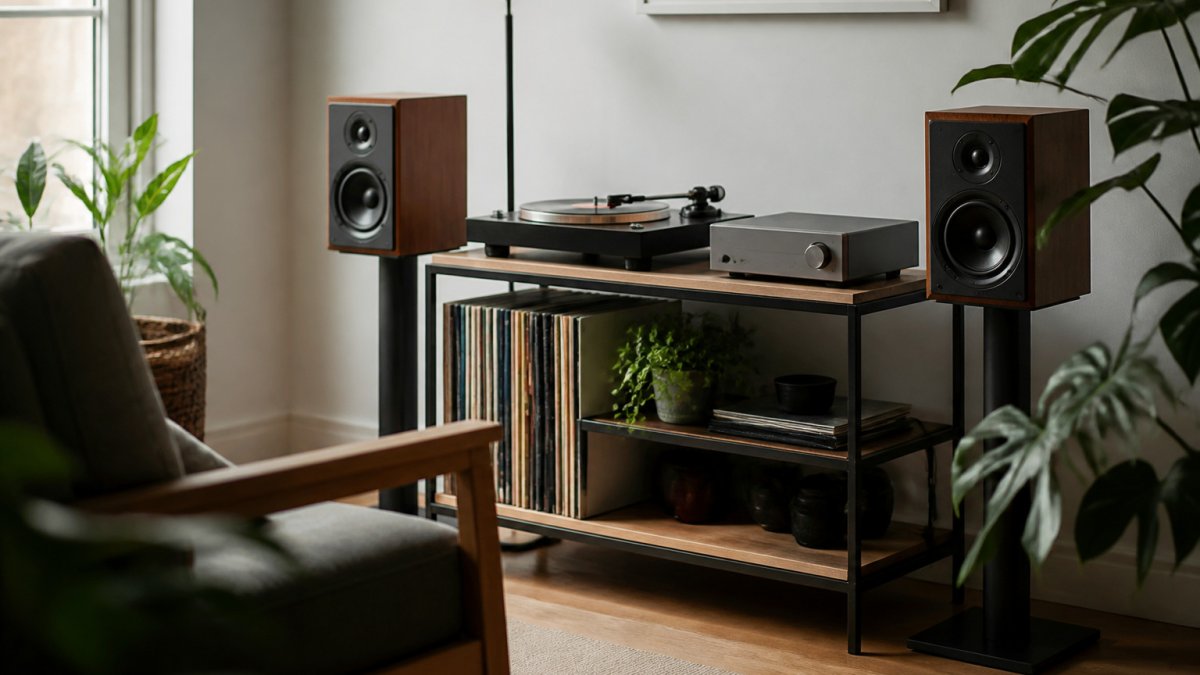
Bookshelf speakers sound their best when the tweeter, the small high-frequency driver, sits at roughly ear height when you are seated.
Floor stands (if you can spare the footprint). A pair of slim stands with a narrow base can place the tweeter at the right height with minimal fuss. Mass-load the stands if the manufacturer provides a cavity, kiln-dried sand or proprietary filler reduces wobble and tightens bass.
Wall shelves and brackets. A fixed shelf or a dedicated speaker bracket frees the floor entirely and lets you set the height precisely.
Desktop isolation pads and angled foam. If the speakers sit on a desk either side of a monitor, purpose-made isolation pads or angled foam wedges decouple the cabinet from the surface and tilt it toward your ears.
Sturdy furniture at the right height. A low sideboard, a solid bookcase or a media unit can work if the top surface puts the tweeter near ear height and does not flex.
What to avoid. Do not sit speakers directly on the floor, on top of a tall wardrobe, or on a shelf above head height, all three break the ear-height rule and make the stereo image collapse. Do not stack them on books or cushions as a permanent fix; it is unstable and the soft material absorbs detail.
Whatever you use, stability comes first. A wobbly base spoils the sound and is a genuine hazard around children and pets, so check fixings and surfaces before you settle on a position.
The table below summarises the four height and placement options covered in this section, along with their main trade-off.
| Option | Best for | Key trade-off |
|---|---|---|
| Floor stands | Tweeter at correct height | Uses floor space; tip hazard |
| Wall shelves and brackets | Freeing the floor entirely | Closer to wall boosts bass; check tenancy |
| Desktop isolation pads | Renter-friendly desk setups | Rarely gives a full listening triangle |
| Sturdy furniture | Using existing units | Must not flex; avoid glass and hollow units |
Step 5: Angle, Level and Fine-Tune the Sound
Once the speakers are in position, angle them toward your listening spot. This is often called toe-in. Turn each speaker slightly so that its front faces you directly. A small turn of a few degrees can make a big difference to the clarity of the stereo image.
Next, check that both speakers are level. A speaker tilted forward or back will sound different from its partner.
Then fine-tune by listening. Play a familiar track with a clear vocal, something you know well. Move each speaker forward or backward in small steps, and listen for:
- A vocal that sits in the middle, not pulled to one side
- Bass that is tight rather than booming
- A sense of width and depth across the room
Make one change at a time, and listen again before the next. To understand how the amplifier pairs with passive speakers to get the sound right, read how to pair an amplifier with passive speakers. It can take half an hour, but this step does more for the sound than any upgrade.
Step 6: Tame Bass Boom and Keep Noise Neighbour-Friendly
Bass is the frequency range most likely to travel through a party wall or a timber floor, and it is also the range that builds up most aggressively in a small room. Decoupling your speakers from the floor or furniture not only cleans up the low-end response but also creates the necessary breathing room to style a small living room without compromising your acoustic environment.
Start with speaker position, not products. The single biggest lever is distance from walls and corners, as covered in Step 3. Moving a rear-ported speaker further from the back wall can reduce the boomy bass that makes small rooms sound muddy.
Decouple the speaker from the building. Vibration travels from the cabinet into shelves, floors and walls, and that is what neighbours tend to hear as thudding. Isolation pads, sorbothane feet or a dense paving slab under each stand break that path.
Treat the room reversibly. Renters cannot install bass traps in corners, but they can use furniture as absorbers. A bookcase packed with books of mixed sizes, placed across a corner, scatters and absorbs some low-mid energy.
Manage listening levels and timing. Bass transmission is largely a function of level and duration.
Check the building, not just the room. Party walls in older converted flats are often the weakest path, and a speaker placed against a shared wall will transmit more than one on an internal wall.
When to consider a subwoofer, or not. In a small flat, a subwoofer adds the very frequencies most likely to travel. If your bookshelf speakers already reach down to around 50-60 Hz, a sub is often unnecessary and can make neighbour issues worse. If you do add one, place it close to your listening position rather than in a corner, and set the crossover conservatively.
Renters can get a lot from soft furnishings and furniture placement, but the biggest gains come from decoupling the speakers and keeping them away from shared walls.
Booking a Setup Check With Chiltern Audio
If you have followed these steps and something still sounds off, a second opinion can save time and money. Chiltern Audio is a dedicated hifi dealer that offers personalised hifi demonstrations and expert guidance on matching audio components for a balanced system. You can book a setup check with the team to talk through your layout and get expert guidance on positioning.
Frequently Asked Questions
Where should bookshelf speakers be placed in a small room?
In a small room, place bookshelf speakers on the shorter wall or on the longest wall you can, with the listening position forming an equilateral triangle with the two speakers. Keep them clear of corners where possible and avoid tucking them into a shelf unit. Symmetry matters more than perfection: measure from each side wall and make the distances match. If you can only fit one wall, use a sofa or chair at ear height as your listening point and adjust from there.
How far apart should bookshelf speakers be?
A common starting point is to place the speakers roughly 1.5 to 2 metres apart, with the listening position about the same distance from each speaker. In a small flat, you may need to work within a narrower gap, which is fine as long as both speakers are equally placed from the side walls. Toe the speakers in slightly towards your seat, then listen and make small adjustments of a few centimetres at a time.
Do bookshelf speakers need stands?
Bookshelf speakers sound best when raised so the tweeters sit at seated ear height, which usually means stands. Placing them directly on a shelf or sideboard can colour the bass and reduce clarity. If you have no floor space, a sturdy shelf with the speakers raised on isolation pads can work, but check that the surface is stable and keep the cables secure for child and pet safety.
How do you reduce bass boom from speakers in a small room?
Start by moving the speakers away from the wall behind them, since bass builds up near boundaries. Try a few centimetres of movement at a time and listen for a more controlled low end. Adding soft furnishings such as rugs, curtains and upholstered furniture absorbs reflections. If bass is still heavy, reduce the volume and consider a subwoofer setting or a low-frequency adjustment on your amplifier.