 ultimate-guide
Understanding Sonic Signature in Compact Monitor Speakers
Quick Summary
Sonic signature is the overall character a speaker gives to sound, covering the balance of bass, mids and treble, the smoothness of the top end, and the width and depth of the stage. Every speaker has one because no driver or cabinet reproduces sound perfectly. Compact monitors reveal it strongly because their small cabinets force deliberate trade-offs.
- Compact monitors have limited bass output, so designers must make trade-offs that shape the sound.
- Studio monitors prioritise accuracy, while hi-fi speakers are often tuned for warmth and bass.
- Room placement and DSP can change how a speaker's signature sounds in your space.
- Audition speakers at consistent volume using familiar tracks, switching between models quickly.
Table of Contents
- Last Updated: November 4, 2026
- What Sonic Signature Means and Why Compact Monitors Have One
- Studio Monitors vs Hi-Fi Speakers: Why the Sound Differs
- How Cabinet Size and Driver Design Shape the Sound
- Psychoacoustics of Compact Enclosures: What Your Ears Are Reacting To
- How Room Acoustics and DSP Change the Sonic Signature
- How to Test Speaker Frequency Response and Audition Compact Monitors
- Choosing Your Next Pair: Auditioning at Chiltern Audio
- Frequently Asked Questions
Last Updated: November 4, 2026
Last Updated: November 4, 2026
Compact monitor speakers can sound quite different from one another, even when they look similar on paper. The answer usually comes down to one idea: sonic signature. Understanding it will help you choose speakers that suit your room, your music and your ears.
What Sonic Signature Means and Why Compact Monitors Have One
Sonic signature is the overall character a speaker gives to sound. It describes the balance of bass, mids and treble, how detailed or smooth the top end feels, and how wide and deep the stage appears. Every speaker has one, because no driver or cabinet reproduces sound perfectly.
Compact monitors are especially revealing. Their small cabinets and limited bass output mean the designer has to make deliberate trade-offs, and those choices shape the sound. A speaker that is strong in the midrange but light on low bass will feel different from one with a more generous low end, even at identical volume.
For most listeners, the practical question is simple: does the speaker sound honest with the music you play? A neutral signature tends to reveal recordings as they were made, which suits critical listening. A warmer signature can feel more forgiving and relaxing over long sessions. Neither is right in every case, which is why auditioning matters.
Studio Monitors vs Hi-Fi Speakers: Why the Sound Differs
Studio monitors and hi-fi speakers are designed for different jobs. Studio monitors aim to show engineers exactly what is in a mix, so they prioritise accuracy and tend to have a flatter response. Hi-fi speakers are usually tuned to make music pleasant in a living room, often with a little more warmth or bass emphasis.
That difference is why a monitor can sound thin or clinical to someone used to a typical hi-fi speaker, while a hi-fi speaker can sound coloured to a studio engineer. Neither is faulty. They simply reflect different priorities.
For a music lover, the useful question is which character you want. If you enjoy hearing every detail and listen critically, a monitor may suit you. If you want a richer, more enveloping sound with less fatigue, a hi-fi speaker may be the better match. Chiltern Audio can demonstrate both categories so you can hear the difference in your own space.
How Cabinet Size and Driver Design Shape the Sound
Cabinet size and driver design are the two physical factors that most strongly influence sonic signature, and in compact monitors they are locked in a constant trade-off. A small cabinet cannot move enough air to reproduce the lowest octaves at realistic level, so the designer must choose where to sacrifice extension and how to disguise the loss. The choices made here are what you actually hear when you compare two compact monitors side by side.
Bass alignment and port behaviour. Most compact monitors use a bass-reflex port rather than a sealed box, because a port lets a small woofer produce more low-frequency output around the tuning frequency. The catch is that port output is narrow-band and arrives slightly out of phase with the driver, which can smear transient attack and make bass sound slower than it is.
Baffle diffraction and the step response. The front baffle is a physical obstacle that sound waves must travel around, and where they do so they interfere with themselves. On a compact cabinet the baffle is narrow, so diffraction effects are pushed higher in frequency, often into the upper midrange where the ear is most sensitive.
Cabinet resonances and internal damping. An enclosure is not acoustically dead. Its panels flex, and the air inside it forms standing waves. Designers control this with bracing, constrained-layer damping, bitumen pads and acoustic wadding, and the quality of that work separates a controlled low end from a boomy, one-note bass.
Driver size, material and directivity. A larger woofer generally reaches lower and moves more air with less excursion, but it also beams at higher frequencies, narrowing the sweet spot. Compact monitors often use a smaller woofer crossed over to a tweeter at a higher frequency, which places more of the critical midrange on the smaller driver.
The psychoacoustic consequence. Because a compact enclosure limits low-frequency output, the ear leans more heavily on the upper bass and lower midrange to judge weight and body.
Psychoacoustics of Compact Enclosures: What Your Ears Are Reacting To
Much of what we call sonic signature happens in the listener's head, not just in the speaker. Psychoacoustics is the study of how we perceive sound, and it explains why two speakers with similar measurements can still feel different. Because perception is shaped by the relationship between sounds reaching each ear, speaker alignment techniques can help keep spatial cues balanced and make a compact monitor’s character easier to judge.
Compact enclosures create a particular perceptual effect. Because the bass output is limited, the ear relies more heavily on the midrange and upper bass to judge the sound. This can make a small speaker feel surprisingly lively in the vocal region, even when its low-frequency extension is modest.
Listening fatigue is another factor worth considering. A speaker with a peaky upper midrange may grab attention at first but become tiring over time.
How Room Acoustics and DSP Change the Sonic Signature
The room is part of the system, and in a compact monitor setup it can be a significant part. Walls, floors, furniture and speaker placement reinforce or cancel certain frequencies, a phenomenon known as room modes.
Placement before processing. Moving a speaker a few centimetres closer to a wall or away from a corner alters the bass balance noticeably, because boundary reinforcement adds low-frequency energy.
What DSP and room correction actually do. Many modern active monitors and streamers include digital signal processing that measures the room, usually with a supplied microphone and a sweep tone, and applies filters to flatten the response at the listening position. These systems typically use parametric equalisation to cut peaks, and sometimes FIR filters to correct phase and timing.
What DSP cannot fix. Room correction works best on peaks, which can be cut reliably. It struggles with deep nulls, because filling a cancellation requires enormous power and headroom, and it cannot correct the early reflections that blur imaging. It also cannot widen a narrow sweet spot or repair a cabinet resonance.
How DSP shapes the perceived signature of compact monitors. This is where the technology becomes interesting for small speakers. A compact monitor with limited bass extension can use DSP to apply a gentle low-frequency shelf or a controlled boost around the tuning frequency, creating the impression of a larger cabinet without the physical volume.
The practical approach. Treat room treatment, placement and DSP as a hierarchy. Fix the room and the placement first, because no processor can undo a speaker jammed into a corner. Then use DSP to trim the remaining peaks, particularly below a few hundred hertz where room modes dominate.
How to Test Speaker Frequency Response and Audition Compact Monitors
If you want to understand a speaker's signature, the frequency response is a good starting point. A graph of frequency response shows how loud different frequencies are relative to one another. A flatter line suggests a more neutral speaker, while peaks and dips point to colouration. Measurements taken in an anechoic environment are the most reliable, so treat manufacturer graphs with some caution.
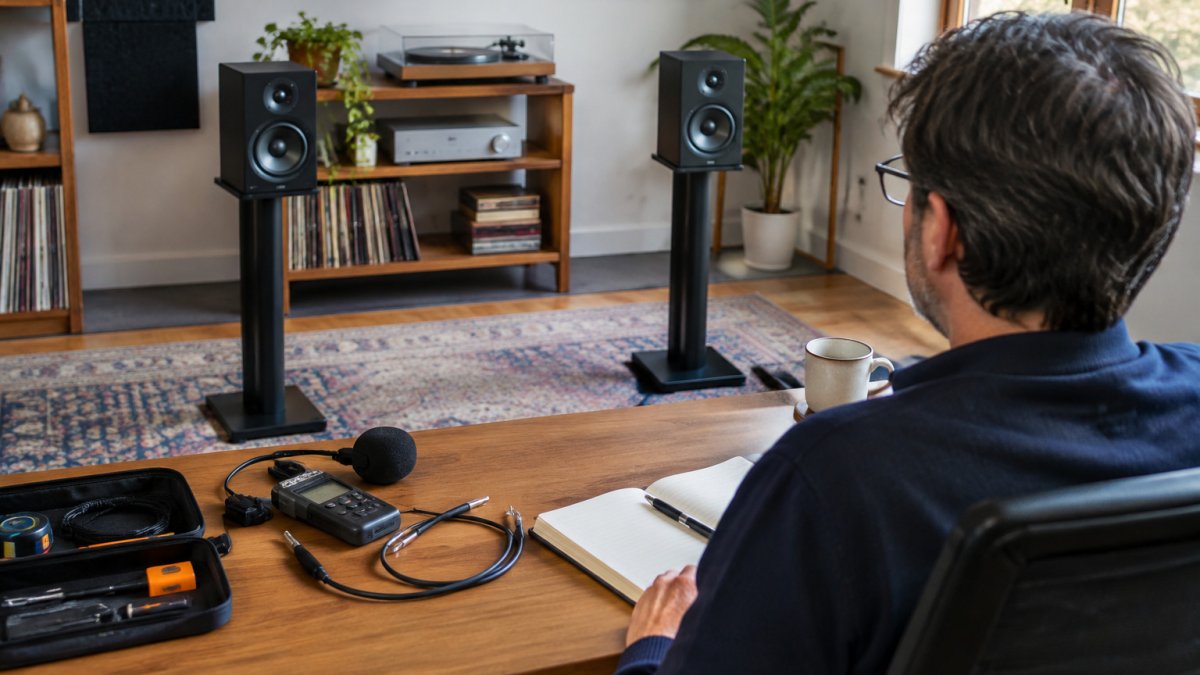
You can also test speakers yourself. Play tracks you know well, with clear bass, vocals and cymbals. Listen for whether the bass is tight, whether voices sound natural, and whether the treble is detailed without becoming harsh. Try a few different recordings, because a speaker can flatter one style of music and expose another.
When you audition, keep the volume consistent. Louder speakers often sound better, which can mislead comparisons. Switch between models quickly, and give your ears time to settle. A short, structured session with the same tracks each time will tell you far more than a single impressive demonstration.
The table below sums up the key listening checks the article recommends when comparing compact monitors.
| Check | What to listen for | Tip |
|---|---|---|
| Frequency response | Peaks and dips show colouration | Trust anechoic measurements over marketing graphs |
| Bass | Tight, controlled low end | Use tracks with clear bass |
| Vocals | Natural, not forward or thin | Compare on familiar voices |
| Treble | Detailed without harshness | Watch for fatigue over time |
| Volume | Consistent level between models | Louder often sounds better, misleading |
| Session | Same tracks each time | Switch quickly and let ears settle |
Choosing Your Next Pair: Auditioning at Chiltern Audio
Reading about sonic signature only goes so far. The best way to judge a compact monitor is to hear it in a setup that resembles your own. At Chiltern Audio, we offer real-world hifi demonstrations so you can compare speakers with your kind of music, and our team can talk you through how the sound will change with your room and amplifier.
Bring a few recordings you know well. Tell us what you listen to and what you dislike about your current sound, so our team can help you think through which speakers to try.
Our team can also explain in plain English how speakers, amplifiers and placement interact, which is often the difference between a good pair and the right pair. If you are unsure where to begin, get in touch and we will help you find a sonic signature you enjoy living with.
Frequently Asked Questions
What does sonic signature mean in audio equipment?
Sonic signature is the characteristic way a speaker colours the sound it reproduces. Every speaker adds some tonal emphasis, whether through the balance of bass, midrange and treble, the way transients are rendered, or how the soundstage is shaped. Compact monitors tend to have a tighter, more forward presentation because of their small cabinets and limited low-frequency output. Understanding this signature helps you judge whether a speaker suits your music and your room, rather than relying on a single headline specification.
Why do compact monitor speakers sound different from hi-fi speakers?
Compact monitors are designed for accuracy at close listening distances, so they prioritise a neutral, detailed midrange and controlled imaging. Many hi-fi speakers are voiced for enjoyment, often with more bass warmth or a smoother top end. Neither approach is wrong, but the difference explains why a monitor can sound lean or analytical to someone used to a warmer speaker. When comparing, listen to familiar recordings and notice whether the tonal balance feels honest or simply different.
How does cabinet size affect the sonic signature of a monitor?
Cabinet volume governs how low a speaker can go and how much air it can move, so smaller cabinets usually roll off bass earlier. Small enclosures also produce different diffraction and port behaviour, which can affect clarity around the crossover region. Sealed compact designs often sound tighter but less full, while ported designs can extend bass at the cost of some transient control. Placement and a subwoofer, if used, can compensate for much of the difference.
Are compact monitors suitable for critical listening?
Yes, provided they are set up correctly. Compact monitors are widely used for critical listening because their smaller size makes it easier to place them at a consistent distance from the listener, which reduces the influence of room reflections. Their midrange detail and imaging are often excellent for judging recordings. The main limitation is bass extension, so critical bass decisions may benefit from a subwoofer or from listening through a room correction system.
How do room acoustics influence the perceived sonic signature?
The room often shapes the sound more than the speaker does. Reflections from nearby walls, corners and furniture can boost or cancel specific frequencies, particularly in the bass, where room modes build up. Two identical speakers can sound noticeably different in two rooms. Positioning speakers away from walls, treating first reflection points and using a measurement-based room correction tool can all bring the perceived sound closer to what the speaker actually produces.