 ultimate-guide
How Turntable Platter Material Shapes Audio Quality
Last Updated: November 4, 2026
Quick Summary
The impact of turntable platter material on audio quality comes down to mass, damping and vibration transfer, so platter material should be a mechanical decision before an aesthetic one. Acrylic platters suit quiet, neutral systems, while MDF platters suit warmer, more forgiving tone. Damping and mass pull in opposite directions, which is why a composite approach often works best.
- A platter must support the record flat, spin with stable inertia and absorb resonance before it becomes audible.
- Acrylic damps well and sounds neutral but can sound lean on bright systems and scratches visibly.
- MDF is soft and moisture-sensitive, so heavy mats and clamps can mark it.
- A heavier platter raises inertia and resists wow and flutter, but it loads the bearing and may need speed recalibration.
- Change one variable at a time, mat first then platter, and keep the change only if it survives a week of listening.
Table of Contents
- What a Turntable Platter Does and Why Its Material Matters
- Why Platter Stability and Vibration Damping Affect Playback
- Acrylic vs MDF Turntable Platter: Which Suits Your Deck
- Turntable Platter Mass and Speed Stability Explained
- How Turntable Platter Mat Sound Quality Is Shaped by Material
- Finding the Best Turntable Mat Material for Your Setup
- Testing Platter Changes Properly in a Demonstration Room
- Frequently Asked Questions
What a Turntable Platter Does and Why Its Material Matters
The impact of turntable platter material on audio quality starts with a simple fact: the platter is the one surface every record touches, and it never stops moving while the stylus reads the groove. Platter choice is best treated as a mechanical decision before an aesthetic one, because the material sets how the record is supported, how steadily it spins, and how much unwanted energy reaches the cartridge.
A turntable platter is the rotating platform that carries the vinyl record, and its material governs mass, damping and the way vibration travels through the deck.
Three jobs matter here:
- Support: holding the record flat so the groove sits at a constant angle to the stylus
- Spin: carrying enough mass and inertia for consistent rotational stability
- Silence: soaking up resonance and mechanical noise before it becomes audible
Get the material wrong and the first two still work; it is the third that suffers.
Why Platter Stability and Vibration Damping Affect Playback
Instability shows up as surface noise, a hardening of tone and a loss of low-level detail. A platter that rings adds its own resonant frequency to everything the stylus reads, and the result is a sound that feels busy rather than quiet. Vibration damping is the fix: the material should absorb energy rather than store and return it. Before judging platter stability, make sure the tonearm is properly balanced, since an unbalanced arm muddies any comparison.
What most guides miss is that damping and mass pull in opposite directions. Heavy metal platters resist speed changes well but can ring; soft, lossy materials damp beautifully but may flex. The practical answer is usually a composite approach, and it is why mat choice matters as much as platter choice.
Resonance, mechanical noise and the limits of audibility
Honesty matters here. Some differences are measurable; others sit at the edge of what most listeners can reliably hear. A controlled comparison, level-matched and repeated, is the only way to separate a real improvement from expectation.
Acrylic vs MDF Turntable Platter: Which Suits Your Deck
Acrylic platters suit listeners chasing a quiet, neutral presentation, while MDF platters suit those who want a warmer, more forgiving tone. That is the short answer. If you are weighing a deck upgrade where platter construction is a factor, it is worth reviewing high end turntables before you commit.
Acrylic is dense, homogeneous and damps well, giving low surface noise and clean midrange. Its trade-offs: it can sound lean on bright systems, it scratches visibly, and it is usually thicker than the stock platter, which changes record height and therefore vertical tracking angle. MDF is easy to machine and reasonably damped, but it is soft, sensitive to moisture and less rigid, so heavy mats and clamps can mark it and long-term flatness is not guaranteed.
Compare materials on consistent criteria rather than adjectives:
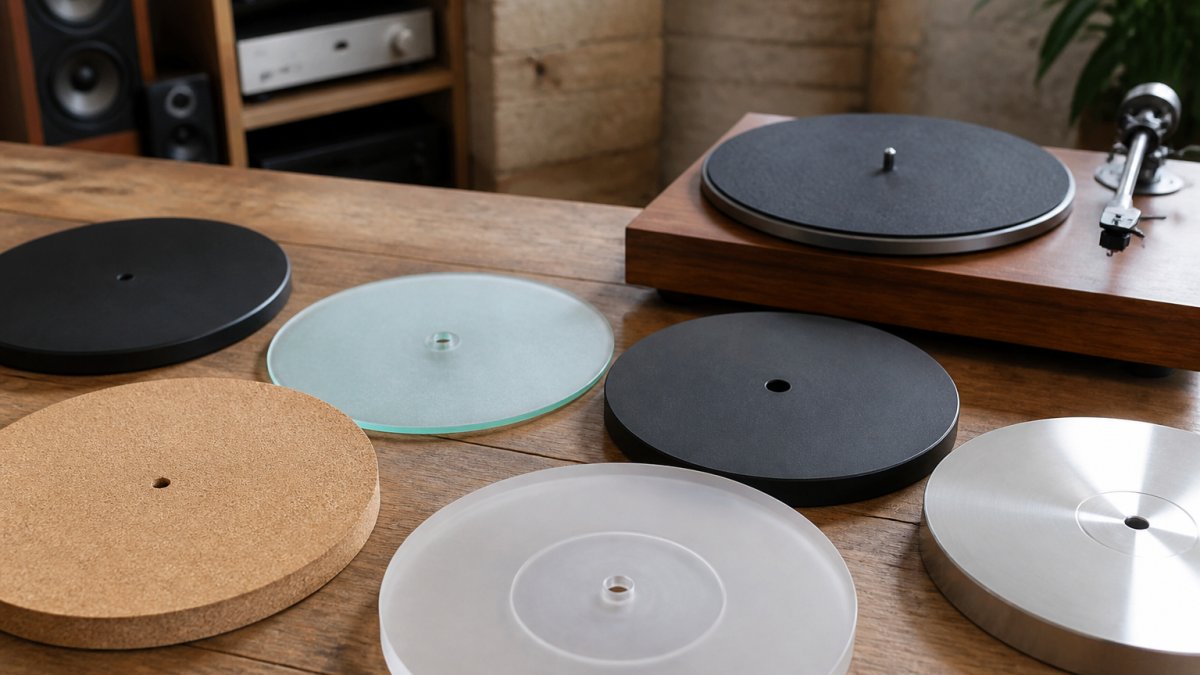
| Material | Damping | Mass | Typical tone tendency | Compatibility and safety watch-outs |
|---|---|---|---|---|
| Acrylic | High | Medium | Neutral, quiet | Height change alters VTA; scratches visibly; check label clearance |
| MDF | Medium-high | Low-medium | Warm, forgiving | Moisture swelling; soft edges mark under clamps |
| Aluminium | Low-medium | High | Dynamic, can ring | Needs damping; adds bearing load; re-check speed |
| Glass | Low | High | Bright, detailed | Ringing; fragility; height and label clearance |
| Delrin | High | Low-medium | Smooth, controlled | Limited availability; check thickness |
| Rubber/cork/felt mats | Varies | Low | Warm to dry | Static, shedding, coupling quality |
Compatibility, safety and setup consequences
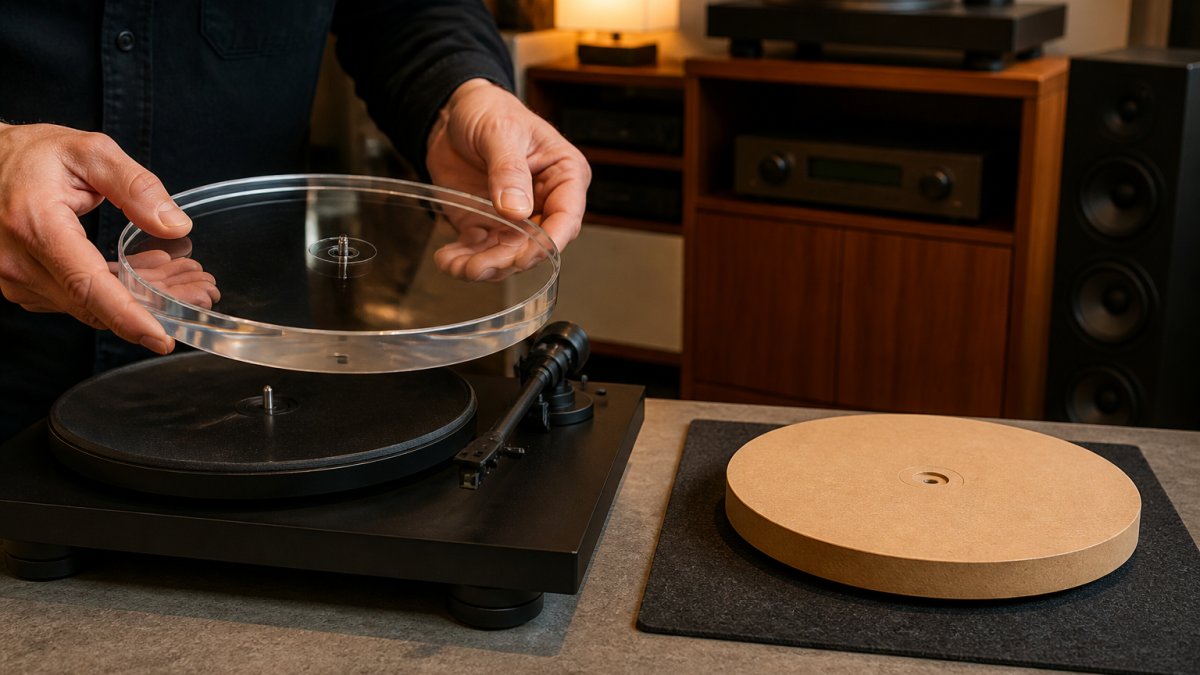
A platter swap is not cosmetic. Thicker platters raise the record relative to the tonearm, which changes vertical tracking angle and can require a tonearm height adjustment or a different mat to compensate. Heavier platters load the bearing and may need speed recalibration. Some platters sit closer to the plinth or the dust cover, so check record-label clearance and that the platter does not foul the tonearm rest or the cueing mechanism. If the deck has a fixed, integrated platter, none of this applies, the platter is not a user-serviceable part.
System matching and when not to upgrade
A platter or mat change is worth trying when the rest of the chain is already sorted: cartridge aligned, tracking force set, tonearm balanced, deck isolated, records clean. If surface noise is the symptom, a mat and a clean record often fix more than a platter. If pitch is unstable, check the belt, the motor and the bearing before spending on mass. If the system is bright, a warmer mat is a cheaper experiment than a new platter. Change one variable at a time, level-match, and repeat the same two or three tracks; keep the change only if it survives a week of normal listening.
Turntable Platter Mass and Speed Stability Explained
Mass buys rotational stability, but the relationship is not linear and it is not free. A heavier platter raises the moment of inertia, so the same motor torque produces a smaller speed deviation when the stylus drags in a groove or a warp lifts the cartridge. That is why platter mass, inertia and speed consistency are discussed together: inertia is the flywheel effect, and it is what actually resists wow and flutter.
Three mechanisms decide whether extra mass helps or hurts:
- Motor torque and control loop: a low-torque motor with a heavy platter accelerates slowly and may hunt around the target speed. Direct-drive decks with servo control handle mass differently from belt-drive decks, where the belt itself is a compliance in the system.
- Bearing load: every gram of platter sits on the bearing. A platter upgrade that adds mass without a bearing rated for it increases wear, raises rumble, and can make speed drift worse rather than better.
- Speed calibration: after a platter change, check speed with a strobe disc or a phone tachometer app at 33⅓ and 45 rpm. A heavier platter often needs the trim re-set, and some decks cannot reach the correct speed at all with a substantially heavier platter.
In practice, mass reduces wow and flutter and keeps pitch steady through dense passages and sustained piano. Too little mass and the deck feels nervous; too much and a modest motor struggles, which can smear timing and make the deck slow to come up to speed. Because platter mass can steady playback but cannot correct flaws in the record itself, choosing high quality vinyl remains part of keeping pitch and timing true.
Watch out: adding a heavy platter or clamp without checking bearing rating and speed calibration is the most common way an upgrade makes a deck measurably worse.
Measuring speed stability rather than guessing
A controlled check is more useful than a listening impression. Play a 3150 Hz or 1000 Hz test tone and record it, then inspect the resulting file for slow pitch drift (wow) and faster cyclical variation (flutter). Repeat with the original platter and the replacement under the same conditions, level-matched, and compare the same passage.
How Turntable Platter Mat Sound Quality Is Shaped by Material
A mat is the cheapest, most reversible way to change platter behaviour, and it changes three things: record contact, damping and static. Felt is warm but sheds fibres and grips poorly. Rubber damps strongly and couples well. Cork is light and dry-sounding. Leather sits between cork and rubber.
Record-to-platter coupling is the key variable. A mat that lets the record move microscopically under the stylus loses information; one that holds it firmly and damps the interface keeps it.
If you are considering a clamp or weight to improve that coupling, it is worth reading whether a record weight is worth it for sound quality before spending.
Finding the Best Turntable Mat Material for Your Setup
The best turntable mat material is the one that fixes a problem you can actually hear, not the one with the longest list of claims. Use this framework:
- Identify the symptom: surface noise, thin tone, static, or unstable pitch
- Change one variable at a time, mat first, then platter
- Level-match and repeat the same two or three tracks
- Note what improved and what got worse
- Keep the change only if it survives a week of normal listening
Watch out: swapping platters and mats at the same time tells you nothing, because you cannot attribute the result.
Best for: owners of entry-level decks wanting a low-risk change. Skip if: your deck has a fixed, integrated platter.
Testing Platter Changes Properly in a Demonstration Room
A demonstration room beats guesswork, because you can compare the same deck with two platters back to back at matched volume. Ask for one variable at a time, your own records, and enough time to stop noticing the room. Before you go, it helps to have the essential turntable setup tools for beginners on hand so each swap is measured accurately.
Our team runs personalised hifi demonstrations so you can hear these differences rather than take our word for them.
Frequently Asked Questions
Does turntable platter material actually affect sound quality?
It affects the mechanical behaviour of the deck, which is what you hear. Platter material changes how much vibration and resonance reach the vinyl record, how firmly the record couples to the surface, and how much rotational inertia the motor has to drive. Acrylic tends to damp resonance well and couple closely with the record, MDF is cheap and fairly inert but can sound softer, and metal platters are rigid and heavy but often need a mat to control ringing. Whether you notice the difference depends on your cartridge, speakers and room.
Is an acrylic turntable platter better than MDF?
Acrylic usually wins on resonance control and record coupling: it is dense, machined flat and does not ring like metal. MDF is reasonably well damped, so it is a sensible choice on budget decks. The acrylic vs MDF turntable platter decision comes down to the rest of your system. On a modest deck with an entry cartridge, the difference is small. On a revealing setup, acrylic's tighter bass and cleaner midrange are easier to hear, which is why many upgrade platters are acrylic.
Do heavier turntable platters sound better?
Not automatically, but mass helps speed consistency. A heavier platter has more inertia, so it resists small speed fluctuations and keeps wow and flutter low. The catch is that the motor and bearing must be built to handle the weight. Fitting a heavy platter to a lightweight deck can strain the motor and slow spin-up. When turntable platter mass and speed stability are properly matched by the manufacturer, a heavier platter usually gives steadier pitch and a more solid low end.
Does a turntable mat change the sound?
Yes, because the mat is the layer that actually touches your record. Felt is traditional and light but generates static and offers little damping. Rubber grips well and controls vibration but can add slight warmth. Cork is a good all-rounder with strong damping and low static. The best turntable mat material for your deck depends on the platter beneath it: metal platters usually need a mat to tame ringing, while acrylic platters are often played without one.
Platter material is a mechanical choice with an audible consequence, and it deserves a proper listen rather than a forum consensus. At Chiltern Audio we match components to your room and your records, with Rega turntables, bespoke system building and real demonstrations in our listening room. Get started with Chiltern Audio and hear the difference before you buy.