 how-to
How to Pair Amplifier With Passive Speakers
Table of Contents
- Understanding Amplifier and Speaker Compatibility
- Speaker and Amplifier Impedance Matching
- Matching Amplifier Power to Speaker Wattage
- Can an Amplifier Be Too Powerful for Speakers?
- How to Connect an Amplifier to Passive Speakers
- Common Mistakes to Avoid
- Troubleshooting After Pairing
- Frequently Asked Questions
Last Updated: October 9, 2026
Understanding Amplifier and Speaker Compatibility
Learning how to pair amplifier with passive speakers properly matters more than most people realise. The wrong pairing can damage your equipment, produce poor sound, or leave you frustrated after spending good money on your setup.
At Chiltern Audio, we help customers navigate these decisions every day.
Think of it like plumbing. The water (your audio signal) needs the right size pipes (impedance) and the right water pressure (power) to flow smoothly. Too much pressure bursts the pipes. Too little and nothing flows.
Speaker and Amplifier Impedance Matching
Impedance is the electrical resistance your speakers present to the amplifier. It's measured in ohms (Ω). This is the first thing you need to check.
What Impedance Means
Impedance is how much your speakers resist the electrical current flowing from your amplifier. Every speaker has a rated impedance, usually 4, 6, or 8 ohms.
The rule is straightforward: your amplifier's minimum impedance must be equal to or lower than your speaker's impedance. If your amplifier says "minimum 8 ohms" and your speakers are 4 ohms, you've got a mismatch that can damage the amplifier.
Why? Lower impedance means less resistance, so the amplifier has to work harder and draw more current. Push it too far and the amplifier's output stage overheats or fails.
Checking Your Speaker and Amplifier Ratings
Find these numbers before you connect anything.
For your speakers:
- Look on the back panel or in the manual for the impedance rating
- It's usually printed near the speaker terminals
- Common values: 4Ω, 6Ω, or 8Ω
For your amplifier:
- Check the specifications in the manual or on the rear panel
- Look for "minimum load impedance" or "speaker impedance"
- This tells you the lowest impedance the amplifier can safely handle
Write both numbers down. Compare them. If your amplifier's minimum is 8 ohms and your speakers are 8 ohms, you're compatible. If your amplifier's minimum is 4 ohms and your speakers are 6 ohms, that's also fine, the amplifier can handle it.
If your speakers are lower impedance than your amplifier's minimum, you have a problem. Do not connect them.
Series and Parallel Wiring for Multiple Speakers
If you're connecting multiple speakers to one amplifier channel, how you wire them changes the total impedance.
Series wiring adds impedance. If you connect two 8-ohm speakers in series, the total is 16 ohms.
Parallel wiring divides impedance. Two 8-ohm speakers in parallel give you 4 ohms total. Two 4-ohm speakers in parallel drop to 2 ohms, which is too low for most amplifiers.
The formula for parallel impedance:
- 2 identical speakers: divide the impedance by 2
- 3 identical speakers: divide by 3
- Example: Three 8-ohm speakers in parallel = 8 ÷ 3 = 2.67 ohms
Always calculate the total before wiring. Check that your amplifier's minimum impedance rating can handle the result. If you're unsure, stick with series wiring or connect fewer speakers per channel.
Matching Amplifier Power to Speaker Wattage
Power matching is the second critical step. Your amplifier's output power must suit your speaker's power handling.
RMS Power vs Peak Power
This is where confusion often starts. Amplifiers and speakers list power in different ways.
RMS (Root Mean Square) power is continuous power, what the amplifier delivers steadily over time. This is the number that matters most.
Peak power is a brief burst. It's higher than RMS but short-lived. Manufacturers sometimes advertise peak power to make numbers look bigger. Ignore it.
Your speaker's power handling is usually listed as a range: for example, "25W to 150W RMS." The lower number is the minimum recommended power.
Your amplifier's RMS output should fall somewhere in that range. Ideally, aim for the middle to upper part of the speaker's range.
Worked Examples: Common Amplifier and Speaker Pairings
Let's look at real scenarios.
Scenario 1: Bookshelf speakers in a small room
- Speaker: 8 ohms, rated 20W-100W RMS
- Amplifier: 50W RMS per channel at 8 ohms
- Result: Good match. The amplifier sits in the middle of the speaker's power range.
Scenario 2: Floor-standing speakers in a large room
- Speaker: 4 ohms, rated 50W-200W RMS
- Amplifier: 100W RMS per channel at 4 ohms
- Result: Good match. Plenty of headroom for dynamic music without pushing the amplifier hard.
Scenario 3: Vintage amplifier with modern speakers
- Amplifier: 30W RMS per channel (old tube amp)
- Speaker: 6 ohms, rated 40W-150W RMS
- Result: Acceptable but tight. The amplifier sits at the lower end of the speaker's range. Volume will be moderate, but sound quality can be excellent if the impedance matches.
Scenario 4: Mismatch to avoid
- Amplifier: 200W RMS per channel
- Speaker: 8 ohms, rated 20W-60W RMS
- Result: Poor match. The amplifier is far more powerful than the speaker can handle. Even at moderate volume, you risk clipping and distortion.
Check your specific equipment. If you're uncertain, ask the retailer or consult the manual.
Can an Amplifier Be Too Powerful for Speakers?
Yes. But it's not the power itself that causes damage, it's how you use it.
A powerful amplifier won't hurt your speakers if you keep the volume at reasonable levels. The danger comes from clipping and distortion, which happen when you push the amplifier too hard.
Clipping, Distortion, and Safe Listening Levels
Clipping occurs when the amplifier tries to produce a signal larger than it can handle. The peaks of the audio wave get cut off (clipped).
Distortion is unwanted noise added to the signal. A small amount adds warmth (especially with tube amplifiers).
Safe listening levels depend on your room and your ears. Most people listen at 75-85 decibels (dB), roughly the volume of a busy restaurant.
If your amplifier is very powerful, keep the volume control low.
A good rule: if the sound starts to distort or feels harsh, you've gone too loud. Turn it down.
How to Connect an Amplifier to Passive Speakers
Once you've confirmed impedance and power compatibility, you're ready to understand how to pair amplifier with passive speakers by wiring everything together.
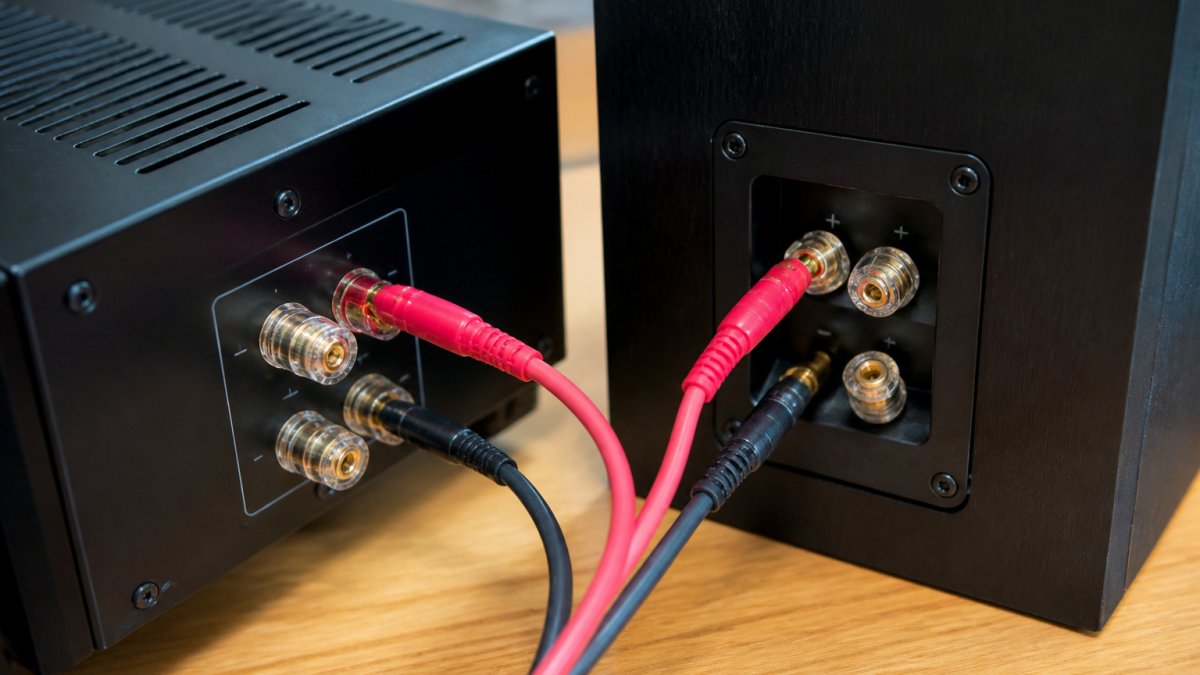
Selecting the Right Speaker Cable
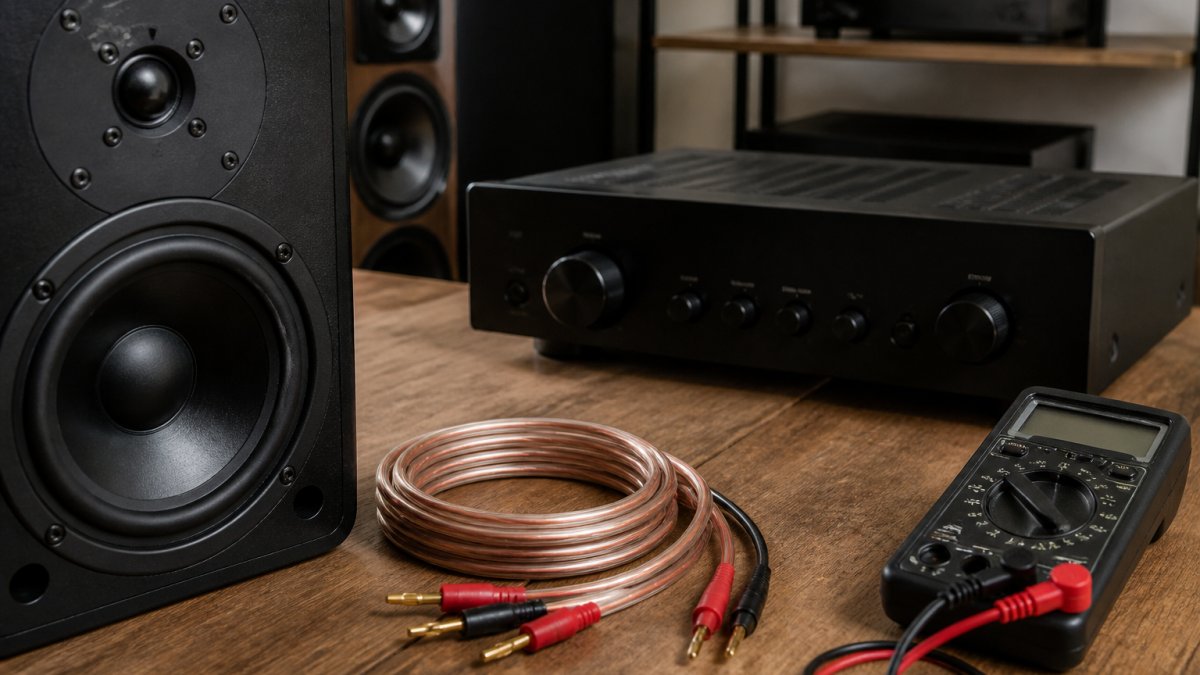
Speaker cable carries the amplified signal from your amplifier to your speakers. Quality matters, but you don't need to spend a fortune.
Cable gauge (thickness):
- For runs under 3 metres: 16 AWG (gauge) is fine
- For runs 3-6 metres: use 14 AWG
- For runs over 6 metres: use 12 AWG or thicker
Thicker cable has lower resistance and works better over longer distances. If your speakers are close to the amplifier, thin cable is acceptable. If they're far away, heavier gauge reduces signal loss.
Cable type:
- Solid core or stranded both work
- Shielded cable is rarely necessary for speaker connections (unlike audio signal cables)
- Avoid cheap, thin cable, it sounds dull and can overheat under heavy use
Buy speaker cable from a reputable supplier. We can advise on the right gauge and length for your room.
Connecting Positive and Negative Polarity
This is critical. Get polarity wrong and your speakers will be out of phase, producing weak bass and a hollow sound.
Every speaker cable has two conductors:
- Red = positive (+)
- Black = negative (-)
Every amplifier has two terminals per channel:
- Red = positive (+)
- Black = negative (-)
Every speaker has two terminals:
- Red = positive (+)
- Black = negative (-)
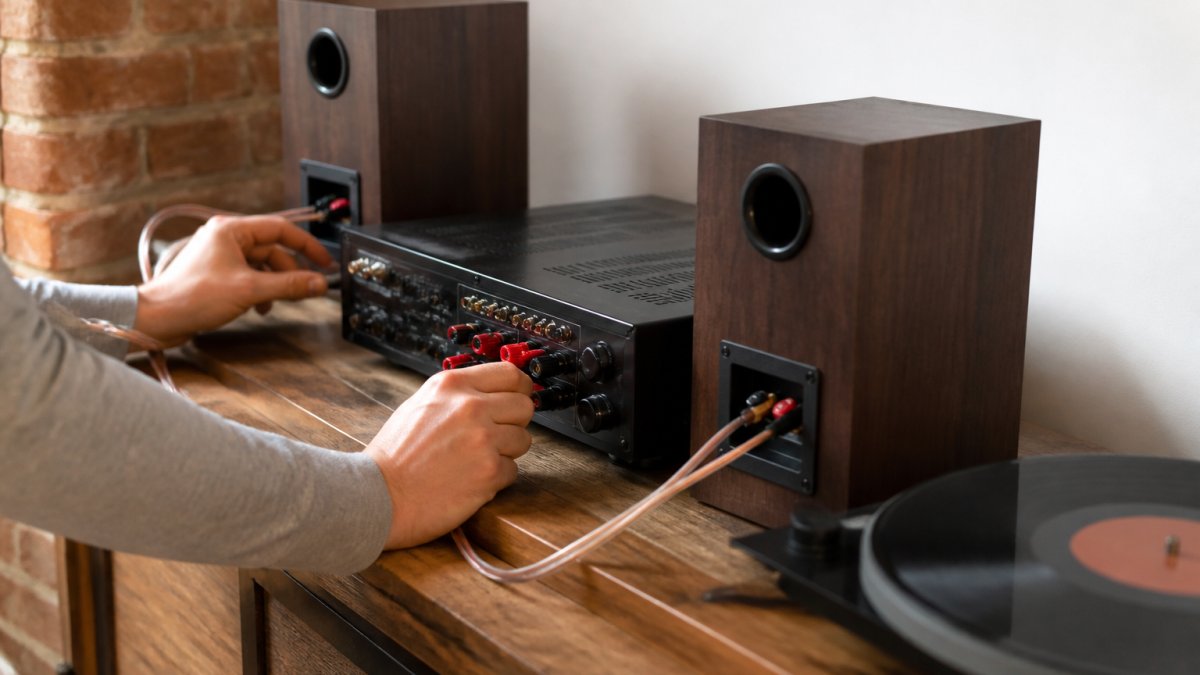
The rule: Red connects to red. Black connects to black. Do this consistently on both speakers and both channels.
If you reverse polarity on one speaker (connect red to black and black to red), that speaker will be out of phase with the others. The result is weak, thin sound with almost no bass. Swap the connections back and the problem disappears instantly.
Step-by-Step Connection Process
Follow this sequence to avoid mistakes.
Step 2: Prepare the speaker cable. Strip about 6 millimetres of insulation from each end.
Step 3: Connect to the amplifier first. Loosen the binding post on the amplifier's positive terminal.
Step 4: Connect to the speaker. Follow the same process at the speaker end. Red to red.
Step 5: Repeat for the other speaker (if applicable). Use the other channel on the amplifier.
Step 6: Check all connections. Give each wire a gentle tug to confirm it's secure.
Step 7: Power on the amplifier. Turn the volume control to minimum. Switch on.
If you hear crackling, popping, or distortion, turn off immediately and check your connections.
Common Mistakes to Avoid
Mixing impedances. Don't assume all your speakers are the same impedance. Check each one.
Assuming more power is always better. A 200W amplifier won't make your 50W speakers sound better.
Using thin, cheap speaker cable for long runs. Resistance builds up and you lose signal quality.
Reversing polarity on one speaker. This is easy to do and ruins the sound.
Connecting speakers while the amplifier is on. This can damage the amplifier's output stage. Always power down first.
Overloading the amplifier. Clipping happens when you push the volume too high.
Troubleshooting After Pairing
Your system is connected, but something doesn't sound right. Here's how to diagnose the problem.
No sound at all:
- Check that all cables are connected firmly
- Make sure the amplifier is powered on
- Confirm the audio source (turntable, streamer, etc.) is playing
- Try a different input on the amplifier
Sound from only one speaker:
- Check the speaker cable connections on both the amplifier and speaker
- Swap the speaker cables between left and right channels to see if the problem moves
- If it moves, the cable is faulty
- If it stays, the amplifier channel may be damaged
Weak or thin sound:
- Check polarity. If one speaker is reversed, it will sound hollow
- Measure the total impedance if you have multiple speakers wired in parallel
- Ensure the amplifier's minimum impedance rating isn't being exceeded
Crackling or popping:
- Tighten all speaker cable connections
- Check for any exposed copper wire touching another terminal
- Try a different audio source to rule out the input device
- If crackling persists, the amplifier may need servicing
Distortion even at low volume:
- Check polarity again
- Confirm the audio source isn't already distorted
- Try a different input cable
- If the problem continues, the amplifier may be faulty
Most problems are connection-related. Before assuming equipment failure, inspect every connection carefully.
Pairing an amplifier with passive speakers doesn't have to be complicated. Check impedance compatibility, match power levels to your listening habits, and wire everything with care. Get these three things right and your system will sound excellent and last for years.
If you're building a new setup or upgrading an existing one, the team at Chiltern Audio can help you choose components that work together properly.
Frequently Asked Questions
How do I know if my amplifier and passive speakers are compatible?
Check three things: impedance (your amplifier must support your speaker's ohm rating), power handling (your amplifier's RMS output should not regularly exceed your speaker's continuous power rating), and connector type (ensure your amplifier has the right terminals for your speaker cables). Most passive speakers are 4 or 8 ohms, and most amplifiers support these ratings. If unsure, consult your equipment manuals or ask an expert before connecting.
What does impedance mean when pairing amplifier with passive speakers?
Impedance, measured in ohms, is the electrical resistance your speakers present to the amplifier. A lower impedance (e.g. 4 ohms) demands more current from the amplifier; higher impedance (e.g. 8 ohms) demands less. Your amplifier must be rated to handle your speaker's minimum impedance. Mismatched impedance can damage the amplifier or produce poor sound. Always check both your amplifier's minimum supported impedance and your speaker's rated impedance before connecting.
Can an amplifier be too powerful for passive speakers?
Not if used correctly. A powerful amplifier won't damage speakers if you keep the volume at reasonable levels and avoid clipping (distorted sound at maximum volume). The risk comes from sustained high volume or clipping, which generates excessive heat in the speaker's voice coil. A higher-powered amplifier actually gives you more headroom, meaning you can listen comfortably without pushing the amp hard. Always match your amplifier's power to your listening habits and room size.
What speaker cable should I use to connect passive speakers to an amplifier?
Use dedicated speaker cable rated for your amplifier's power output. Thicker gauge (lower AWG number) is better for longer runs. Ensure the cable has proper connectors that match your amplifier terminals (banana plugs, spade terminals, or bare wire). Avoid using regular electrical wire, as it lacks the shielding and quality needed for audio. Keep cable runs as short as practical to minimise signal loss.