 how-to
Speaker Impedance for Beginners: A Simple Guide
Table of Contents
- What Is Speaker Impedance?
- Understanding Ohms and Speaker Ratings
- How to Match Speakers to an Amplifier
- 4 Ohm vs. 8 Ohm Speakers: Key Differences
- Speaker Impedance Formula and Calculation
- How to Check Speaker Impedance
- What Happens When Impedance Doesn't Match
- Getting Your System Right: A Compatibility Checklist
- Frequently Asked Questions
Last Updated: October 17, 2026
What Is Speaker Impedance?
Speaker impedance is the electrical resistance a speaker presents to an amplifier. Think of it like water pressure in a pipe; the speaker creates resistance, and the amplifier has to push current through it.
This matters because mismatched impedance can damage your amplifier or produce poor sound. We help customers understand this fundamental concept because it's the foundation of building a system that actually sounds good and stays safe.
Impedance isn't a fixed number; it changes across different frequencies.
Impedance as Electrical Resistance
When current flows through a speaker, it encounters two types of resistance: resistance (R) and reactance (X). Resistance comes from the speaker's voice coil wire. Reactance comes from the speaker's inductance and capacitance at different frequencies.
Together, these create impedance, the total opposition to AC (alternating) current. Your multimeter can measure DC resistance, but impedance is what matters for audio, because audio is AC current. They're different measurements.
Why Impedance Changes Across Frequencies
The voice coil in a speaker has inductance. Inductance increases with frequency, meaning higher frequencies face more opposition. This is why a speaker's impedance curve rises and falls across the frequency spectrum.
A speaker might present 6 ohms at 100 Hz, 8 ohms at 1 kHz, and 10 ohms at 10 kHz. Manufacturers give you a nominal impedance (the average) and a minimum impedance (the lowest point on the curve). The minimum impedance matters most for amplifier safety.
Understanding Ohms and Speaker Ratings
Ohms (Ω) measure electrical resistance. One ohm is the resistance that allows one amp of current to flow at one volt. The ohm is the SI derived unit of electrical resistance.
An 8-ohm speaker is easier on an amplifier than a 4-ohm speaker. When you wire speakers in parallel, the total impedance drops. Wire two 8-ohm speakers in parallel, and you get 4 ohms total; the amplifier now delivers twice the current.
Nominal Impedance vs. Minimum Impedance
Nominal impedance is the average rating you see on a speaker's spec sheet. It's roughly the impedance in the midrange frequencies where human ears are most sensitive.
Minimum impedance is the lowest point on the speaker's impedance curve, usually at a specific frequency. This is the critical number for amplifier safety.
Manufacturers list both because they tell different stories. Nominal tells you the general category. Minimum tells you whether the speaker is actually safe for your amplifier.
Common Speaker Ratings: 4, 6, and 8 Ohms
Most passive speakers come in three standard ratings:
- 8-ohm speakers: The most common. Easier on amplifiers. Produce slightly less power output than lower impedance speakers from the same amplifier.
- 6-ohm speakers: Less common. A middle ground between 8 and 4 ohms. Some vintage systems and certain brands use this rating.
- 4-ohm speakers: More demanding on amplifiers. Draw more current. Deliver more power from the same amplifier, but require the amplifier to be rated for 4-ohm loads.
If your amplifier says "8 ohms minimum," you can safely use 8-ohm or higher impedance speakers. You cannot use 4-ohm speakers without risking damage.
How to Match Speakers to an Amplifier
Matching speaker impedance to your amplifier is straightforward: your total speaker impedance must be at or above your amplifier's minimum load rating.
If your amplifier is rated for 4-8 ohms, you can use speakers between 4 and 8 ohms. If your amplifier is rated for 8 ohms only, you must use 8-ohm speakers or higher.
Checking Your Amplifier's Minimum Load Rating
Find your amplifier's spec sheet. Look for "minimum impedance," "minimum load," or "impedance range." This tells you the lowest impedance the amplifier can safely handle.
Most integrated amplifiers are rated for 4-8 ohms. Some high-end amplifiers are rated for 2-8 ohms. Vintage amplifiers often specify 8 ohms only. If you cannot find the spec sheet, contact the manufacturer or a dealer before connecting speakers.
Practical Matching Examples
Single speaker setup: You have an 8-ohm amplifier and one 8-ohm speaker. Total impedance is 8 ohms.
Two speakers in series: Two 8-ohm speakers wired in series = 16 ohms total. This is above your amplifier's range.
Two speakers in parallel: Two 8-ohm speakers wired in parallel = 4 ohms total.
Mixed impedance: One 8-ohm speaker and one 4-ohm speaker wired in parallel = 2.67 ohms total.
The rule is simple: calculate total impedance, then check against your amplifier's spec.
4 Ohm vs. 8 Ohm Speakers: Key Differences
The difference between 4-ohm and 8-ohm speakers comes down to how hard the amplifier works and how much power it delivers.
Power Delivery and Amplifier Load
An amplifier rated at 100 watts into 8 ohms typically delivers 200 watts into 4 ohms. Lower impedance means more current flow, leading to more power output. But the amplifier also works harder and generates more heat.
This is Ohm's Law in action: Power = Voltage² ÷ Impedance. When impedance halves, power doubles (if the amplifier can handle it).
4-ohm speakers are more efficient at extracting power from an amplifier.
Which Rating Suits Your Setup
Choose 4-ohm speakers if:
- Your amplifier is rated for 4-8 ohms
- You want maximum power output
- You're building a compact system
- You need efficiency in a smaller room
Choose 8-ohm speakers if:
- Your amplifier is rated for 8 ohms only
- You prefer a simpler, safer setup
- You're using vintage or lower-powered amplifiers
- You want to run multiple speakers without complex impedance calculations
When in doubt, 8 ohms is the safer choice. Most amplifiers handle it well, and you have fewer compatibility headaches.
Speaker Impedance Formula and Calculation
To calculate total impedance when wiring multiple speakers, you need to know whether they're in series or parallel.
Series wiring: Total impedance = Speaker 1 + Speaker 2 + Speaker 3...
Two 8-ohm speakers in series = 8 + 8 = 16 ohms.
Parallel wiring: Total impedance = 1 ÷ (1/Speaker 1 + 1/Speaker 2 + 1/Speaker 3...)
Two 8-ohm speakers in parallel = 1 ÷ (1/8 + 1/8) = 1 ÷ (0.25) = 4 ohms.
Series and Parallel Wiring Effects
Series wiring increases total impedance. Use this when you need to raise impedance above your amplifier's minimum.
Parallel wiring decreases total impedance. Use this when you want more power and your amplifier can handle lower impedance. The trade-off: the amplifier works harder and generates more heat.
Most home systems use parallel wiring because it delivers more power. Car audio often uses series-parallel combinations to hit specific impedance targets.
How to Check Speaker Impedance
You can find speaker impedance two ways: check the product specifications or measure it with a multimeter.
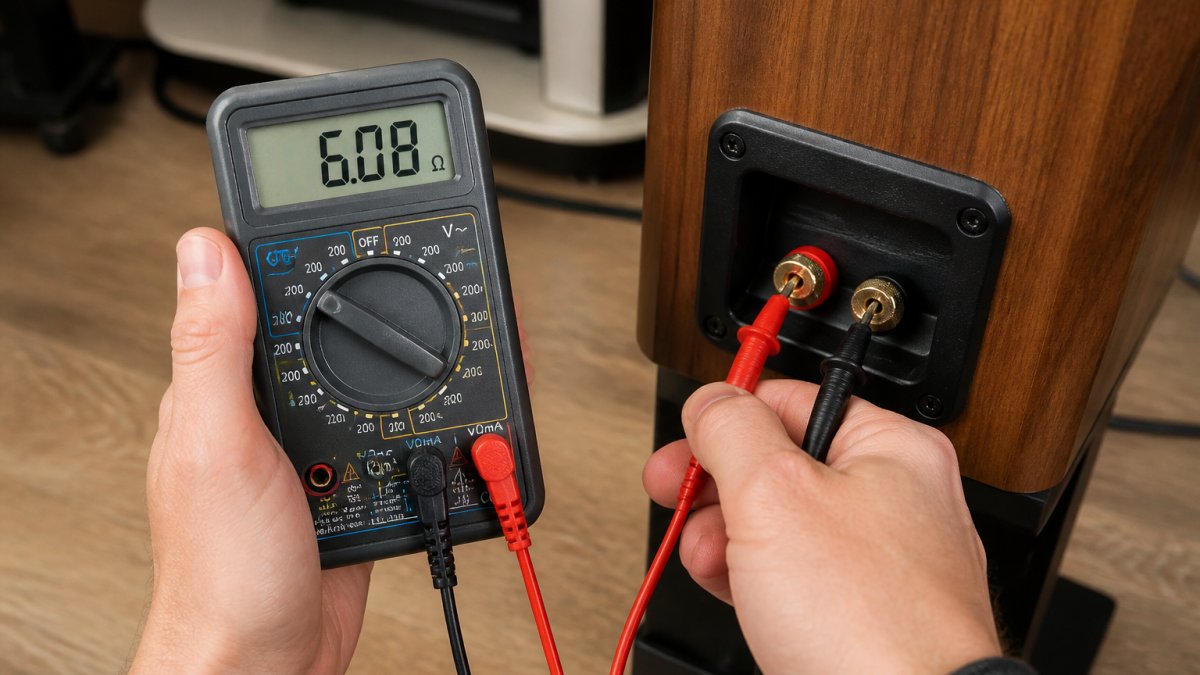
Using a Multimeter
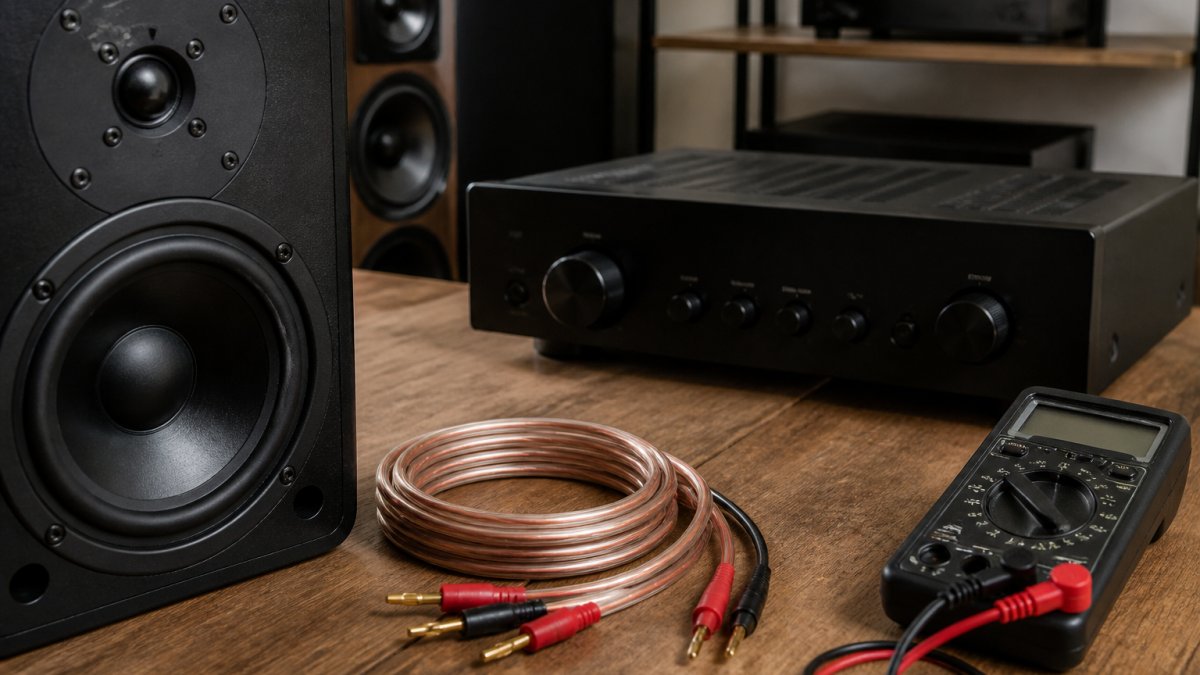
A digital multimeter can measure DC resistance, which approximates impedance at low frequencies. Set the multimeter to the ohms setting (Ω symbol). Disconnect the speaker from the amplifier.
The reading you get is DC resistance, not true impedance. It's lower than the nominal impedance rating because it doesn't account for reactance.
A reading close to the speaker's nominal rating (within 20%) is normal. If the reading is much lower, the speaker may have internal damage.
Checking Product Specifications
The easiest method: look at the speaker's spec sheet. Manufacturers list nominal impedance and minimum impedance clearly. This is the accurate number, not a measurement estimate.
On the back of the speaker or in the manual, you'll see something like "Impedance: 8 ohms nominal, 4 ohms minimum." Use the minimum impedance when calculating total system impedance.
If you cannot find the spec sheet, contact the manufacturer. Chiltern Audio can also help you identify speaker impedance if you have the model number.
What Happens When Impedance Doesn't Match
Mismatched impedance causes problems. The severity depends on how far off you are.
Risks of Impedance Below Your Amplifier's Rating
If total speaker impedance is below your amplifier's minimum rating, the amplifier delivers too much current. The output transistors overheat. Protection circuits kick in, shutting down the amplifier. Repeat this enough times, and you risk permanent damage.
Some amplifiers have no protection circuit. Running them below their minimum impedance rating can destroy them instantly.
The damage is usually not covered by warranty because it's user error. A £2,000 amplifier can be ruined by a £200 speaker mismatch.
Distortion, Overheating, and Protection Circuits
Even if the amplifier survives, you'll hear problems. Distortion increases. The amplifier sounds strained. Bass loses control. This is the amplifier struggling.
Overheating is the first sign. If your amplifier gets hot during normal listening, check your impedance calculation.
Modern amplifiers have protection circuits that shut them down when they overheat. This is good; it saves the amp.
The fix is always the same: raise total impedance or use a more powerful amplifier rated for lower impedance.
Getting Your System Right: A Compatibility Checklist
Before you buy speakers or connect them to an amplifier, use this checklist to verify compatibility.
Step 1: Find your amplifier's minimum load rating
- Check the spec sheet or manual
- Contact the manufacturer if you cannot find it
- Write down the number (e.g., "4-8 ohms")
Step 2: Identify each speaker's nominal and minimum impedance
- Check the spec sheet or the back of the speaker
- If using multiple speakers, list each one
- Note the minimum impedance for each
Step 3: Calculate total impedance
- If wiring in parallel: use the parallel formula
- If wiring in series: add impedances together
- If mixing series and parallel: calculate each section separately, then combine
Step 4: Compare total impedance to amplifier rating
- Total impedance must be at or above the minimum
- If below minimum, do not connect the speakers
- If at or above minimum, you're safe
Step 5: Listen for problems
- Play music at normal volume
- Check if the amplifier gets hot
- Listen for distortion or strain
- If problems appear, recheck your calculation
| Step | Action | Check |
|---|---|---|
| 1 | Find amplifier minimum rating | Spec sheet or manual |
| 2 | List speaker impedances | Nominal and minimum |
| 3 | Calculate total impedance | Series or parallel formula |
| 4 | Compare to amplifier | Total ≥ minimum rating? |
| 5 | Test in real use | No distortion, no overheating |
At Chiltern Audio, we help customers work through this checklist before they buy. Matching speakers to an amplifier correctly means your system sounds great and stays safe for years.
Getting speaker impedance right is the difference between a system that sounds effortless and one that sounds strained. It's also the difference between an amplifier that lasts decades and one that fails prematurely.
Frequently Asked Questions
What does speaker impedance mean in simple terms?
Speaker impedance is the electrical resistance your amplifier encounters when driving your speakers. It's measured in ohms (Ω). Think of it like water pressure in a pipe: higher impedance means your amplifier has to work harder to push current through. Most home speakers range from 4 to 8 ohms. Matching your speakers' impedance to your amplifier's capabilities ensures clean sound and protects your equipment from damage.
What's better, 4-ohm or 8-ohm speakers?
Neither is universally better; it depends on your amplifier. A 4-ohm speaker draws more current and lets your amplifier deliver more power, producing louder output. An 8-ohm speaker draws less current but is easier on your amplifier's power supply. Check your amplifier's minimum load rating (often printed on the back). If it says 4 ohms, both ratings work. If it says 8 ohms only, use 8-ohm speakers. Using speakers below your amplifier's minimum rating risks overheating and distortion.
How do I check my speaker impedance?
The easiest method is to check your speaker's manual or look for a label on the speaker itself; it will state something like '8Ω'. If you have a digital multimeter, set it to measure ohms (Ω) and touch the probes to the speaker terminals with the amplifier switched off. You'll get a resistance reading. For accurate impedance testing, some specialist hifi retailers can measure your speakers as part of a system check during a demonstration.
Can I use speakers with a lower impedance than my amplifier supports?
No, this is a common mistake that can damage your amplifier. If your amplifier's minimum load rating is 8 ohms, using 4-ohm speakers forces excessive current through the power supply, causing overheating and triggering protection circuits that cut sound. Over time, this can permanently damage components. Always match or exceed your amplifier's minimum impedance rating. If you're unsure about your setup, our team can verify compatibility during a demonstration.