 how-to
How to Position HiFi Speakers for Best Soundstage
Table of Contents
- Why Speaker Placement Decides Your Soundstage
- Step 1: Set Up the Equilateral Triangle Listening Position
- Step 2: Get the Speaker Distance From Wall Right
- Step 3: Fine-Tune With Speaker Toe-In
- Step 4: Apply the 38% Rule Speaker Placement for Balanced Bass
- Step 5: Speaker Placement for Small Rooms
- Speaker Design and Subwoofer Integration
- Frequently Asked Questions
Last Updated: October 15, 2026
Why Speaker Placement Decides Your Soundstage
Your speakers are almost certainly capable of more than your room is letting them deliver. Someone buys a lovely pair of hifi speakers, sets them either side of a sideboard, and wonders why the vocals sit in a muddy lump instead of floating between the cabinets.
Soundstage is the three-dimensional picture your system paints of a recording: how wide the instruments spread, how far back the drummer sits, how sharply you can point to the singer. It's built from two things working together.
That's the whole game. Placement, not price, sets the limits on stereo imaging and image focus.
Below, we'll walk through a five-step setup you can run this afternoon with a tape measure and your ears. No special tools, no jargon.
Step 1: Set Up the Equilateral Triangle Listening Position
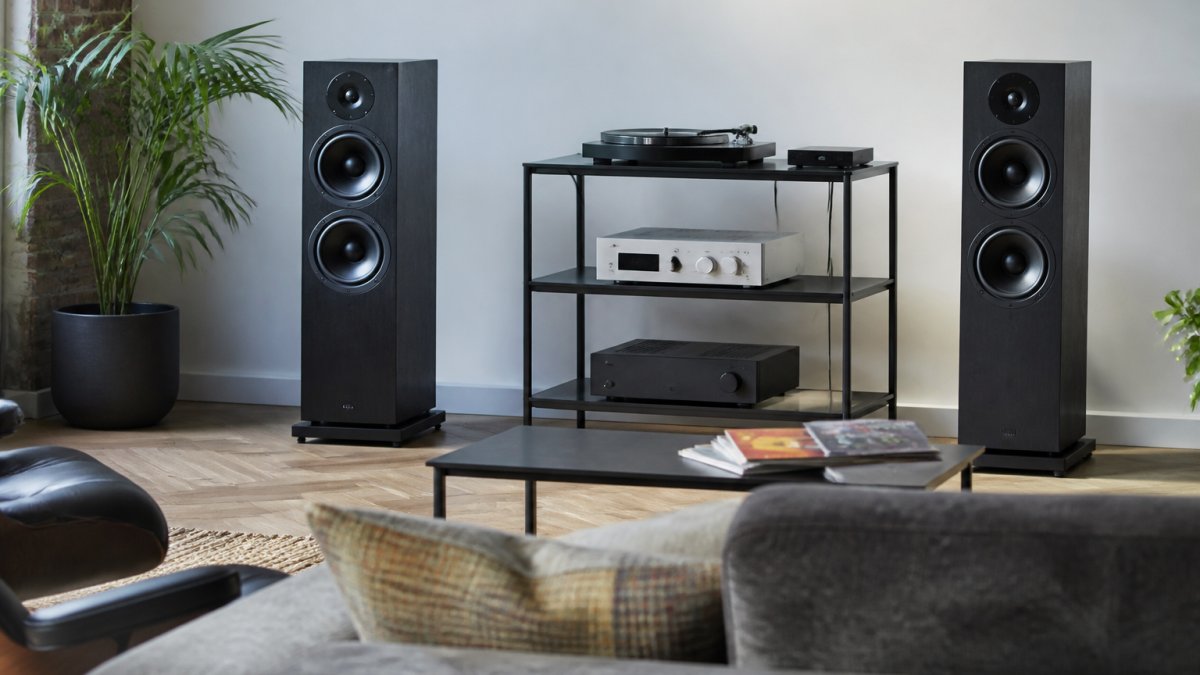
Start with an equilateral triangle: your two speakers and your head form three corners of a triangle with equal sides.
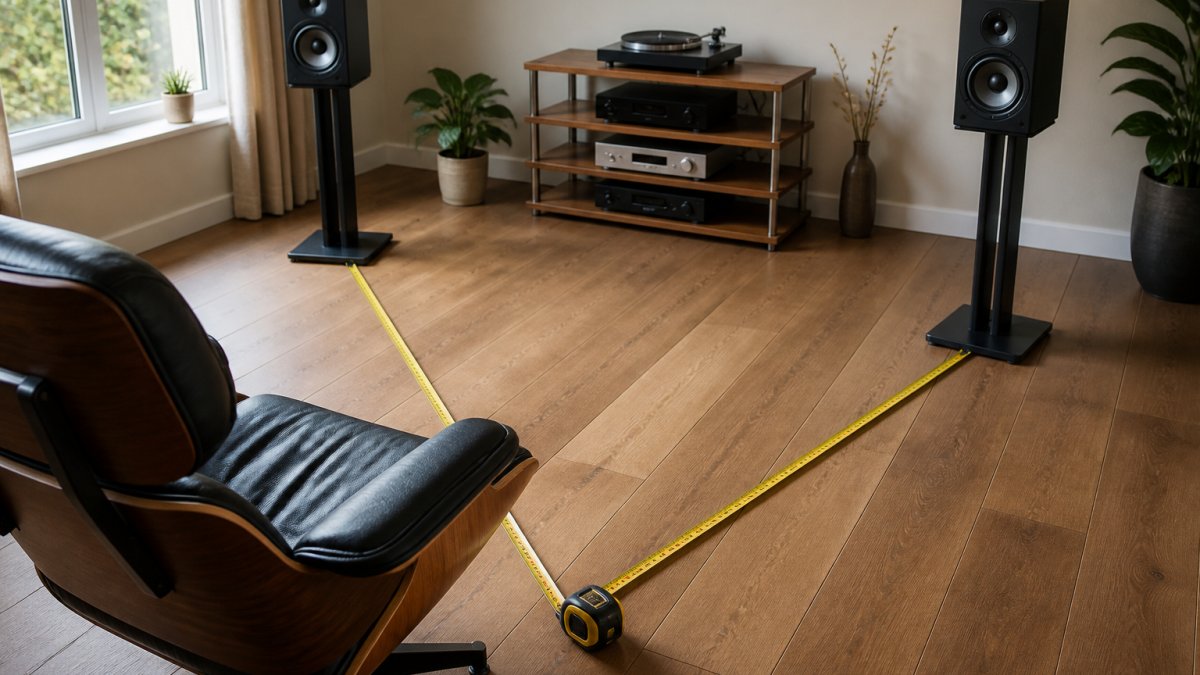
Measure it properly, not by eye
Most people set the triangle up by eye and end up 10-15cm out on one side. That is enough to pull the centre image off-axis. Here is a repeatable procedure you can run in about ten minutes with a tape measure and a length of string:
- Mark the listening seat. Put a small piece of tape on the floor directly below where your ears sit when you are in your normal listening position. Measure from the floor to your ear height while seated and write it down.
- Mark the speaker positions. Put tape on the floor directly under the front-centre of each speaker cabinet (not the back, not the corner).
- Measure the triangle. Measure seat-to-left-speaker and seat-to-right-speaker. They should match within about 1cm. Then measure speaker-to-speaker. All three should be within about 2cm of each other for a true equilateral triangle.
- Check the tweeter height. Measure from the floor to the centre of each tweeter. It should be within a few centimetres of your seated ear height. If it is not, raise or tilt the speaker until it is.
- Check symmetry. Measure from each speaker's front-centre to the nearest side wall. These two numbers should match within about 5cm. If they cannot, note the difference, you will compensate for it later with toe-in and level.
Verify by ear with a centre-image test
Sit in the seat. Play a recording with a strong, clearly centred vocal, a solo singer, a spoken-word track, or a well-recorded mono vocal. Close your eyes and point at where the voice appears to come from.
- Voice pulls left or right: one speaker is closer, or one side wall is closer. Re-measure and adjust.
- Voice sits low or high: tweeter height is off. Adjust stand height or tilt.
- Voice is smeared or wide: the triangle is too narrow, or you are sitting too close to a rear wall.
- Voice is thin and hollow: you are likely sitting in a null. Move the seat forward or back by 20-30cm and re-check.
A useful extra check is a mono test tone or pink noise played through both speakers at once. If the image is not locked in the centre, the geometry is still off.
Step 2: Get the Speaker Distance From Wall Right
Speaker distance from wall is the single biggest lever on bass and depth. Close to the front wall, bass gets louder and boomier. Pull them out, and the low end tightens while the soundstage depth opens up.
Here's the practical range:
- 20-40cm from the front wall: fuller bass, shallower stage. Works in small rooms.
- 60-90cm out: the sweet spot in most living rooms. Balanced bass, decent depth.
- 1 metre or more: maximum depth and imaging, but bass thins out and the room starts to dominate.
Start at 60cm. Keep both speakers identical distances from the side wall too, ideally at least 50cm clear of it. Corners are the enemy: corner placement loads the bass and smears the centre image.
Step 3: Fine-Tune With Speaker Toe-In
Speaker toe-in means angling the speakers inward so they point toward your listening position rather than firing straight ahead. It's the fastest way to sharpen image focus and lock the centre image in place.
The standard starting point is to aim each tweeter at a spot just behind your head, so the two axes cross slightly behind you. From there, adjust in small steps:
- More toe-in: sharper centre image, tighter focus, narrower soundstage width.
- Less toe-in: wider stage, airier feel, softer centre image.
Change one speaker at a time, then listen to both. Incremental adjustments of a few degrees are enough. If your speakers have a tweeter sitting above ear level, tilt or raise them so the tweeter fires at your ears. Ear level is where imaging lives.
Step 4: Apply the 38% Rule Speaker Placement for Balanced Bass
The 38% rule speaker placement is a starting point borrowed from studio design: sit so your ears are roughly 38% of the room's length from the front wall, not halfway back.
Measure your room length. If it's 5 metres, aim to sit about 1.9 metres from the front wall. Then adjust your speaker-to-listener distance to keep the triangle intact.
This rule won't fix a bad room on its own, but it moves you out of the worst seat. Treat it as a starting position, then fine-tune by ear.
Step 5: Speaker Placement for Small Rooms
Speaker placement for small rooms needs different priorities. You have less space, so you have to spend it carefully.
What works:
- Lengthwise placement. Fire the speakers down the long wall, not across the short one. You get more distance for reflections to decay.
- Closer listening. A smaller triangle (1.5 to 2 metres) keeps you in the direct sound and reduces the room's influence.
- Near the front wall, but not in the corner. 30-40cm out is a fair compromise when space is tight.
- Symmetry above all. If one speaker sits beside a sofa and the other beside a bare wall, the image will lean.
Acoustic treatment versus placement: try placement first. It's free, and it solves most imaging problems. Treatment helps once the geometry is right.
Speaker Design and Subwoofer Integration
Different cabinet designs want genuinely different setups. Treating a rear-ported standmount the same as a sealed floorstander is one of the most common reasons a system never quite images properly.
Placement by cabinet design
- Rear-ported speakers. These need clear space behind the cabinet for the port to breathe. Most find 30-60cm from the front wall is the minimum before bass becomes congested and the midrange loses focus. If you must go closer, consider foam port bungs (many manufacturers supply them) to reduce boom, accepting a slightly leaner low end.
- Front-ported speakers. More forgiving of close-to-wall placement because the port fires forward. You can often run them 20-30cm from the front wall without the bass turning to mud, which makes them a good choice for smaller rooms.
- Sealed-box speakers. Roll off gently and tolerate close-to-wall placement better than ported designs. They typically trade ultimate low-end extension for tighter, more controlled bass, which often helps soundstage depth because the room is excited less.
- Dipole and bipole speakers. These radiate front and rear (or in a figure-of-eight) and are far more sensitive to side-wall and rear-wall distance. They usually need 60cm or more behind them and benefit from being pulled well clear of side walls. Toe-in matters less; room symmetry matters more.
- Boundary-friendly and on-wall designs. Engineered with a bass shelf to compensate for wall loading. Place them as the manufacturer specifies, usually flush or near-flush to the wall, and do not pull them out, or the bass will thin out.
Standmounts versus floorstanders
Small standmounts usually image better on rigid, mass-loaded stands at ear height. A wobbly stand smears the image more than a slightly wrong toe-in angle. Floorstanders can sit lower, but the tweeter still needs to be at or near ear level, check with a tape measure rather than assuming.
Subwoofer integration
Adding a subwoofer changes the bass balance and, if set up badly, the coherence of the stereo image.
- Crossover frequency. Set the sub to take over below where your main speakers naturally roll off. For most standmounts that is somewhere between 60Hz and 80Hz; for floorstanders it may be 40-60Hz. Check your speaker's published low-frequency response as a starting point.
- Level. Set the sub level by ear with familiar music, then fine-tune over a few days. A sub that is too loud thickens the bass and pulls attention away from the centre image.
- Phase. If the sub has a phase control (often 0-180 degrees, sometimes continuously variable), adjust it while listening to a track with a strong, repeating bass line. The correct setting is the one where the bass sounds fullest and most integrated with the main speakers, not detached.
- Placement. Below roughly 80Hz, bass becomes largely non-directional, so the sub's exact position matters less for imaging than for room response. Avoid corners unless you want maximum output at the expense of boom. A common starting point is along the front wall, between or slightly outside the main speakers.
| Setup Goal | Adjustment | Watch Out For |
|---|---|---|
| Sharper centre image | More toe-in | Stage narrows |
| Wider soundstage | Less toe-in, wider spacing | Centre image softens |
| Tighter bass | Pull speakers from front wall | Bass feels thinner |
| Fuller bass | Move closer to front wall | Boominess, muddiness |
| Balanced room seat | Apply the 38% rule | Still needs ear tuning |
| Integrated sub | Match crossover to main speaker roll-off, set phase by ear | Detached or boomy bass |
If you'd rather not guess, our team at Chiltern Audio offers real-world hifi demonstrations and bespoke system building, so you can hear the difference before you commit.
Frequently Asked Questions
How far apart should hifi speakers be?
Start with the speakers and your listening position forming an equilateral triangle. If you sit 2.5 metres from the speakers, they should be roughly 2.5 metres apart. This gives a wide soundstage without a hole in the centre image. In smaller rooms you can narrow the triangle slightly, but keep the left and right distances from your ears equal. Measure with a tape and adjust in small steps.
How much toe-in should hifi speakers have?
Begin with the speakers firing straight ahead, then angle them inward in small increments. A common starting point is aiming the tweeters at a spot just behind your head. If the centre image feels vague, increase the angle; if the soundstage feels narrow, reduce it. Every room and speaker design responds differently, so trust your ears and make one change at a time.
What is the 38% rule for speaker placement?
The 38% rule suggests placing your listening position about 38% of the room's length from the front wall. In a 5 metre room, that puts your ears around 1.9 metres from the wall behind the speakers. This position often reduces uneven bass caused by room modes. It is a starting point rather than a fixed law, so adjust from there based on what you hear.
How far should speakers be from the wall?
Most speakers benefit from at least 30 centimetres of clearance from the front wall, and some need 60 centimetres or more. Moving speakers closer to the wall boosts bass but can blur the soundstage. Pulling them further out tightens imaging but reduces low-end weight. Try a few positions and listen for the best balance between bass response and stereo imaging.
Getting your hifi speakers to disappear into a wide, deep soundstage is a job of centimetres, not cash. Most rooms can be transformed with a tape measure, patience and a few honest listening tests. If you'd like help matching speakers to your space, Chiltern Audio offers expert guidance, in-room demonstrations and bespoke system building to get the balance right. Get started with Chiltern Audio and hear what your system has been hiding.