 ultimate-guide
Bookshelf Speaker Stands and Acoustic Isolation Guide
Last Updated: November 5, 2026
Quick Summary
Bookshelf speaker stands lift the speaker to the right height, with the tweeter at roughly your seated ear level. Isolation pads placed between the cabinet and the stand stop the cabinet from vibrating into the surface beneath it, which keeps the sound clearer.
- Measure your seated ear height from the floor, then set the tweeter to match.
- A stand that is too short fires the speaker into the floor and thins the top end.
- Isolation pads decouple the cabinet so the shelf does not add muddy resonance.
- On a heavy, well-damped stand a pad may be unnecessary, so listen before buying.
- Fix placement and tweeter height first, then add pads only if you can still hear the surface.
Table of Contents
- Why Bookshelf Speakers Need Support in the First Place
- Speaker Stand Height: Getting the Tweeter at Ear Level
- How Speaker Isolation Pads Work
- Bookshelf Speaker Placement: Positioning Before Isolation
- Speaker Stands vs Isolation Pads: Which Should You Choose?
- Common Mistakes That Undo Good Setups
- Booking a Setup Session to Get Your Room Right
- Frequently Asked Questions
Why Bookshelf Speakers Need Support in the First Place
Bookshelf speakers are designed to sit on something, not on the floor of a cupboard or a shelf that vibrates along with them. Without proper support, the cabinet itself can colour the sound, and the room around it can smear the detail you paid for. Guidance on loudspeaker placement and room acoustics from the Acoustical Society
A good pair of speakers sitting on a bookcase can sound muddy and boomy, while the same speakers on a proper stand can sound more open and focused. The stand does not add anything. It removes the problems that come from a surface that was never built for audio.
Bookshelf speaker stands and acoustic isolation work on the same principle. Stands lift the speaker to the right height, and isolation pads stop the cabinet from transferring energy into the surface beneath it. Get both right and the speaker can do the job it was built for.
Speaker Stand Height: Getting the Tweeter at Ear Level
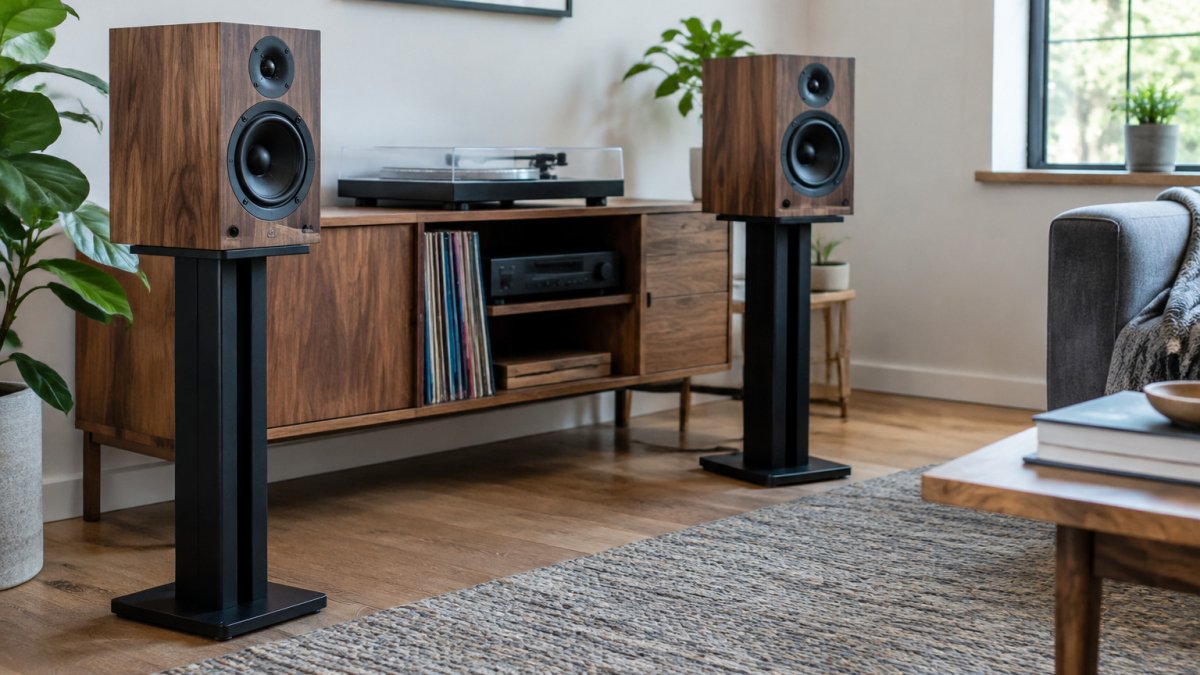
The most useful rule of thumb is simple: the tweeter should sit at roughly the height of your ears when you are seated in your listening position. High-frequency detail is directional, so a tweeter pointed at your knees or your ceiling loses much of its clarity.
The right stand height depends on your seat and your speakers, so measure before you buy.
Measuring the Right Height for Your Seating Position
Sit in your normal listening position and have someone measure from the floor to your ear. That is your target tweeter height. Check that the speaker sits at that height on the stand, allowing for the stand's top plate and any spikes or pads underneath.
Watch out: a stand that is too short forces the speaker to fire downward into the floor, and the result is a thinner, less defined top end. Choosing a stand that is too tall can make the stereo image sound raised and unnatural.
The article's key setup points for stand height and common mistakes are summarised below.
| Step | What to do | Time or frequency |
|---|---|---|
| Measure seated ear height | Sit in listening position and measure floor to ear | Once, before buying |
| Set tweeter height | Match tweeter to ear height on the stand | Once per setup |
| Check stand top plate | Allow for top plate and spikes or pads | Each height adjustment |
| Avoid short stands | Stop speaker firing down into the floor | Before purchase |
| Avoid tall stands | Prevent unnaturally raised stereo image | Before purchase |
How Speaker Isolation Pads Work
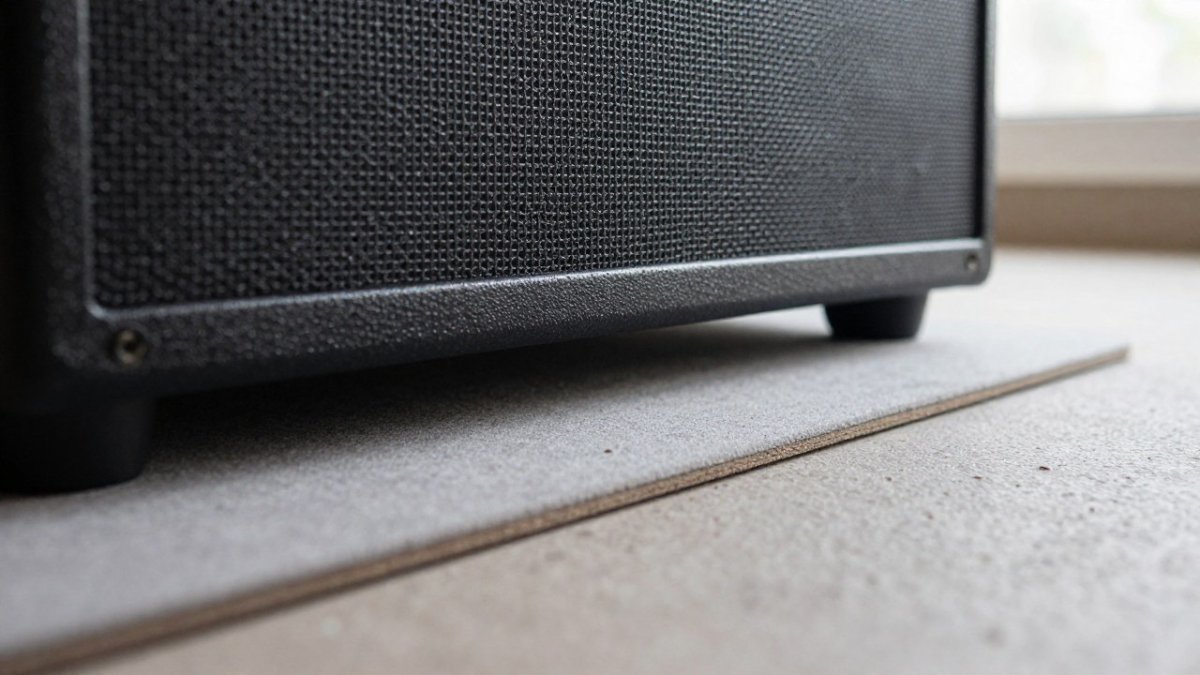
An isolation pad sits between the speaker cabinet and the stand or shelf. Its job is to decouple the cabinet from the supporting surface so that vibrational energy from the drivers and cabinet walls is dissipated as heat within the pad material rather than being transmitted into the shelf, the floor or the wall behind, where it re-radiates as colouration. Pads are usually made from dense rubber, cork, sorbothane-style viscoelastic polymer, or a composite of these, and they are often sold sized to a particular cabinet footprint and weight.
The mechanism matters more than the marketing. A loudspeaker cabinet is never perfectly rigid: the driver cones push against the air and, by reaction, against the baffle, and the cabinet walls flex slightly at low frequencies. If the cabinet sits directly on a resonant surface such as a hollow wooden bookcase or a thin metal stand top, that surface becomes a secondary radiator. The result is not extra bass but smeared, boomy bass and a midrange that sounds thicker than it should, because the surface is radiating a delayed, filtered copy of the direct sound. A pad interrupts that path.
The effect is most noticeable on lightweight shelves, wooden bookcases and hard stands, where vibration has an easy path to travel. On a heavy, well-damped stand the difference is smaller, so it is worth listening before you assume a pad is essential. A common pattern is that pads make the biggest audible difference to the low midrange and upper bass, where cabinet and shelf resonances cluster, and very little difference to the treble.
This is where the physical limits of small cabinets become audible. A compact bookshelf speaker has a small internal volume, a shallow baffle and often a rear-firing port. The small baffle produces diffraction around the cabinet edges at frequencies where the wavelength is comparable to the baffle width, which subtly colours the upper midrange and can make a small speaker sound forward or 'boxy' compared with a larger monitor.
Watch out: a pad that is too soft or too thick lets the cabinet rock, which smears stereo imaging and can make the speaker sound vague; a pad that is too hard transmits almost everything and achieves little. Choose a pad rated for the weight of your speaker and check that the cabinet still sits level.
Bookshelf Speaker Placement: Positioning Before Isolation
Placement comes before isolation. A pad will not fix a speaker that sits too close to a rear wall or in a corner, where bass reinforcement can turn boomy and vague. Start by keeping the speakers a comfortable distance from walls, then adjust the toe-in so that both speakers aim at your listening position.
In a small flat, space is the main constraint. For a dedicated guide to positioning speakers for the best soundstage, the article covers the details this section only touches on. Experiment with the speakers a little further from the wall than feels natural, and listen for changes in bass depth and clarity. Small adjustments of a few centimetres often make a surprising difference, so take your time.
Speaker Stands vs Isolation Pads: Which Should You Choose?
Stands and pads solve different problems, and many setups benefit from both. If you are weighing stand-mounted bookshelf speakers against larger models, this comparison of bookshelf and floorstanding options for music sets out the trade-offs. A stand sets the height and the speaker's relationship to your ears. A pad controls how the cabinet interacts with whatever it sits on.
Start with the stand. Height errors are easy to hear and hard to live with: a tweeter firing at your knees loses high-frequency detail, and a stand that is too tall raises the stereo image unnaturally. A rigid stand with a top plate sized to the cabinet, mass-loaded or spiked to the floor, gives the driver a stable reaction point, which tightens bass and improves imaging. If you have to choose one first, get the stand right.
Then consider isolation. Pads earn their place when the supporting surface is resonant or lightweight. On a heavy, well-damped stand, a modest pad or none at all is often enough; on a wooden bookcase, a pad is close to essential. Buying expensive pads for a flimsy shelf can be a poor use of money, because a sturdy stand with a modest pad will often perform better than a premium pad on a wobbly bookcase.
The angle most guides miss is what happens to the perceived sonic signature over time. A compact speaker that is bright or forward in the upper midrange, often because of baffle diffraction or a rising on-axis response, can sound impressive for ten minutes and fatiguing after two hours. Stands and pads do not change the speaker's on-axis response, but they change how much of the room and the supporting surface is added to it.
Some compact monitors include digital signal processing and room-correction features. These tools work on the signal, not on the cabinet, so they cannot stop a hollow shelf from resonating or undo the diffraction caused by a small baffle. Treat the physical setup first, then use any correction to refine what remains.
A practical order of work: set tweeter height and toe-in, move the speakers clear of the rear wall, add a rigid stand, then add pads only if you can still hear the surface contributing. Change one thing at a time and listen to familiar music for at least half an hour before deciding, because the effects that matter most are the ones that persist rather than the ones that impress in the first minute.
Common Mistakes That Undo Good Setups
- Placing speakers on a shelf that is too narrow, so the cabinet overhangs and rocks.
- Ignoring tweeter height and accepting whatever the speaker happens to sit at.
- Pushing speakers hard against the wall to save space, which exaggerates bass.
- Fitting pads without checking that the speaker sits level on the stand.
- Changing several things at once, so you cannot tell which adjustment made the difference.
A common mistake is judging a setup in the first five minutes. Let the speakers settle, then listen to music you know well before making any further changes.
Booking a Setup Session to Get Your Room Right
If you are unsure about stand height, placement, or which pads suit your speakers and room, a demonstration at Chiltern Audio can help. Our team can talk you through the options and help you work out what suits your room.
For current stand and pad prices, please check Chiltern Audio's website or contact our team for a quote, as pricing depends on the model and accessories you choose. Bring your speakers, your shelf or stand measurements, and a rough idea of where you sit, and we will help you work out a setup that sounds right in your room.
Frequently Asked Questions
Do bookshelf speakers sound better on stands?
In most rooms, yes. Placing bookshelf speakers on dedicated stands lifts the tweeter toward ear level, which improves imaging and reduces the coloration caused by reflections off a desk or sideboard. Stands also move the speaker away from surfaces that can resonate. The gain depends on stand height, rigidity and how well the stand is filled and fixed to the floor. A poorly built or wobbly stand can add its own resonances, so stability matters as much as height. Chiltern Audio can demonstrate the difference in a demonstration room, and pricing for stands and accessories depends on the model and options chosen, so check the current range on the Chiltern Audio website or ask for a quote.
How tall should stands for bookshelf speakers be?
The aim is to bring the tweeter to roughly ear height when you are seated in your usual listening position. The right figure depends on your seat height and the speaker's driver layout. Measure from the floor to your ears while seated, then check the tweeter position on the speaker. Avoid stands so tall that the speakers sit above your head, and avoid stands so low that the sound is directed into your lap. Test a few heights where possible before committing.
Do speaker isolation pads make a difference?
Isolation pads can reduce vibration transferred from the speaker cabinet into a stand, shelf or desk, which can tighten bass and reduce low-level rattles. They work best where the surface beneath the speaker is lightweight or resonant. They will not fix poor placement or a room that has strong standing waves. Results vary between speakers and surfaces, so audition a pad before assuming it is needed. Pricing for isolation products varies by brand and material, so check current prices directly with Chiltern Audio.
Should speaker stands be filled with sand?
Filling a hollow stand with sand or similar dense material adds mass, which can reduce the stand's tendency to vibrate and resonate. Many stands are designed to be filled, and manufacturers usually specify the material and quantity. Overfilling or using the wrong material can stress the construction, so follow the maker's instructions. Filling also makes a stand heavier to move, which is worth considering if you rearrange your room often.